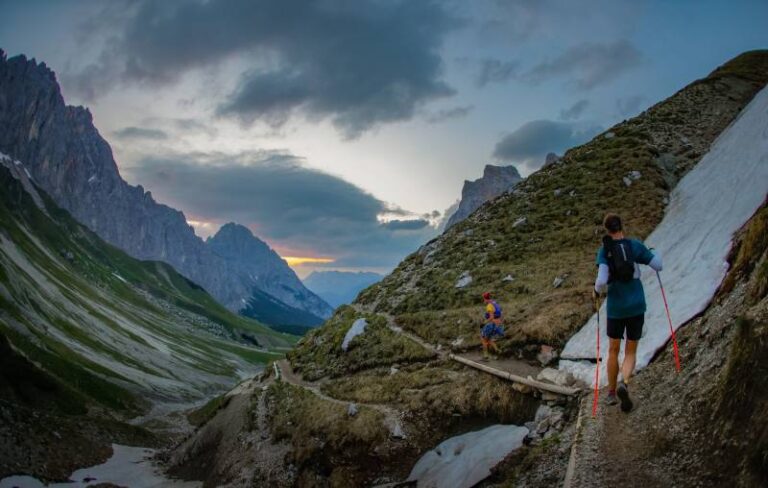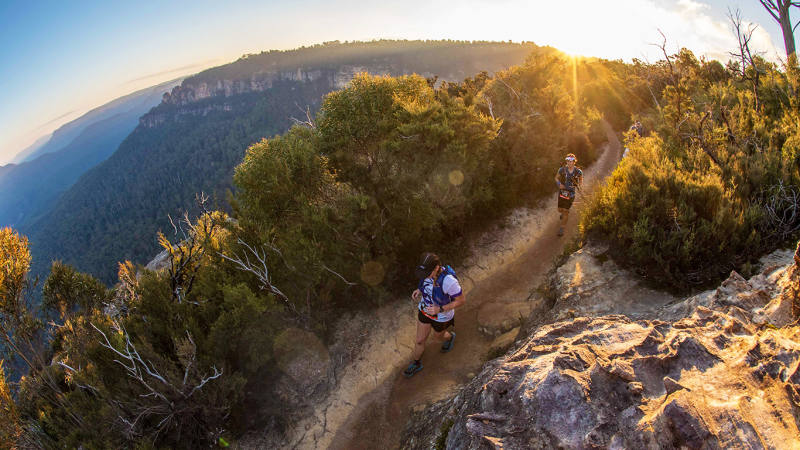
Your HOKA Ultra-Trail Australia by UTMB training plan is preparation for the Oceania Major of the UTMB World Series, raced in the Blue Mountains National Park around Katoomba, New South Wales. UTA takes place in mid-May, in the southern autumn, with formats from 11.4 km to the 161 km UTAMiler and a famous finish up the 951 Furber Steps. Here is how to train for Ultra-Trail Australia, with the official distances and elevation gain.
The short answer
- Allow 8–10 weeks for UTA11 or UTA22, 12–16 weeks for UTA50, 16–24 weeks for UTA100 and 6–12 months for the UTAMiler, with several ultras already completed.
- At peak, aim for roughly 1500–2500 m of weekly climbing for UTA50 and 2500–4000 m for UTA100 and the UTAMiler, depending on your history.
- Key sessions: stairs and short steep climbs, mixed long runs combining runnable wide trails and steep single track, descents, and back-to-backs for UTA100 and the UTAMiler.
- The defining challenge: a course that alternates very runnable sections with abrupt stair climbs, finishing with 951 steps.
Contents
Ultra-Trail Australia distances and elevation gain
Figures from the official HOKA Ultra-Trail Australia by UTMB website, with the Running Stones categories shown by the organisers.
| Format | Distance | Elevation gain | Profile/notes |
|---|---|---|---|
| UTAMiler | 161.1 km (100 miles) | 7200 m | 100M category, starts at Govetts Leap (Blackheath), finishes at Scenic World (Katoomba); Grose Valley, Megalong Valley |
| UTA100 | 101 km | 4400 m | 100K category, start and finish at Scenic World; Narrow Neck, Ironpot Ridge, Kedumba Pass |
| UTA50 | 51 km | 2400 m | 50K category |
| UTA22 | 22 km | 1200 m | 20K category |
| UTA11 | 11.4 km | 731 m | No category shown, starts at Scenic World |
| 1km-4-Kids | 1 km | 25 m | Kids’ race |
The terrain is mostly single track and wide trails through a World Heritage-listed park: cliff tops, lush valleys, escarpments and ridgelines. The official site notes that maps and profiles can change from one edition to the next, and warns that the Blue Mountains’ weather is unpredictable, with cut-offs possibly brought forward in bad conditions.
What makes Ultra-Trail Australia hard
UTA catches out runners who only read the profile. The climbing ratio of around 44 m per kilometre on UTA100 looks moderate, but it comes in short, very steep climbs and descents, often on stairs, that break your rhythm and hammer your quads and calves. Between those walls, long runnable sections reward runners who can still move quickly on flat or gently rolling ground after hours of effort.
The Furber Steps sum it up: 951 steps to the finish on tired legs. Add an early start, many hours that run into the night for most runners, and autumn weather that can swing from crisp and dry to cold and wet. On the UTAMiler, the 44h30 maximum race time means two nights out for many runners, so sleep management, fuelling and focus are central.
How long to train for each format
For UTA11 and UTA22, 8–10 weeks is enough if you run regularly; UTA22 has 1200 m of climbing, so real hill experience helps. For UTA50, allow 12–16 weeks, ideally after a 30–40 km trail race. UTA100 takes 16–24 weeks and previous experience of at least 50 km. For the UTAMiler, plan 6–12 months and several ultras, including one of at least 100 km. Our guide to preparing a 100-mile UTMB race covers the same principles. These are guidelines depending on your level, time and recovery.
The phases of your training plan
Base
Easy running, consistency and strength work twice a week with a focus on quads, calves and core. Build volume gradually.
Specific phase
Stairs, steep hills, mixed long runs, descents and fuelling practice. For UTA100 and the UTAMiler, back-to-back weekends and night runs become the backbone. Keep a lighter week every three or four weeks.
Taper
Two to three weeks of reduced volume depending on your format, with a few short efforts, so you reach Katoomba fresh and still able to run the flats.
Key sessions for Ultra-Trail Australia
Stairs and steep hills
Repeats of 2–5 minutes on stairs or very steep ground, alternating powerful hiking and running, with a controlled descent as recovery. This is the most race-specific session for UTA and the Furber Steps.
Mixed long run
Three to six hours depending on format, linking runnable sections with steep hiked climbs. The goal is to keep running efficiently on the flat after each climb.
Steep descents
Three to six short, steep descents, staying relaxed, to condition your quads to repeated impact.
Back-to-backs and night runs (UTA100 and UTAMiler)
Two consecutive long runs, for example 4–5 hours then 2–3 hours, plus one or two night runs to test your headlamp and fuelling.
To get the dosage right week after week, the RunMotion Coach app, the official online coach of the UTMB World Series, builds a personalised trail or ultra-trail plan, up to 12 months before race day, and adapts it to your completed sessions and availability. Try it free for 7 days.
Plan your race strategy with Race Strategy
The classic UTA mistake is running the early runnable sections too fast. Race Strategy by RunMotion builds a kilometre-by-kilometre strategy with pace adjusted for elevation, altitude and technical terrain, estimates your split times at key points, and gives you a nutrition and hydration plan per section (carbohydrates, water, sodium), adjusted to race-day weather. Import the official GPX of your format to base it on the real course.
Running Stones and the UTMB World Series
UTA is the UTMB World Series Major for Oceania, and its Running Stones reflect that: according to the official site, the UTAMiler earns 8 Running Stones, UTA100 6, UTA50 4 and UTA22 2. Running Stones improve your odds in the draw for the Finals in Chamonix. To build your season around the series, see our UTMB World Series training plan guide and our advice on planning your trail running season.
Ultras and mountains are home ground for RunMotion: founders Guillaume and Romain Adam, twin brothers, come from the Alps, and that experience of big climbing days shapes our plans.
FAQ
Do I need poles for Ultra-Trail Australia?
Check the mandatory gear page on the official site. On the many stair sections, lots of runners prefer free hands; test both options in training.
What level do I need for UTA100?
Ideally you have finished a trail race of at least 50 km and are comfortable with more than 12 hours of effort, both hiking and running on flatter ground.
How many kilometres per week to train for UTA50?
As a rough guide, many runners peak at 40–70 km per week with 1500–2500 m of climbing, depending on level. Time on feet and stair work matter more than raw mileage.
Final thoughts
HOKA Ultra-Trail Australia by UTMB rewards complete runners: strong on steep stairs, quick on the flat and still solid on the Furber Steps. Choose your format based on experience and give yourself time to build. For a plan that adapts to you every week, start your free 7-day RunMotion Coach trial.
Article updated by the RunMotion Coach team.
Sources: