A Speedgoat training plan has to get you ready for one of the steepest 50Ks on the circuit: 3,450 m (11,319 ft) of climbing in 50 km (31.1 miles) above Snowbird in Utah’s Wasatch Mountains, topping out around 11,000 ft (about 3,350 m) on Hidden Peak. Held in late July, the Speedgoat Mountain Races by UTMB offer four races, from a pure uphill to the signature 50K. Here are the official numbers and how to train for this very alpine terrain.
The short answer
- Typical build: 6 to 10 weeks for The Summit and the 10K, 3 to 4 months for the 30K, 4 to 6 months for the 50K, with prior mountain trail experience.
- Specific-phase volume: roughly 3 to 5 hours a week for the short races, up to 7 to 11 hours for the 50K, with a large share of climbing.
- Key sessions: long power-hiking climbs, technical descents, long mountain days and time at altitude if possible.
- The defining feature: an extreme climbing ratio (nearly 70 m per km, about 365 ft per mile, on the 50K) combined with altitude.
Contents
Speedgoat distances and elevation
Figures below come from the official race pages. All races start from the Snowbird Center plaza.
| Race | Distance | Elevation gain | Profile / notes |
|---|---|---|---|
| 50K (50K category) | 50 km (31.1 mi) | 3,450 m (11,319 ft) | Signature race: Chips Switchbacks, Hidden Peak, the Tunnel, Cirque ridge; 13-hour limit; 2 Running Stones |
| 30K (50K category) | 31 km (19.3 mi) | 2,000 m (6,562 ft) | Two visits to Hidden Peak, Peruvian Gulch, Cirque ridge; 10-hour limit; 2 Running Stones |
| 10K | 10 km (6.2 mi) | 500 m (1,640 ft) | Singletrack across the ski area, Chips Switchbacks; 3 h 30 min limit; no Running Stones listed |
| The Summit | 5.6 km (3.5 mi) | 921 m (3,022 ft) | Straight uphill to the Hidden Peak aid station, tram down; 3-hour limit; no Running Stones listed |
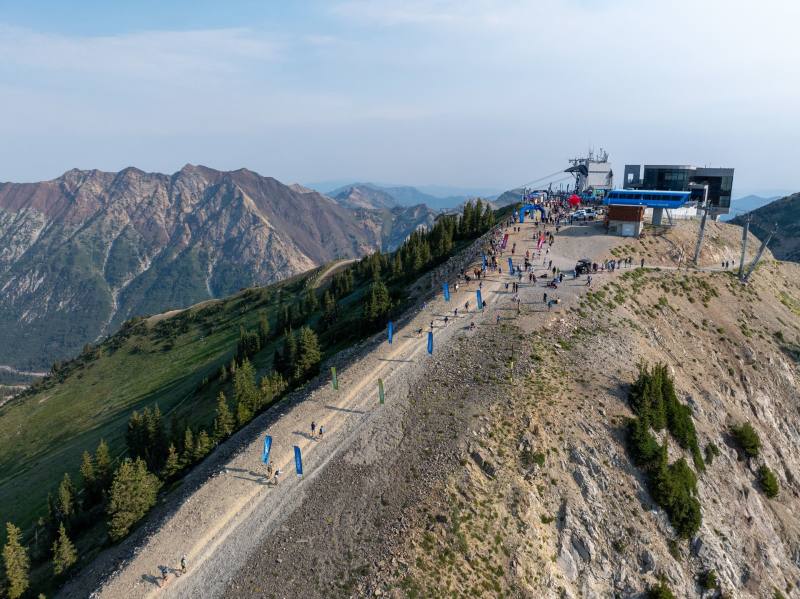
The 50K opens on a slightly downhill service road, then climbs about 600 ft to the first singletrack and the Chips Switchbacks. It reaches the summit of Snowbird at around 11,000 ft before a roughly 4-mile descent on rocky singletrack and ATV trail, the Tunnel, a fast service-road descent, the climb up the Cirque ridge and a mostly downhill finish. More on the official website.
What makes Speedgoat hard
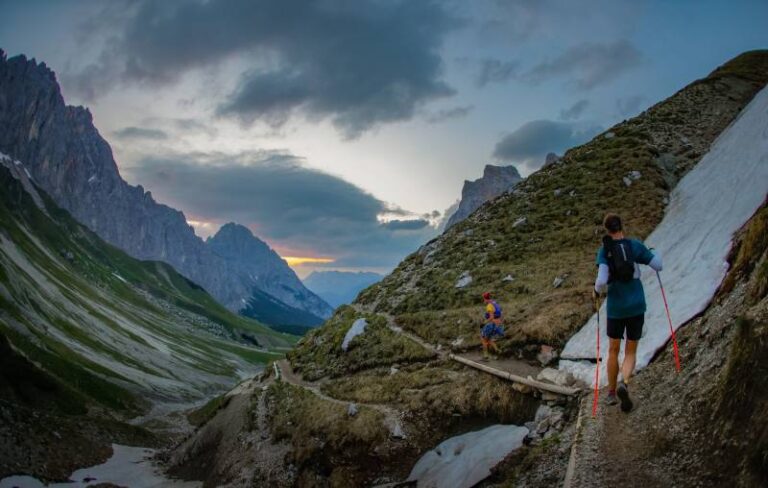
At nearly 70 m of gain per kilometre, the Speedgoat 50K is closer to a steep alpine race than a standard 50K. The 13-hour limit tells the story: here, time on feet matters far more than distance. Climbs are long and steep, and descents, often rocky, hammer your quads and test your technique.
Altitude is the extra layer. You start in the mountains and climb to around 11,000 ft, so most lowland runners will feel every effort cost more up high. In midsummer, sun exposure on the ridges also counts.
How long to train for each distance
The Summit and the 10K are short but intense: 6 to 10 weeks of focused work, with heavy emphasis on climbing, is enough if you already run regularly. The 30K calls for a previous 20 to 30 km mountain race with serious vertical; allow 3 to 4 months. The 50K is not a regular 50K: a 40 km+ trail race with at least 2,000 m of gain is a sensible prerequisite, with 4 to 6 months of specific preparation. These are benchmarks that depend on your history and access to mountains.
The phases of your training plan
For a late-July race, the base phase runs through late winter and spring: progressive easy volume, one quality session a week and two strength sessions focused on calves, quads and balance. No hills nearby? Use treadmill incline, stairs and strength work. The specific phase, 8 to 10 weeks before the taper, should get you into the mountains as often as possible: big-vertical long runs, technical descents and ideally a few days at altitude. Take a lighter week every three or four. The taper lasts one to two weeks depending on your race.
Key workouts for Speedgoat
The long power-hike climb. On a steep slope, climb continuously for 20 to 45 minutes, alternating fast hiking and running depending on gradient. This is the number one Speedgoat skill.
Threshold hill repeats. Blocks of 6 to 12 minutes uphill at threshold effort (roughly what you could hold for an hour). Essential for The Summit and the 10K, useful for everyone.
Technical descents. Once a week or every other week, finish a run on rocky downhill terrain to train footwork and quad durability.
Long mountain days (30K and 50K). Think in hours and vertical, not kilometres: a 4- to 6-hour outing with lots of climbing prepares you better than a long flat run.
Want a plan that adjusts every week to what you actually ran, your level and your schedule? The RunMotion Coach app, official online coach of the UTMB World Series, factors in elevation, strength and recovery. Try it free for 7 days.
Plan your race with Race Strategy
On a course this steep, average pace means nothing. Race Strategy by RunMotion builds a kilometre-by-kilometre plan with pace adjusted for gradient, altitude and terrain, estimates your splits at key points such as Hidden Peak, and gives you a per-section nutrition and hydration plan (carbs, water, sodium) adjusted to race-day weather. Import the official GPX for your race.
Running Stones and the UTMB World Series
The Speedgoat 50K and 30K each earn 2 Running Stones; the official site lists none for the 10K and The Summit. To build a full season, see our UTMB World Series training plan hub and how to plan your trail running season. RunMotion’s founders, twin brothers Guillaume and Romain Adam, come from the Alps: mountains, vertical and ultra distance are home turf.
FAQ
Should I use poles at Speedgoat?
On climbs this steep they can be a real asset if you have practised with them. Check that they are permitted in the race regulations.
What experience do I need for the Speedgoat 50K?
A mountain race of 40 km or more with at least 2,000 m of gain is a solid prerequisite. Ignore the distance: in time on feet, this 50K is closer to an ultra.
How much vertical per week should I train?
It depends on your level and terrain. Rather than chasing a fixed number, build weekly vertical progressively through the specific phase, with a lighter week every three or four.
Speedgoat rewards runners who can climb for a long time, descend cleanly and handle altitude. Build your base, get into the mountains often and progress patiently. For a plan that adapts to you, start your free 7-day RunMotion Coach trial.
Article updated by the RunMotion Coach team.
Sources