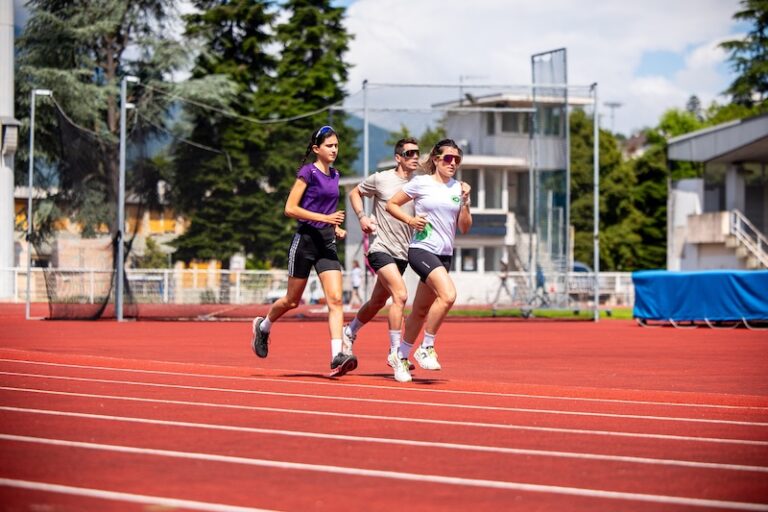
Running at the right pace means running at the speed that matches the purpose of your session: slow on easy runs, fast but controlled in intervals, steady on race day. To get there, you need three things: pace targets that fit your level, sensations you know how to read, and a watch you use as a check rather than a judge.
The short answer
- The right pace depends on the session: there is no single “right speed”, but one pace per type of effort.
- Start from paces based on your MAS, your recent race times and your workouts, not on your training partners’ paces.
- On easy runs, you should be able to speak in full sentences. If you can’t, you’re running too fast.
- On your watch, look at the average lap pace rather than the instant pace.
- On hills, in the heat or when you’re tired, run by effort, not by the number.
- On race day, don’t go out too fast: a little ahead of your goal pace, 5 s/km at most, no more.
Contents
- Why the right pace changes from one session to the next
- Step 1: work out your reference paces
- Step 2: recognise the right pace by feel
- Step 3: use your watch without becoming its slave
- Adjusting your pace to terrain, weather and fatigue
- Holding the right pace on race day
- The most common mistakes
- An exercise to calibrate your sensations
- FAQ
- In short
- Sources
Why the right pace changes from one session to the next
Every session has a specific job. Easy runs build your endurance and help you recover. Threshold work teaches you to hold a hard effort for a long time. Short intervals work your MAS (maximal aerobic speed). Race-pace work prepares you for the rhythm of your goal.
If you run every session at the same speed, you miss those effects. The most common trap is well known: easy runs that are too fast, which tire you out without building endurance, followed by hard sessions run on tired legs, and therefore too slow. You end up doing everything at a “medium” pace that doesn’t really train anything.
The table below sums up the main targets. The MAS percentages are those of the intensity zones used by RunMotion Coach; they vary from one runner to another.
| Type of session | Zone | Target (% of MAS) | How it feels |
|---|---|---|---|
| Easy run, aerobic base | 1 to 2 | up to 70% | You can talk in full sentences, breathing is easy |
| Marathon pace, tempo | 3 | 70 to 79% | Sustained but comfortable, short sentences |
| Threshold | 4 | 79 to 88% | Hard, a few words at a time |
| MAS, short intervals | 5 | 88 to 100% | Very hard, talking is impossible |
Step 1: work out your reference paces
Before you try to find the right pace by feel, you need a starting point in numbers. There are two reliable sources: your MAS, measured with a test, and your recent race times. If you have neither, start by calculating your MAS or use a recent result to predict your race times over other distances.
Here’s an example. With a MAS of 15 km/h, an easy pace between 60 and 70% of MAS works out at 9 to 10.5 km/h, or between 6′40″ and 5′43″/km. Many runners find this pace “too slow” at first. Yet it’s the pace that lets you string weeks of training together without wearing yourself out.
MAS alone isn’t enough: two runners with the same MAS don’t necessarily have the same endurance over a half marathon or a marathon. That’s the point of a performance model, which describes your whole profile rather than a single number.
How RunMotion Coach calculates your paces
The app’s paces are based on a performance model that comes from the research of Guillaume Adam, co-founder of RunMotion Coach, carried out at MIT and CNRS and published in 2018 in the journal PLOS ONE (Mulligan, Adam and Emig, 2018).
The model describes a runner’s performance with a few individual parameters: a speed close to your MAS, how long you can sustain it, your short-distance endurance and your long-distance endurance.
To estimate these parameters, the model first relies on your races. A race result shows what you can really do on a day when you give everything. But a race can be old or run in poor conditions, and you can improve a lot between two races.
That’s why it also analyses your training. Quality sessions (MAS intervals, threshold, 10K, half marathon or marathon pace) are taken into account using the paces you actually ran, the structure of the intervals and the elevation. This version of the model is built on the analysis of 1.6 million sessions. For it to work, the session recorded by your watch must be matched to the planned session in your plan: the model then knows whether it was an interval session or an easy run, and an easy run done too fast doesn’t skew the estimate of your level.

The result: your paces are updated after every validated race and every eligible session. They go up when your progress is confirmed, not after a single unusually fast session, and they can come down after a break or a difficult period. That’s exactly what you need to run at the right pace: targets that follow your real level, not the one you had six months ago. To find out more, read how to calculate your training paces and our new model for predicting your paces.
Step 2: recognise the right pace by feel
Numbers give you the direction; your sensations tell you whether you’re in the right lane on the day. They’re what keep you on target when terrain, weather or fatigue change the picture.
The talk test
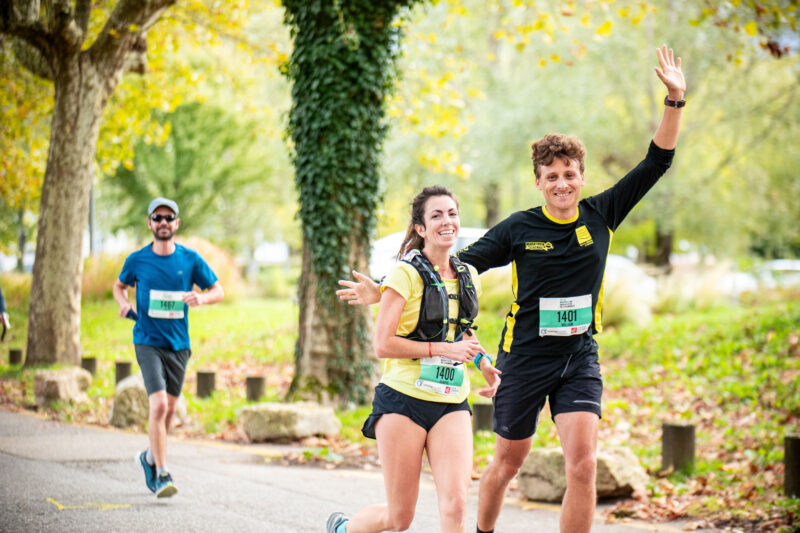
It’s the simplest tool, and far from a rough guess. A study published in 2004 showed that the point where talking stops being comfortable matches the first ventilatory threshold fairly well, which is the upper limit of easy, aerobic running (Persinger et al., 2004).
In practice, say a few sentences out loud or chat with your running partner. On an easy run, you should be able to do it without gasping. If you can only manage a short sentence, you’ve moved into a sustained effort. If only single words come out, you’re at threshold or above.
Breathing and perceived effort
Also rate your breathing and overall effort on a scale of 1 to 10. An easy run sits around 3 to 4: you could keep going for a long time. A threshold session climbs to 7 or 8. For more on breathing, read our article on how to breathe while running.
These sensations can be learned. At first, compare them every time with the pace on your watch: after a few weeks, you’ll be able to guess your speed to within a few seconds.
Step 3: use your watch without becoming its slave
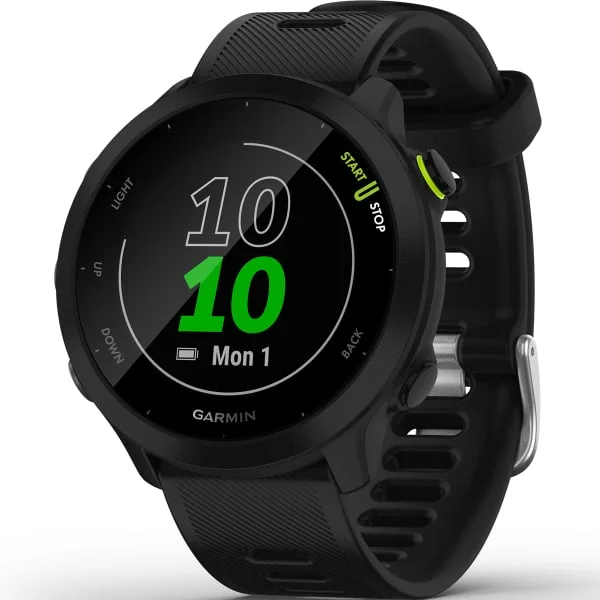
A GPS watch is very useful for checking that you’re staying within your paces. But it has its limits, and knowing them saves you pacing mistakes.
Instant pace or lap pace?
Instant pace changes all the time: the GPS signal is disturbed by trees, buildings and tight turns. If you follow it second by second, you’ll keep speeding up and slowing down. Display the average pace of the current lap instead, with an automatic lap every kilometre, and accept a margin of a few seconds.
Pace alerts can help, as long as you set a range rather than a single value. On easy runs, a range of about thirty seconds per kilometre is plenty.
Heart rate: a good guide on easy runs
On easy runs, heart rate is a useful safeguard, especially if you tend to speed up without noticing. It’s much less useful for short intervals: it takes time to rise and hasn’t finished climbing when the rep ends. It also drifts upwards in hot weather or towards the end of a long run, at the same pace. To set your heart rate targets, start by determining your maximum heart rate.
Adjusting your pace to terrain, weather and fatigue
A pace only makes sense on flat ground, in mild weather and when you’re rested. As soon as one of these conditions changes, it’s the effort you should keep constant, not the number.
On hills, your pace will naturally drop. If you insist on holding it, you’ll go over your threshold without meaning to. Keep the same breathing and the same ease as on the flat, and check your grade-adjusted pace afterwards to judge the session.
In the heat, with a headwind or after a bad night, slow down without feeling guilty. A slightly slower session at the right effort is still a good session. Pushing to “hold the planned pace” on an off day just adds fatigue with no benefit.
So you no longer have to wonder how fast to run, the RunMotion Coach app calculates your paces for every session from your races and your training, using a performance model that comes from research carried out at MIT, then adjusts them as you improve. Try it free for 7 days.
Holding the right pace on race day
On race day, adrenaline, the crowd and the freshness of your taper make the first kilometres feel deceptively easy. That’s where many races are lost. An analysis of 1.7 million recreational marathon runners shows that those who start too fast finish, on average, slower than runners who pace evenly (Smyth, 2018).

In the marathon, a negative split (running the second half faster than the first) is tempting, but hard to pull off for a recreational runner: in practice, many have to slow down by about 10 s/km from the 30th kilometre. Our advice: start a little ahead of your goal pace, 5 s/km at most, then settle in and hold that rhythm as long as you can. Prepare your splits with our split time calculator, and check them at each kilometre marker rather than on your GPS, which often drifts in cities.
Above all, practise that pace before the race. The race-pace sessions in a marathon training plan are there for exactly that: to imprint the rhythm in your legs so you find it without thinking.
The most common mistakes
The first mistake is running easy runs too fast. Yet elite endurance athletes spend most of their training time at low intensity: a 2023 review found a median of about 85% in zone 1 (Sperlich et al., 2023). To understand why, read our guide to easy aerobic running.
Next come interval sessions run like races: the first rep is too fast and the last ones fall apart. Aim for even reps instead, even if you finish feeling you could have done one more.
Other common traps: keeping paces calculated a year ago when your level has changed (hence the value of recalculating them from your recent sessions), or matching the rhythm of a faster partner. Your right pace is personal, and it changes over time.
An exercise to calibrate your sensations
For three weeks, do this simple test on one easy run a week. Hide the pace on your watch, or don’t look at it. Run 10 minutes at what you think is your easy pace, then 5 minutes at what you think is your marathon or half marathon pace.
At home, compare your guess with the pace you actually ran. Most runners discover they run their easy runs faster than they think. Week after week, the gap narrows, and you gain a valuable reference for the days your watch lets you down.
FAQ
How do I know if I’m running my easy runs too fast?
If you can’t hold a conversation in full sentences, or if you finish your easy runs tired, you’re probably running too fast. Also compare your pace with your easy-pace targets.
What pace should a beginner run at?
A pace at which you can talk without difficulty, even if that means alternating running and walking at first. For a beginner, what matters is running regularly, not speed.
Why does my pace vary from day to day?
Sleep, accumulated fatigue, heat, wind and elevation all change the effort needed for the same speed. That’s normal: keep the effort constant and let the pace vary a little.
Should I run by pace or by heart rate?
They complement each other. Pace is more precise for fast sessions, heart rate is a good safeguard on easy runs. Your sensations remain the referee when the two disagree.
In short
Running at the right pace starts with knowing why you’re running that day. Start from paces calculated for your level, learn to recognise them by your breathing and the talk test, and use your watch as a check. Start on your next run: a truly easy run is often the first real step forward.
If you’d like paces calculated for every session and a plan that adapts to your results, try RunMotion Coach free for 7 days.
Sources
- Mulligan M, Adam G, Emig T. A minimal power model for human running performance. PLOS ONE, 2018, 13(11):e0206645. doi:10.1371/journal.pone.0206645
- Persinger R, Foster C, Gibson M, Fater DCW, Porcari JP. Consistency of the talk test for exercise prescription. Med Sci Sports Exerc, 2004, 36(9):1632–1636. doi:10.1249/01.MSS.0000074670.03001.98
- Smyth B. Fast starters and slow finishers: a large-scale data analysis of pacing at the beginning and end of the marathon for recreational runners. Journal of Sports Analytics, 2018. doi:10.3233/JSA-170205
- Sperlich B, Matzka M, Holmberg HC. The proportional distribution of training by elite endurance athletes at different intensities during different phases of the season. Front Sports Act Living, 2023, 5:1258585. doi:10.3389/fspor.2023.1258585