This Puerto Vallarta by UTMB training plan guide covers all five races of the early-March event on Mexico’s Pacific coast, between the Sierra Madre Occidental and the ocean. High pine forests, muddy singletrack, agave fields and coastal jungle down to the beach: the course keeps changing, and the longest race starts at midnight. Here are the official numbers, how long to train and the key workouts for each distance.
The short answer
- Training time: 12 to 16 weeks for the Ereno 20K, 16 to 20 weeks for the Haramara 37K and Nakawé 53K, 20 to 24 weeks for the Hikuri 81K.
- Indicative Hikuri peak: 60 to 90 km per week with 2500 to 4000 m of climbing, depending on your level.
- Key sessions: long climbs with power hiking, downhills on slippery ground, night runs, heat preparation.
- Main challenge: dense climbing (about 48 m of gain per km on the Hikuri) combined with a midnight start and a finish in coastal heat.
Contents
Puerto Vallarta by UTMB distances and elevation
| Race | Distance | Elevation gain | Profile/notes |
|---|---|---|---|
| Hikuri 81K | 81 km | 3900 m | 100K category (3 Running Stones). Midnight start on the Malecón, loop back to the Pacific shore, 20 h 30 max race time. |
| Nakawé 53K | 53 km | 2500 m | 50K category (2 Running Stones). Listed location: Malecón Puerto Vallarta. |
| Haramara 37K | 37 km | 1600 m | 50K category (2 Running Stones). Listed location: Malecón Puerto Vallarta. |
| Ereno 20K | 20 km | 1050 m | 20K category (1 Running Stone). Listed location: Canopy River Park. |
| Pata Salada 5K | 5 km | 200 m | Short discovery race, no Running Stones listed. |
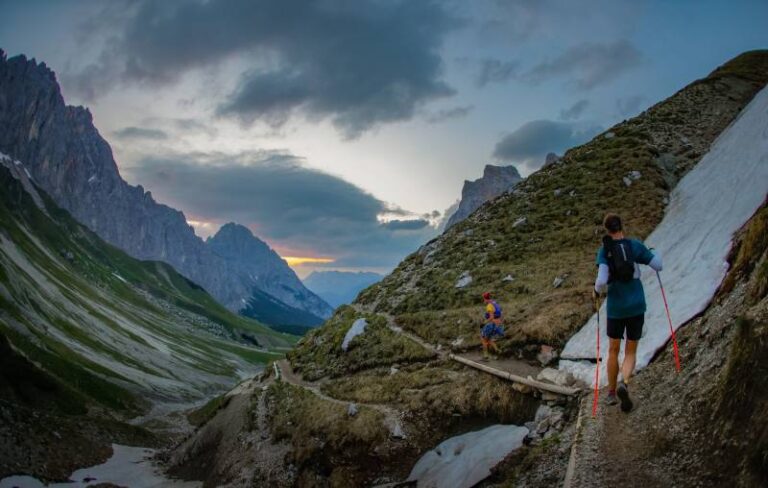
The Hikuri climbs into the high country of the Sierra Madre Occidental through pine forest, then descends on muddy singletrack, through agave fields and coastal jungle, following the Cuale River back to the Malecón. The shorter races use the same kinds of terrain. All figures come from the official Puerto Vallarta by UTMB website; check them again before race day.
What makes Puerto Vallarta by UTMB demanding
Climbing comes first: with roughly 47 to 48 m of gain per kilometer on the Hikuri and Nakawé, you spend much of the race going up or down. Long climbs into the sierra demand a smart mix of running and power hiking, and muddy descents test your footing and your quads.
Then there is the schedule. The Hikuri starts at midnight, so you run the first part under headlamp after a full day of waiting; managing sleep and food before the start is part of your preparation. The Pacific coast can also be hot and humid, especially in the jungle and late in the race. Swings between cool night air up high and coastal heat during the day call for adaptable gear and hydration.
How long do you need to train?
For the Ereno 20K, allow 12 to 16 weeks: 1050 m of gain over 20 km is not an easy introduction, so you should already run regularly and enjoy hills. For the Haramara 37K and Nakawé 53K, plan 16 to 20 weeks after a 25 to 30 km mountain trail race. Our trail marathon training plan is a good framework for these distances.
For the Hikuri 81K, aim for 20 to 24 weeks after finishing a mountainous 50K. The night start and the 20 h 30 limit mean you need to know your climbing and descending pace well. Our 100 km trail running training plan covers the fundamentals.
The phases of your training plan
Base (6 to 8 weeks). Build easy volume with one or two strength sessions a week (quads, glutes, calves, core) and a lighter week every three or four weeks. This base lets you absorb repeated climbs and descents.
Specific (8 to 10 weeks). Increase weekly climbing gradually and move long runs to mountainous terrain. For the Hikuri, add two or three night runs. If you train through a cool winter, include gradual heat adaptation late in the block, carefully and with good hydration.
Taper. Two to three weeks for the Hikuri, 10 to 14 days for the others. Factor in travel and time zones, and arrive a few days early if you can.
Key workouts for Puerto Vallarta by UTMB
Long climbs with power hiking. 3 to 5 climbs of 10 to 15 minutes, switching between running and fast hiking depending on the grade, so you can climb for a long time without redlining.
Slippery downhill. 20 to 30 minutes of controlled descent on damp, loose or muddy trail, focusing on quick steps and stability.
Night run (Hikuri). A long run that starts in the evening or before dawn, with headlamp and race fueling, to test your lighting, alertness and stomach at unusual hours.
Mountain long run. Three to six hours depending on your race, with as much climbing as you can get. For the Hikuri, a back-to-back weekend simulates second-half fatigue.
Every runner has a different level, history and schedule. The RunMotion Coach app, the official online coach of the UTMB World Series, builds a personalized plan that includes climbing, strength and recovery, and adjusts it every week to the sessions you complete. It is available in English and Spanish, among other languages. Its founders, twin brothers Guillaume and Romain Adam, come from the Alps, where mountains, vertical gain and ultra running are home ground. Try RunMotion Coach free for 7 days.
Plan your race with Race Strategy
Between night in the sierra and heat on the coast, your needs change a lot along the way. Race Strategy by RunMotion calculates a kilometer-by-kilometer plan with pace adjusted for elevation, altitude and terrain, estimated split times at key points, a carbs, water and sodium plan for each section and a race-day weather adjustment. Import the official course GPX to generate yours.
Running Stones and the UTMB World Series
According to the official website, the Hikuri earns 3 Running Stones, the Nakawé and Haramara 2 each, and the Ereno 1. Running Stones improve your odds in the UTMB World Series Finals draw. To place Puerto Vallarta in your season, see our UTMB World Series training plan hub.
FAQ
Do you need poles for Puerto Vallarta by UTMB?
On the Hikuri and Nakawé, poles can help on long climbs if you have trained with them. Check the official rules for whether they are allowed.
What experience do you need for the Hikuri 81K?
A finished mountainous 50K, regular long runs with lots of climbing and, ideally, some night racing experience.
How do you handle a midnight start?
Bank sleep in the nights before, nap on race afternoon and eat an easily digested meal in the evening. Rehearse this routine during a night training run.
Bottom line
Puerto Vallarta by UTMB calls for mountain legs, sure footing on slippery ground and smart management of night and heat. Build your climbing gradually, train in the dark and dial in your hydration. For a plan that adapts to you, start your 7-day free trial of RunMotion Coach.
Article updated by the RunMotion Coach team.
Sources