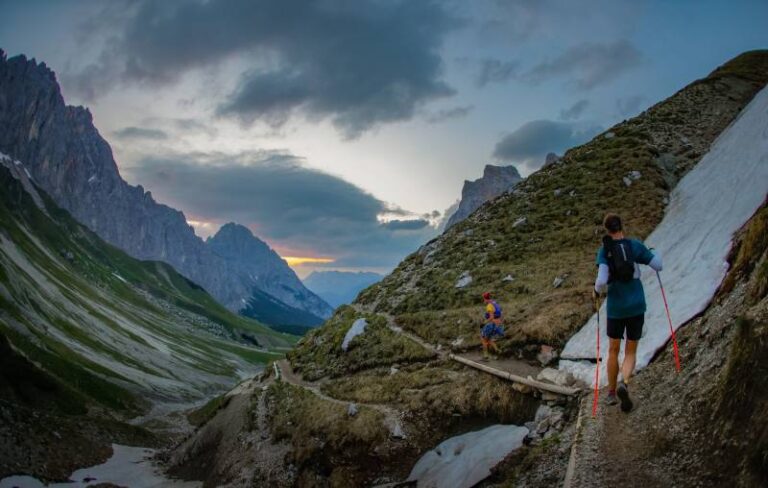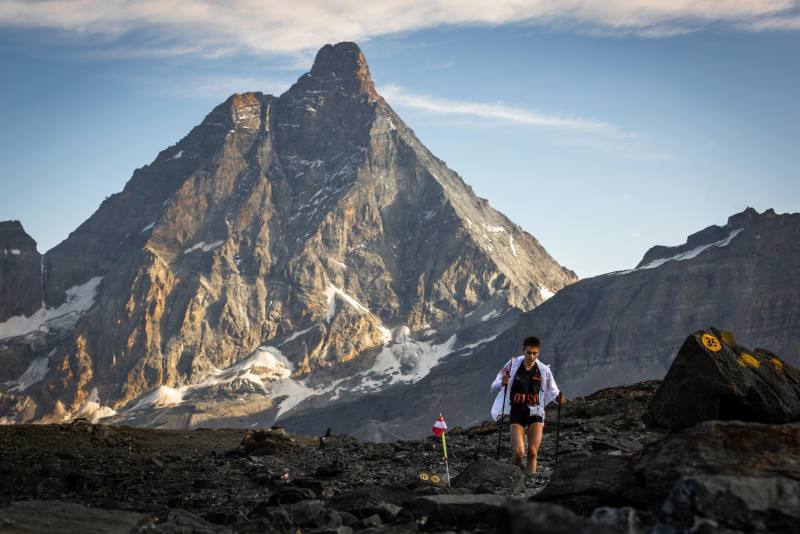
A Monterosa Walser Waeg by UTMB training plan has to prepare you for a high-mountain race beneath the Monte Rosa massif in Italy’s Aosta Valley, linking Aosta, the Ayas valley and the Gressoney valley. The flagship race, Les Sentiers des Valdôtains, packs 120 km and 8200 m of climbing, and the Monte Rosa Trail is steeper still. Here is how to train for each format.
The short answer
- Typical build: 8 to 12 weeks for the RMT, 12 to 16 weeks for the GLT and WWT, 16 to 24 weeks for the MRT, 6 to 12 months for Les Sentiers des Valdôtains.
- The race is held in mid-July, so your specific phase falls in May and June, sometimes before high trails near you are snow-free.
- Key sessions: long power-hiking climbs, technical descents, long mountain days, back-to-backs, a night run.
- The defining trait: extreme gradients (about 68 m of gain per km on the SDV and 77 m per km on the MRT) in a high-mountain setting.
Contents
Monterosa Walser Waeg distances and elevation gain
| Format | Distance | Elevation gain | Profile/notes |
|---|---|---|---|
| Les Sentiers des Valdôtains, SDV (100M) | 120 km | 8200 m | Evening start in Aosta, finish in the Gressoney valley, 36 h max race time; 4 Running Stones |
| Monte Rosa Trail, MRT (100K) | 82 km | 6300 m | Starts in Pont-Saint-Martin; 3 Running Stones |
| Walserwaeg Trail, WWT (50K) | 43 km | 3100 m | Gressoney-Saint-Jean; 2 Running Stones |
| Gressoney Lys Trail, GLT (50K) | 35 km | 1800 m | Gressoney-La-Trinité; 2 Running Stones |
| Regina Margherita Trail, RMT (20K) | 15 km | 650 m | Gressoney-Saint-Jean; 1 Running Stone |
| Junior Walser Trail, JWT | 9 km | 600 m | Youth race, Gressoney-La-Trinité |
| Becca Pink | 4 km | not published | Aosta; short format, no category |
Figures come from the official Monterosa Walser Waeg by UTMB website. The organisers present a journey among the 4000 m peaks of Monte Rosa, which they describe as the most extensive massif in the Alps, through the open, sunny Ayas valley and the Walser villages, settled centuries ago by German-speaking communities. In mid-July, expect heat in the valleys, cool air up high and summer thunderstorms.
What makes Monterosa Walser Waeg tough
Here, elevation is the whole story. On the SDV, 8200 m over 120 km means hours of steep climbing and as many of descending. The MRT’s 6300 m over 82 km works out at about 77 m per kilometre, an exceptional ratio for a 100K-category race. Uphill hiking speed and robust quads matter far more than flat-ground speed.
On the SDV, the evening start in Aosta and 36-hour limit mean at least one full night in the mountains, adding fuelling, cold and fatigue management to the vertical challenge.
How long do you need to train?
The RMT (15 km, 650 m) takes 8 to 12 weeks for a regular trail runner. The GLT (35 km, 1800 m) and WWT (43 km, 3100 m) need 12 to 16 weeks; the very steep WWT assumes a previous mountain race of at least 25 km and 1500 m. The MRT (82 km, 6300 m) needs 16 to 24 weeks and mountain ultra experience. For the SDV, plan at least six months of specific work, ideally after an 80 to 100 km ultra with plenty of climbing. Our guide to the UTMB Mont-Blanc races and training tips covers similar mountain demands. These are guidelines: level, mountain experience and time available decide.
The phases of your training plan
Base and strength (winter). Build aerobic endurance through easy running, plus ski touring or cycling for low-impact volume, and two strength sessions a week: eccentric quads, calves, posterior chain, core.
Mountain-specific phase (April to June). Weekly climbing rises gradually, with long mountain days, big weekends and, for the SDV, a night outing. If high trails are still snowbound, use lower slopes or an inclined treadmill. This is terrain we know well at RunMotion: founders Guillaume and Romain Adam, twin brothers, come from the Alps, where mountains, vertical and ultra are part of everyday life.
Taper (2 to 3 weeks). Cut volume by about 30 to 50% while keeping a few hard climbs: three weeks for the SDV and MRT, two for the shorter races.
Key sessions for Monterosa Walser Waeg
Long power-hiking climbs. Continuous 45 to 90-minute steep climbs at a fast walk, with poles if you plan to race with them and the rules allow it.
Repeated technical descents. Hike up, run down on technical ground, several times per session: your best protection against muscle damage.
Threshold hill repeats. Repeats of 6 to 10 minutes at an effort you could hold for about an hour, the session that improves your time on the RMT and GLT.
Mountain back-to-backs. For the MRT and SDV, two big mountain days over a weekend, the second on tired legs. For the SDV, start one of them in the evening.
To structure all this, the RunMotion Coach app, the official online coach of the UTMB World Series, builds a personalised plan for your Monterosa Walser Waeg format, with elevation, strength and recovery included, adjusted every week to your completed sessions and availability. Try it free for 7 days.
Plan your race strategy with Race Strategy
With this much climbing, guessing your split times is close to impossible. Race Strategy by RunMotion calculates your plan kilometre by kilometre with pace adjusted for elevation, altitude and terrain technicality, estimated split times at key points and a fuelling and hydration plan by section (carbohydrates, water, sodium), plus a race-day weather adjustment. Start from the race list or import the official GPX file of your course from the organisers’ website to check your margin against the 36-hour limit on the SDV.
Running Stones and the UTMB World Series
According to the official website, the SDV earns 4 Running Stones, the MRT 3, the WWT and GLT 2, and the RMT 1. They improve your chances in the Finals draw in Chamonix. See our UTMB World Series training plan guide and our article on preparing a UTMB World Series season.
FAQ
Why is the 120 km SDV a 100M race?
Because the category reflects combined distance and elevation. With over 8000 m of gain, the SDV demands an effort comparable to longer but flatter 100-milers, so train for it as one.
What level do you need for the Monte Rosa Trail?
With 82 km and 6300 m of gain, the MRT suits runners who have finished a mountain ultra of at least 50 km with substantial climbing and are comfortable on technical ground.
Do you need poles at Monterosa Walser Waeg?
The rules and mandatory kit list on the official website are the reference. On climbs this long and steep, most runners on the long formats find poles very useful.
Final thoughts
Monterosa Walser Waeg by UTMB is a climber’s race: lots of up, lots of down, in a high-mountain setting. Build your legs over several months, train your descents and learn to handle the night, and you will enjoy these Walser valleys beneath Monte Rosa. Start your 7-day free trial of RunMotion Coach for a personalised plan that adapts every week.
Article updated by the RunMotion Coach team.
Sources