This Desert RATS training plan guide covers all four races of the Desert RATS Trail Running Festival by UTMB, held in April around Fruita in the high desert of western Colorado. Fast singletrack, cliff edges above the Colorado River, sandy tracks and long gaps between aid stations make it a runnable but exposed race, where water management matters as much as fitness. Here are the official numbers, how long to train and the workouts that count.
The short answer
- Training time: 10 to 14 weeks for the 10K and 21K, 16 to 20 weeks for the 50K, 20 to 24 weeks for the 100K.
- Indicative 100K peak: 70 to 100 km (45 to 60 mi) per week with 1000 to 2000 m (3300 to 6500 ft) of climbing, depending on your level.
- Key sessions: long runs on mixed terrain with little hiking, back-to-back weekends, flat running on tired legs.
- Main challenge: a low-gradient 100K (about 20 m of gain per km) in a desert setting, with long sections between aid stations where carrying enough water is essential.
Contents
Desert RATS distances and elevation
| Race | Distance | Elevation gain | Profile/notes |
|---|---|---|---|
| 100K | 100 km (62.1 mi) | 2050 m (6726 ft) | 100K category (3 Running Stones). 5 a.m. start at Hawkeye Trailhead, 20-hour max race time. |
| 50K | 48 km (29.8 mi) | 1050 m (3445 ft) | 50K category (2 Running Stones). Colorado River views, singletrack and a mesa climb. |
| 21K | 21 km (13.0 mi) | 700 m (2297 ft) | 20K category (1 Running Stone). Cliff edges and mesas. |
| 10K | 9 km (5.6 mi) | 200 m (656 ft) | No Running Stones listed. Short race among red slickrock buttes. |
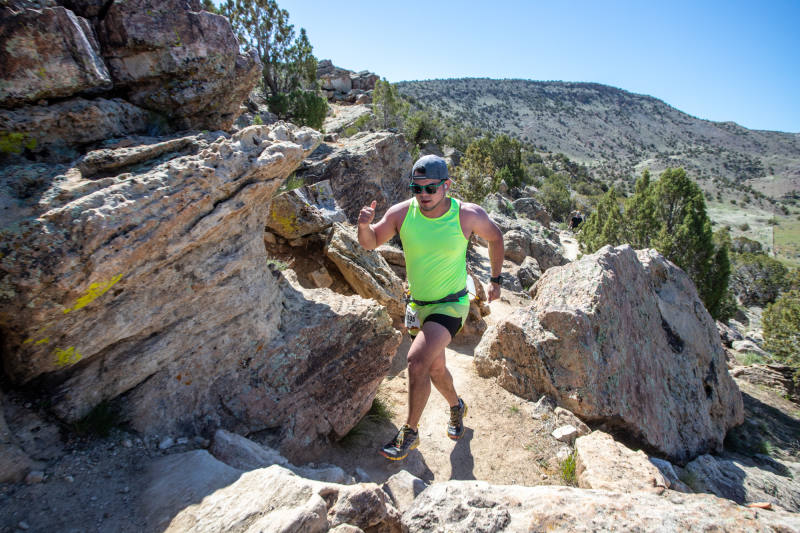
The 100K mixes singletrack, 4WD roads and dirt tracks, including the Kokopelli Trail, the Rustler’s and Western Rim loops, Troybuilt Trail and the Salt Creek area. Footing alternates between rocky and sandy, with mesa climbs early and long gravel stretches in the second half, finishing on a last mile of gravel. All figures come from the official Desert RATS Trail Running Festival by UTMB website; check them again as race day approaches.
What makes Desert RATS demanding
Water comes first. The official 100K page notes that the Troybuilt section is the longest between aid stations and tells runners to carry water, and there is an unstaffed water drop at the Western Rim exit. In a dry, sun-exposed high desert, you can dehydrate without noticing, so your drinking and sodium plan needs to be dialed in long before race day.
The profile is the second trap. With 2050 m of gain over 100 km, you run nearly all the time. Climbs do not break your rhythm, and the back half on gravel and frontage road means running flat on legs that are already worn. Rocky and sandy footing loads your ankles and calves, and temperatures can swing between a dawn start and the afternoon. It is not a mountain ultra, but it is a true endurance ultra.
How long do you need to train?
For the 10K and 21K, 10 to 14 weeks is enough if you already run regularly; the 21K needs some hill and downhill work. For the 50K, allow 16 to 20 weeks and some prior experience over 25 to 30 km of trail. Our trail marathon training plan is a solid foundation.
For the 100K, plan 20 to 24 weeks, ideally after finishing a 50K in good shape. The 20-hour limit gives you room, but running for most of a day takes a real endurance base. Our 100 km trail running training plan details the progression.
The phases of your training plan
Base. On a course this runnable, you build your base by running. Increase easy volume gradually with a lighter week every three or four weeks, and add one or two strength sessions for calves, ankles, quads and core. Sand and rock demand stable footing.
Specific (8 to 10 weeks). Long runs become the priority: mixed terrain, little walking, race pack and water on your back. For the 100K, back-to-back long runs teach you to run on tired legs. Keep one threshold session a week to lift your aerobic pace.
Taper. Two to three weeks for the 100K, 10 to 14 days for the other races: lower volume, a few race-pace touches, plenty of sleep.
Key workouts for Desert RATS
Self-supported long run. Three to five hours depending on your race, on mixed trails, carrying the water you will need between aid stations. You test weight, consumption and fueling frequency.
Back-to-back weekend (100K). For example 4 hours on Saturday and 2 h 30 on Sunday at an easy effort, the safest way to simulate second-half fatigue.
Flat finish. End a long run with 30 to 60 minutes on flat, fast ground at goal effort, just like the gravel miles at the end of the course.
Rolling threshold. 3 × 10 to 12 minutes at threshold (the effort you could hold for about an hour) on undulating ground, to raise your cruising pace.
Every runner starts from a different place. The RunMotion Coach app, the official online coach of the UTMB World Series, builds a personalized plan that adapts weekly to the sessions you complete, with strength, recovery and race nutrition guidance included. Its founders, twin brothers Guillaume and Romain Adam, come from the Alps, where mountains, vertical gain and ultra distance are part of daily life. Try it free for 7 days.
Plan your race with Race Strategy
At Desert RATS, knowing how much to drink between aid stations is as important as pacing. Race Strategy by RunMotion calculates a kilometer-by-kilometer plan with pace adjusted for elevation, altitude and terrain, estimated split times at key points, a carbs, water and sodium plan for each section, and a race-day weather adjustment. Import the official course GPX to build yours.
Running Stones and the UTMB World Series
According to the official website, the 100K earns 3 Running Stones, the 50K 2 and the 21K 1. Running Stones increase your chances in the UTMB World Series Finals draw. To fit Desert RATS into a wider season, see our UTMB World Series training plans.
FAQ
Do you need poles for Desert RATS?
With such a runnable profile, most runners go without. Check the official rules and mandatory gear list anyway.
What experience do you need for the Desert RATS 100K?
A finished 50K and regular long runs of four hours or more. The climbing is moderate, but the distance and exposure call for self-sufficiency experience.
How much water should you carry?
It depends on your sweat rate, the weather and the distance between aid stations. Check the official aid station chart and test your real needs on long runs in warm conditions.
Bottom line
Desert RATS rewards runnable endurance, strong ankles and well-managed hydration. Stack up long runs on mixed terrain, practice running flat on tired legs and test your water autonomy. For a plan that fits your life, start your 7-day free trial of RunMotion Coach.
Article updated by the RunMotion Coach team.
Sources