This Boréalys Mont-Tremblant training plan guide will help you prepare for any of the six races of this mid-August event in Québec’s Laurentians. Steep climbs, roots, rocks and technical descents: with more than 60 m of gain per kilometer on the shorter races, Boréalys is one of the steepest UTMB World Series events in North America. Here are the official numbers, how long to train and the key workouts.
The short answer
- Training time: 12 to 16 weeks for the 20K races, 16 to 20 weeks for the Tremblante 50K, 20 to 24 weeks for the Odyssée 100K.
- Indicative Odyssée peak: 60 to 90 km (35 to 55 mi) per week with 2500 to 4000 m (8200 to 13100 ft) of climbing, depending on your level.
- Key sessions: steep hill repeats with power hiking, technical downhills, long runs packed with vertical, quad strength work.
- Main challenge: an Alpine-style climbing density (from 44 to over 60 m of gain per km depending on the race) on rooty, rocky ground.
Contents
Boréalys Mont-Tremblant distances and elevation
| Race | Distance | Elevation gain | Profile/notes |
|---|---|---|---|
| Odyssée 100K | 81 km | 3600 m | 100K category (3 Running Stones). 5 a.m. start from Village Tremblant, 18-hour max race time. |
| Tremblante 50K | 46.1 km | 2437 m | 50K category (2 Running Stones). Three climbs of Pic White and Pic Johannsen, three technical descents, 10 h 30 max. |
| Diable 20K | 26.6 km | 1645 m | 20K category (1 Running Stone). Two climbs of Mont Tremblant, two tough descents, 6 h 22 max. |
| Chutes-Croches 20K | 14.5 km | 896 m | 20K category (1 Running Stone). Along the Rivière du Diable, then up the slopes of Mont Tremblant, 3 h 35 max. |
| Relais 80K | 81 km | 3600 m | Relay on the Odyssée course, no Running Stones listed. |
| P’tite 5K | 5.8 km | 379 m | Short discovery race, no Running Stones listed. |
Every race starts from Village Tremblant, heads deep into the forests of the massif and returns to the village. Altitude is modest, but the slopes are steep and relentless. Figures come from the official Boréalys Mont-Tremblant by UTMB website; the homepage and individual race pages do not always match, so check the latest version before race day.
What makes Boréalys Mont-Tremblant demanding
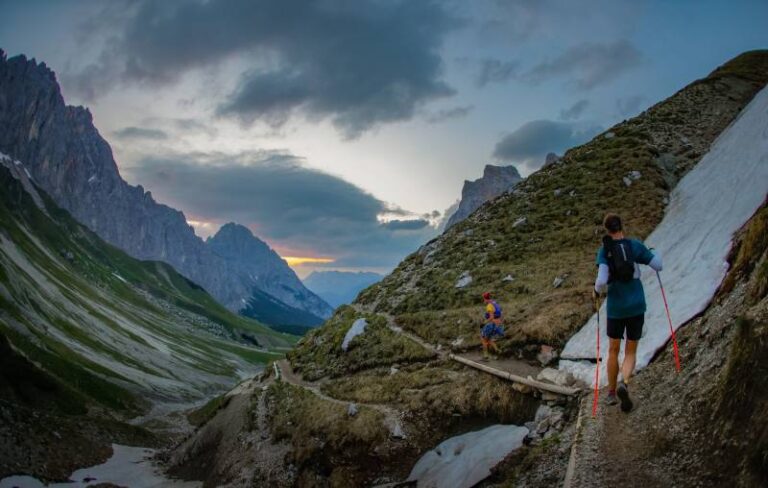
Gradient first. On both the Diable and Chutes-Croches, you average more than 60 m of climbing per kilometer, a density usually associated with the Alps rather than the Laurentians. The Tremblante strings together three climbs and three technical descents, and the Odyssée stacks it all up over 81 km.
Terrain second. Roots, rocks and narrow trails constantly break your stride, especially downhill, where your quads take a beating. That is often where races are decided. Mid-August in Québec can also bring heat, humidity or thunderstorms depending on the year, so keep your hydration plan flexible. The Odyssée starts at 5 a.m., so many runners will begin under headlamp.
How long do you need to train?
For the short races (Chutes-Croches, Diable), allow 12 to 16 weeks if you already run regularly. With 1645 m of gain, the Diable requires real hill experience, so avoid it as a very first trail race without specific preparation.
For the Tremblante 50K, aim for 16 to 20 weeks after at least one hilly 25 to 30 km trail race; our trail marathon training plan lays the groundwork. For the Odyssée 100K, plan 20 to 24 weeks after finishing a mountainous 50K in good shape. Our 100 km trail running training plan applies, with more vertical than usual.
The phases of your training plan
Base (6 to 8 weeks). Build easy volume and add two strength sessions a week: squats, lunges, step-ups, calves, core. Strength work protects your quads on descents and makes power hiking more efficient. Take a lighter week every three or four weeks.
Specific (8 to 10 weeks). Vertical gain becomes the priority. If you live somewhere flat, your steepest local hill, a ski slope or a staircase become your best tools, in repeats. Test your gear, and your poles if you plan to use them.
Taper. Two to three weeks for the Odyssée, 10 to 14 days for the others. Cut volume, especially downhill, to arrive with fresh quads.
Key workouts for Boréalys Mont-Tremblant
Steep hill repeats. 5 to 8 climbs of 5 to 8 minutes on the steepest slope you can find, power hiking with hands on thighs or poles and running as soon as the grade eases. This is the foundation of any Boréalys build.
Technical downhills. 20 to 40 minutes of controlled downhill on rooty or rocky trail, eyes a few meters ahead, quick light steps.
Vertical long run. Three to six hours depending on your race, with as much climbing as you can find, your race pack and fueling. For the Odyssée, a back-to-back weekend (for example 5 hours Saturday, 3 hours Sunday) simulates accumulated fatigue.
Threshold climbs. 3 to 4 × 10 minutes uphill at threshold, the effort you could hold for about an hour in a race.
The RunMotion Coach app, the official online coach of the UTMB World Series, builds a personalized plan that accounts for vertical gain, strength work and your availability, then adjusts it every week to the sessions you complete. Its founders, twin brothers Guillaume and Romain Adam, come from the Alps: steep climbs and ultra distance are their home ground. Try it free for 7 days.
Plan your race with Race Strategy
On a course this steep, your pace can vary threefold between a climb and a runnable stretch. Race Strategy by RunMotion calculates a kilometer-by-kilometer plan with pace adjusted for elevation, altitude and terrain technicality, estimated split times at key points, a carbs, water and sodium plan for each section and a race-day weather adjustment. Import the official course GPX to build yours.
Running Stones and the UTMB World Series
According to the official website, the Odyssée earns 3 Running Stones, the Tremblante 2, and the Diable and Chutes-Croches 1 each, improving your odds in the UTMB World Series Finals draw. To plan your season around Boréalys, see our UTMB World Series training plan hub and our guide to planning your trail running season.
FAQ
Do you need poles for Boréalys?
On climbs this steep, poles can help, especially on the Odyssée and Tremblante, provided you have trained with them. Check the official rules to see whether they are allowed.
What experience do you need for the Odyssée 100K?
A finished mountainous 50K and regular long runs with plenty of climbing. The Odyssée’s 81 km take far longer than a runnable 80 km.
How do you train for Boréalys without mountains nearby?
Repeat your steepest local hill, use ski slopes or stairs and build quad strength. One or two weekends in mountainous terrain during the specific phase make a real difference.
Bottom line
Prepare for Boréalys Mont-Tremblant like a mountain race: repeated steep climbs, technical descents, strength work and long runs loaded with vertical. Pick your race based on your experience and give yourself time. For a plan that adapts to you, start your 7-day free trial of RunMotion Coach.
Article updated by the RunMotion Coach team.
Sources