Almost every running app calls itself an AI coach now. Some are developer-built, with a training engine based on sports science and coaching logic refined across thousands of real runners. Others are vibe-coded: put together quickly by prompting an AI, with a general chatbot writing your plan.
This guide to the best AI running coaching apps 2027 explains the difference and helps you tell them apart. We compare seven apps, look at what the research says about AI-written training plans, and give you a checklist to use before you pay for any subscription.
Full disclosure: we make RunMotion Coach, and it’s our top pick. We’ve tried to be as fair to the other apps as we’d want them to be to us. Prices were checked in September 2026 and can change.
Contents
The short answer
| If you want | Try |
|---|---|
| The best overall pick: science-based paces and a plan that adapts after every run | RunMotion Coach |
| Trail and ultra plans from the official online coach of the UTMB World Series | RunMotion Coach |
| The most polished road-race plans with audio on your watch | Runna |
| Adaptive road plans with the option to ask a human coach | Coopah |
| Free coaching on a watch you already own | Garmin Coach or COROS |
| A machine-learning plan with a free tier | TrainAsONE |
| Free guided runs to get started | Nike Run Club |
Vibe-coded vs. developer-built AI running coach apps
The biggest difference between AI running coach apps in 2027 isn’t the design or the price. It’s how the app was built, and what actually writes your training plan.
What is a vibe-coded running app?
“Vibe coding” is a term AI researcher Andrej Karpathy coined in early 2025. It means building software by describing what you want to an AI and letting it write the code. Building an app has never been faster or cheaper, and running apps are no exception.
A vibe-coded AI coaching app is usually a sign-up form connected to a general AI model like ChatGPT. You answer a few questions, the model writes a plan, and the app wraps it in a clean design. There’s often no coach, no sports scientist and no tested training model behind it, and an app like this can be put together in days.
What is a developer-built AI running coach app?
A developer-built app is engineered by developers working alongside coaches and sports scientists. At its core is a training engine. A scientific performance model sets your paces, and coaching logic decides how your load builds, when you recover and what happens after a missed session. The engine is tested against real runners’ data and refined over years.
Many developer-built apps also include an in-app coach you can talk to. RunMotion Coach works this way: its in-app coach guides you through your sessions, while a training engine built on a peer-reviewed performance model sets each one.
Vibe-coded vs. developer-built at a glance
| Vibe-coded AI coaching app | Developer-built AI coaching app | |
|---|---|---|
| Who builds it | Often a solo builder prompting an AI | Developers working with coaches and sports scientists |
| What writes your plan | A general AI model like ChatGPT | A training engine with coaching logic |
| Where your paces come from | A text prediction based on your answers | A performance model tested on real runners |
| How your load builds | Whatever the model produced | Rules for progression, recovery weeks and tapers |
| After a missed session | Often nothing changes | Upcoming sessions recalibrate |
| Your watch data | Often not used to set paces | Synced and used to adjust your plan |
| Your injury history | Easy to lose between chats | Part of every load decision |
| Proof it works | Nothing published | Research, race partnerships and years of runner results |
Which type is each app?
When we looked at the best AI running coaching apps 2027 has to offer, almost all of them fell into one of three groups.
| Type | What sets your plan | Examples | Watch out for |
|---|---|---|---|
| Vibe-coded | A general AI model writes the plan from your answers | Many new “AI coach” apps in the app stores | No coaching logic or testing behind the plan |
| Developer-built, coach-written plans | Coaches write the plans, then an algorithm adjusts paces and sessions | Runna, Coopah, Garmin Coach, COROS | Adjustments can be limited to pace targets |
| Developer-built, scientific training engine | A performance model or machine learning trained on runner data sets your paces and load | RunMotion Coach, TrainAsONE | Some need a few weeks of your data |
Every app we recommend below is developer-built. Coach-written plans can be excellent. What matters most is that the paces you run and the load you carry come from something tested on real runners.
What the research says about AI-written plans
A vibe-coded app hands the most important job, writing your plan, to a general AI model. Researchers have tested how well those models do it, and the findings line up.
- Coaches rated ChatGPT plans below optimal. In a 2024 study in the Journal of Sports Science and Medicine, Düking and colleagues asked coaching experts to rate six-week running plans written by ChatGPT. The plan written from a short prompt scored below the midpoint on 19 of 22 quality criteria. Even the best plan, written with far more detail, wasn’t rated optimal. The authors advise against using a ChatGPT plan without an expert coach’s feedback.
- Eight AI models, the same gaps. In 2026, a team including sports medicine researcher Nicola Maffulli tested eight AI models, including ChatGPT, Claude, Gemini and DeepSeek, on six-month marathon plans. Most got the basics right: gradual mileage increases, a taper and mostly easy running. Some plans left out weekly mileage entirely, some treated intermediate and advanced runners the same, and pacing was inconsistent. The authors concluded these plans need validation and professional oversight.
Where AI chat does help
Language models aren’t useless for runners. A 2026 study from Ghent University found ChatGPT answered common exercise questions better than personal trainers on six of nine questions. Explaining why a tempo run matters, or what a taper does, is something they do well.
The gap is between explaining and prescribing. Writing one plausible plan is easy. Managing your load week after week, around missed runs, fatigue and a race date, takes coaching logic and a model tested on real runners. That’s what a developer-built app adds.
How to spot a vibe-coded running app
- You can’t find a named coach, sports scientist, developer team or any research behind the app.
- Every feature is described as “AI”, with no explanation of how your plan is actually built.
- Your plan comes from a chat conversation, and your watch data isn’t used to set your paces.
- The app caps how many messages you can send your “coach”.
- It can’t tell you where your training paces come from.
- A missed session or a hard week doesn’t change anything that follows.
- The privacy policy doesn’t say whether your health data is sent to a third-party AI model.
Why expertise and experience with thousands of runners matter
A developer-built app is only as good as the science and coaching logic inside it. That logic also needs years of real runners to be tested against. Load management shows why both matter.
The 10% rule isn’t the whole story
Most runners have heard the 10% rule: don’t raise your weekly mileage by more than 10%. A vibe-coded app will happily repeat it. The evidence behind it is weak. In a randomized trial of 532 novice runners, a program built on the 10% rule didn’t reduce injuries. In that trial, 20.8% of runners on the graded program were injured, against 20.3% on a standard program.
A much larger 2025 study points somewhere more useful. Researchers followed 5,205 runners through 588,071 training sessions recorded on Garmin watches, and 1,820 of them (35%) got injured. Week-to-week changes in mileage didn’t predict injury. Single runs did.
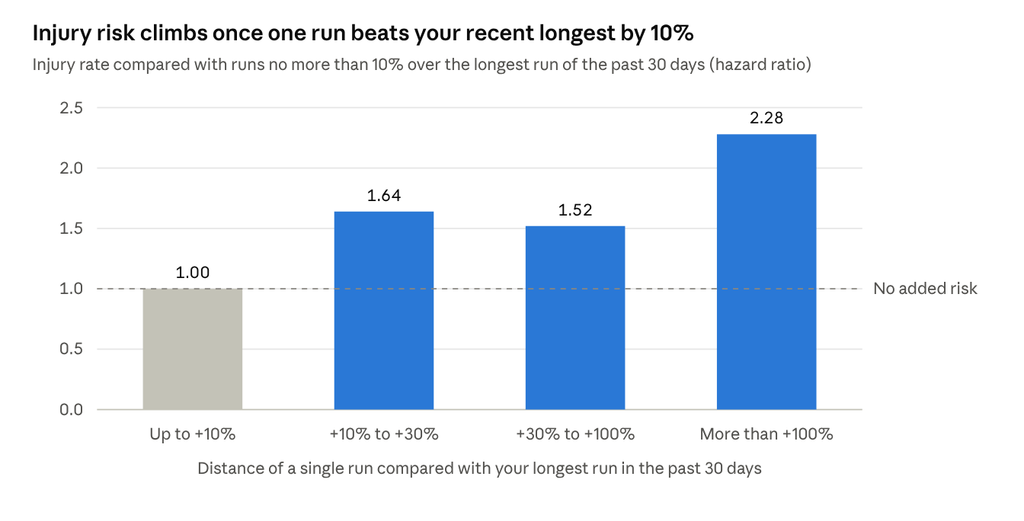
Frandsen et al., British Journal of Sports Medicine, 2025 · 5,205 runners, 588,071 sessions · 95% confidence intervals on hover
When one run was more than 10% longer than the longest run of the previous 30 days, the injury rate was about 64% higher. Runs more than double the recent longest carried the highest risk, with a hazard ratio of 2.28. A developer-built coach should apply this kind of detail for you, run by run. A vibe-coded app won’t know about it unless someone wrote that logic in.
Paces should come from a model tested on real runners
Your training paces are only as good as the model behind them. In RunMotion Coach, paces come from a performance model our co-founder Guillaume Adam co-authored while at MIT, published in PLOS ONE in 2018. It estimates your velocity at VO2max and your endurance, then sets the right pace for each type of session.
In 2020, the model’s co-author Thorsten Emig and Jussi Peltonen tested it on wearable data from about 14,000 runners and 1.6 million sessions. Their results, published in Nature Communications, showed highly accurate race time predictions. You can see the model at work in our free race time predictor.
Experience with more than one million runners
Science sets the method, and experience shows where it needs to bend. More than one million runners have used RunMotion Coach since 2018, training for everything from a first 5K to a mountain ultra. Since 2025, RunMotion Coach has been the official online coach of the UTMB World Series, where plans have to hold up over thousands of meters of climbing.
That experience shows up in the unglamorous parts of a plan: a missed week, a bad night’s sleep, a work trip, a hot race day. Since September 2026, RunMotion Coach adapts your plan after every session you complete instead of once a week.
What no app can do yet
Be careful with any app that claims it can predict your injuries. A 2026 study used machine learning on training data from 643 runners preparing for the New York City Marathon. For runners who weren’t already injured, the predictions were weak. What a good AI running coach app can do is keep your progression sensible and adjust when your training goes off script.
The best AI running coaching apps 2027 compared
Here’s how the seven apps compare on how they build your plan, which races they cover and what they cost. Prices are in US dollars and were checked in September 2026.
| App | How the AI works | Race distances | Workouts on your watch | Price |
|---|---|---|---|---|
| RunMotion Coach (our top pick) | Peer-reviewed performance model sets paces; plan adapts after every session | 5K to ultra-trail, trail with elevation, triathlon | Garmin, COROS, Suunto, Apple Watch | Free version; $19.99/mo or $119.99/yr, 7-day trial |
| Runna | Coach-written plans; algorithm adjusts paces | Couch to 5K to ultra | Garmin, Apple Watch, COROS, Suunto, Fitbit | $19.99/mo or $119.99/yr; $149.99/yr with Strava |
| Coopah | Coach-built plans that adapt, with AI answers and human coach support | 5K to marathon | Garmin, Apple Watch, COROS | About $119.99/yr (US App Store), 1-week trial |
| TrainAsONE | Machine learning, no templates, weather-aware | 5K to marathon | Garmin, Apple Watch, COROS, Suunto, Polar | Free tier; $9.99/mo or $101.99/yr |
| Garmin Coach | Coach-written plans that adjust pace targets | 5K to marathon (coach-led plans stop at the half) | Garmin only | Free with a Garmin; Connect+ $6.99/mo |
| COROS | 200+ coach-written plans; optional ChatGPT or Claude connector | 5K to marathon, trail | COROS only | Free with a COROS watch |
| Nike Run Club | Static plans with guided audio runs | 5K to marathon | Apple Watch app | Free |
Prices vary by country and app store, so check each app’s own pricing page before you subscribe.
Why RunMotion Coach tops our list
RunMotion Coach is a developer-built app with a scientific training engine at its core. It’s the only app on this list whose paces come from a peer-reviewed performance model, and its coaching logic adapts your plan after every session you complete. It also has dedicated trail and ultra plans as the official online coach of the UTMB World Series. That’s why it leads our list of the best AI running coaching apps 2027, whether you run roads, trails or both.
The 7 apps, reviewed
RunMotion Coach is our top pick, and yes, we make it. For every app, including ours, we’ve noted who it suits and what to keep in mind.
1. RunMotion Coach
RunMotion Coach was built in the French Alps by brothers Guillaume and Romain Adam. Guillaume raced the 1,500 m for the French national team, has run a sub-four-minute mile and is a certified coach. Romain has finished UTMB in under 30 hours. More than one million runners have used the app, and it’s the official online coach of the UTMB World Series.
It’s a developer-built app with a scientific training engine at its core. Your plan is built from your level, your goal and the days you can train. Paces come from Guillaume’s peer-reviewed performance model, and the plan adapts after every session you complete. Miss a run or pile up fatigue, and your upcoming sessions recalibrate.
Plans cover 5K to ultra-trail, with trail plans that account for elevation, and triathlon too. Premium adds strength and conditioning designed with a physiotherapist, plus mobility, stretching, mental preparation and nutrition tips. You can pick your coach’s tone (motivating, caring or serious), and RunMotion Coach works with Garmin, COROS, Polar, Suunto, Apple Watch, Fitbit and Strava.
- Best for: road and trail runners who want adaptive, science-based training, especially for trail and ultra races.
- Keep in mind: no human coach reviews your plan week to week. If you want that, expect to pay several times more for one-to-one coaching.
- Price: free version available. Premium is $19.99 a month or $119.99 a year in the US, with a 7-day free trial.
2. Runna
Runna was founded in 2021 by Dom Maskell and Ben Parker, and Strava has owned it since 2025. It has one of the most polished interfaces of any running app, and it sends structured workouts to Garmin, Apple Watch, COROS, Suunto and Fitbit.
Runna has said publicly that its plans aren’t created by AI. Its coaches write them, and an algorithm adapts your paces as results come in. In early 2026, the Wall Street Journal reported physical therapists seeing Runna-related overuse injuries, though no study has compared injury rates between apps. Runna has since announced a review of its plans with Loughborough University.
- Best for: road runners who want a polished app and structured sessions on their watch.
- Keep in mind: there’s no free tier, plans are road-focused, and Runna doesn’t publish that it uses sleep or HRV data. If Runna isn’t the right fit, see our guide to Runna alternatives.
- Price: $19.99 a month or $119.99 a year, or $149.99 a year bundled with Strava.
3. Coopah
UK-based Coopah builds adaptive plans from 5K to marathon, with strength and conditioning in every plan. Its 24/7 coaching combines instant AI answers with support from real human coaches, and a weekly coach’s report reviews your sessions. It syncs with Garmin, Apple Watch, COROS and Strava.
- Best for: road runners who want the option of asking a human coach a question.
- Keep in mind: plans stop at the marathon, so there’s nothing for trail or ultra races. TechRadar’s review also found the planning could feel rigid at times.
- Price: about $119.99 a year in the US App Store, with a 1-week free trial.
4. TrainAsONE
UK-based TrainAsONE has been around since 2014. It uses machine learning trained on more than 100 million kilometers of running data. It builds each session from your data instead of a template, factors in the weather and handles missed sessions well.
- Best for: data-driven runners who want algorithmic personalization and a free tier.
- Keep in mind: the interface feels dated, and the reason behind a session isn’t always clear.
- Price: free tier after a 21-day trial. Premium is $9.99 a month or $101.99 a year in the US App Store.
5. Garmin Coach
Garmin Coach is free if you own a Garmin watch. Its coach-led plans from Jeff Galloway, Greg McMillan and Amy Parkerson-Mitchell cover the 5K, 10K and half marathon. Garmin’s adaptive Run Coach plans now go up to the marathon. Garmin Connect+ adds AI insights for $6.99 a month, and Garmin bought TrainingPeaks in July 2026.
- Best for: Garmin owners training for anything from a 5K to a marathon.
- Keep in mind: it only works with Garmin watches, and the adjustments are conservative.
- Price: free with a Garmin watch.
6. COROS
COROS owners get more than 200 coach-written plans in the COROS app, plus strong training load and recovery tools. COROS also lets you connect ChatGPT or Claude to your data to build plans that sync to your watch. That’s convenient, but those plans don’t get an expert review.
- Best for: COROS watch owners who want free structure.
- Keep in mind: it only works with COROS watches, and it’s stronger at monitoring your training than adapting a full plan.
- Price: free with a COROS watch.
7. Nike Run Club
Nike Run Club is free and offers well-produced guided audio runs and plans from 5K to marathon. The plans are largely static, so they won’t change much if you miss a week.
- Best for: beginners and anyone who wants free guided runs.
- Keep in mind: there’s little adaptation, so pair it with a structured plan if you’re chasing a time.
- Price: free.
How to choose an AI running coach app: a 10-point checklist
Use these questions when you compare the best AI running coaching apps 2027 for yourself. Most apps offer a free trial, so you can check each point with real training before you pay.
- Who built it? Look for a developer team, named coaches, sports scientists or published research. If you can’t find anyone, the app may be vibe-coded.
- Where do your paces come from? A model tested on real runners, a coach’s template or a chatbot’s answer are very different things.
- Does it adapt after each run? Skip a session during your trial and see whether the following days change.
- How does it build your long runs? They should grow gradually from what you’ve actually run in the past month.
- Does it include strength and mobility? Strength work belongs in the same plan as your runs.
- Does it cover your races? Check for trail, ultra or triathlon plans if that’s where you’re headed.
- Does it work with your watch? Look for workouts sent to the watch, not just activity sync afterward.
- Can it explain itself? You should be able to see why each session is in your plan.
- What happens to your data? Read the privacy policy, especially whether your health data goes to a third-party AI model.
- Can you try it free? Give any app at least a week or two of real training before you commit.
If you’re weighing an app against a human coach or a coaching platform, our guides to choosing an online running coach and TrainingPeaks alternatives go deeper.
FAQ
What are the best AI running coaching apps in 2027?
It depends on how you run. RunMotion Coach is our top pick for road and trail runners who want science-based plans that adapt after every session. Runna has the most polished road-race plans, Coopah adds access to human coaches, and Garmin Coach and COROS are free with their watches. TrainAsONE suits runners who want a pure machine-learning plan.
What is a vibe-coded AI running coach app?
A vibe-coded app is built quickly by prompting an AI to write the code, and it usually relies on a general model like ChatGPT to write your training plan. There’s typically no coach, sports scientist or tested training model behind it. Studies of AI-written plans have found missing mileage, inconsistent paces and plans that coaches rate below optimal.
How can you tell if an AI running app is vibe-coded?
Look at who built it and how your plan is made. A developer-built app names its coaches or scientists, explains where your paces come from, uses your watch data and adapts after missed sessions. If an app can’t tell you any of that, treat it as vibe-coded.
Is an AI running coach as good as a human coach?
A good human coach still brings judgment and support that no app can match. One-to-one coaching often costs $150 or more a month, though. For most runners, a developer-built AI running coach app offers adaptive, science-based training for a fraction of that.
What’s the best AI running coach app for trail and ultra running?
Most AI running apps focus on road races. RunMotion Coach includes trail and ultra-trail plans that account for elevation, and it’s the official online coach of the UTMB World Series.
Can an AI running app prevent injuries?
No app can predict or prevent every injury. Good apps lower your risk by managing load: building long runs gradually, adapting after missed sessions and fatigue, and including strength work. Be wary of any app that claims it can predict your injuries.
Is there a free AI running coach app?
Yes. Garmin Coach and COROS are free with their watches, TrainAsONE has a free tier, and Nike Run Club is completely free. RunMotion Coach has a free version and a 7-day free trial of Premium.