In the UK and most of Europe, the clocks go back one hour on Sunday 25 October 2026 (at 2 am in the UK, 3 am in central Europe). In the US and Canada, it happens a week later, on Sunday 1 November 2026. Dates vary from country to country, and some countries don’t change their clocks at all, so check your local time change.
Either way, from the next day it gets dark an hour earlier and your 6 pm run ends up in the dark. To keep running when the clocks go back, you just need to rethink your schedule or adapt your sessions, and make sure you’re easy to see.
The short answer
- Mornings get lighter again right after the clocks go back: it’s the perfect time to try morning runs.
- In the evening, keep your quality sessions (intervals, race pace) for a familiar, well-lit route or the track.
- Head torch, reflective clothing, phone: that’s the bare minimum for running in the dark.
- Keep the same consistency, not the same times: that’s what makes you progress.
Contents
- Running when the clocks go back: what changes?
- Running in the morning or the evening: which slot should you choose?
- Which sessions should you do when it’s dark?
- See and be seen: gear for running in winter
- How do you stay motivated when it’s dark so early?
- The day the clocks go back: what to watch out for
- FAQ
Running when the clocks go back: what changes?
Your watch goes back an hour, but the sun doesn’t move. As a result:
- In the evening, it gets dark an hour earlier. After-work runs often happen in the dark.
- In the morning, it gets light an hour earlier for a few weeks. After that, the days keep getting shorter until the December solstice.
If you want to keep running through winter, now is the right time to rethink your weekly schedule instead of just putting up with the change.
Running in the morning or the evening: which slot should you choose?
There’s no perfect slot for everyone: the best one is the one you can stick to every week.
Running in the morning
- Pros: you make the most of the returning daylight after the clocks go back, the streets are quieter, and your session is done before the day gets away from you.
- Watch out for: a longer warm-up, as your body is stiffer when you wake up. Don’t cut into your sleep to get up earlier.
Running in the evening
- Pros: your body is already awake, and it’s often easier to fit in your hard sessions.
- Watch out for: it’s dark, there’s more traffic, and training too late can make it harder for some runners to fall asleep.
An approach that works well: easy runs in the morning or at lunchtime, quality sessions in the evening on a well-lit route.
Which sessions should you do when it’s dark?
In the dark, you can’t see the ground as well and you misjudge distances more easily. So adapt the type of session to the terrain.
Easy runs: stick to routes you know
For an easy endurance run, choose a route you know by heart, that’s well lit (or use your head torch) and has an even surface. A 2 or 3 km loop that you repeat stops you ending up far from home on a dark path. Run by feel rather than by pace: it’s normal to be a little slower in the dark.
Intervals: on the track or a well-lit straight
Running in winter, and therefore in the dark, means you need to trust your footing. For your speed sessions, go for:
- the athletics track, often lit in the evening (check opening hours with your local council or club);
- a well-lit straight for short intervals, for example 10 × 1′ fast / 1′ easy jog recovery.
The long run: at the weekend, in daylight
Keep your long run for Saturday or Sunday, during the day. It’s your longest session, so it’s the one where you most need good visibility and safety.
The treadmill: a backup option
If your only slot is late in the evening and your neighbourhood isn’t suited to it, a treadmill session is better than a skipped one. Use it as a backup, without making it a habit.
Your plan adapts to winter time
With RunMotion Coach, your training plan is personalised to your level and your goal. You can organise your sessions around your new schedule. Try the app free for 7 days.
See and be seen: gear for running in winter
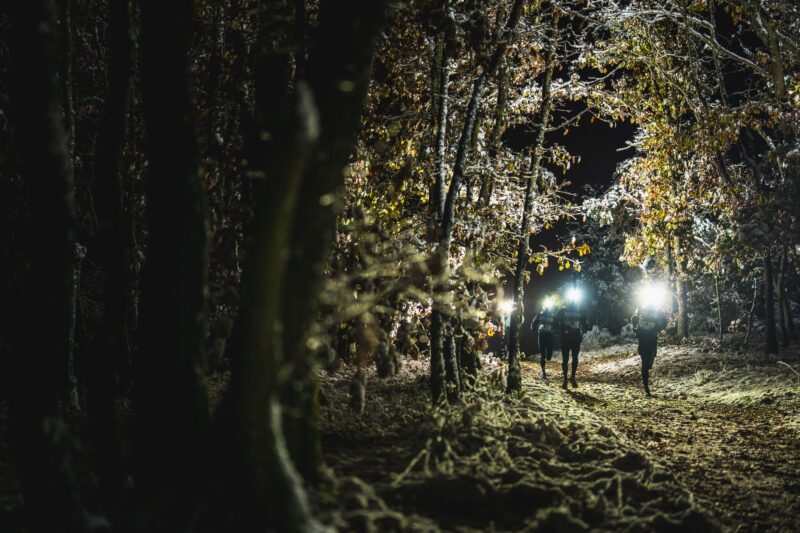
We cover everything in our guide to running safely at night. The essentials:
- A head torch: 100 to 200 lumens is enough in town; go for more than 400 lumens on trails.
- Reflective details, especially on your back and on the parts that move (ankles, wrists): they catch drivers’ eyes.
- Light or fluorescent colours rather than all black.
- Your phone, charged, for GPS and emergencies.
And a few good habits:
- Run facing the traffic when there’s no pavement.
- Tell someone your route and when you expect to be back.
- Keep one earbud out, or turn the volume down, so you can hear what’s around you.
- Running with a partner or a club is safer and more motivating.
How do you stay motivated when it’s dark so early?
The hardest part is often getting out the door. A few tips:
- Put your sessions in your calendar, like an appointment.
- Get your kit ready the night before: head torch charged, clothes laid out, shoes by the door.
- Find a running partner or join a club’s night runs.
- Set yourself a goal: a spring race makes winter training more worthwhile. Take a look at our 10K or half marathon training plans.
- Accept running slower in the dark and the cold. What matters is consistency.
The day the clocks go back: what to watch out for
If you’re running on the morning of the change, check that your GPS watch and your phone have switched to the new time. If you have a race that day, make sure you note the start time and bib collection time in the new time. That Sunday, you gain an hour: make the most of it and get a good night’s sleep before your long run.
FAQ
Is it dangerous to run in the dark?
Running in winter is perfectly doable if you take the right precautions: be visible, choose a familiar, well-lit route, carry your phone and let someone know where you’re going. If you’re unsure about a route, save it for the weekend.
Should you run slower in the dark?
Often a little, yes: you can’t see your footing as well and you’re more careful. For easy runs, run by feel. Keep pace-specific sessions for the track or a well-lit route.
Does running in the evening stop you sleeping well?
It depends on the runner. If you struggle to fall asleep after a hard session late in the evening, move that slot earlier or keep easy runs for the evening.
How many lumens do you need for a running head torch?
In town, 100 to 200 lumens is enough. On trails, aim for more than 400 lumens.
When do the clocks go back in 2026?
In the UK and the EU, on Sunday 25 October 2026 (2 am becomes 1 am in the UK, 3 am becomes 2 am in central Europe). In the US and Canada, on Sunday 1 November 2026 at 2 am. Dates vary by country, and some countries don’t change their clocks at all.
Keep your rhythm all winter
The dark doesn’t mean you have to stop. To keep running when the clocks go back, reorganise your slots, adapt your sessions to the light and get the right gear to be seen. For a plan that follows your level and your goal all winter, try RunMotion Coach free for 7 days.