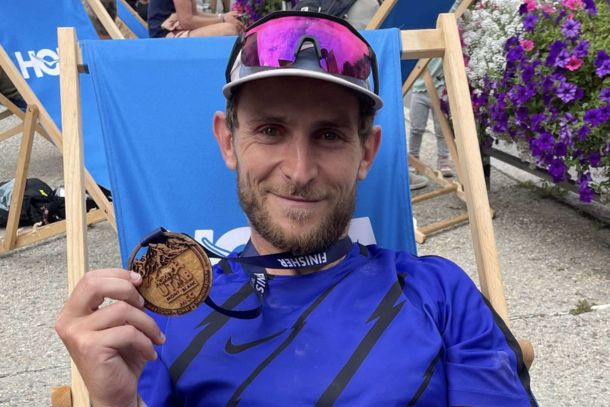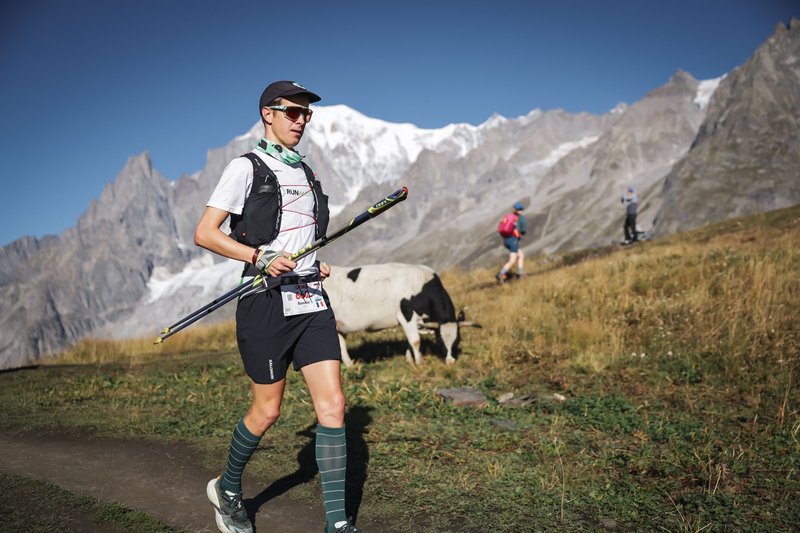
On Saturday night, at 23:08, I crossed the UTMB finish line in Chamonix for the second time, in 27h19. Two hours faster than in 2023, 192nd over more than 170 km and 9700 m of elevation gain. Here is my race report, from training to the finish, with the numbers and the lessons I’d pass on to you if you’re preparing for your own UTMB.
The short answer
- Result: 27h19′32″, 192nd overall, 49th in my age category, versus 29h24 in 2023.
- Training: 273 hours of training, or 10h40 per week, 34% of it cross-training (cycling, cross-country skiing, strength work).
- The race: a cautious start, a cramp scare after Courmayeur, then a strong second half: more than 140 places gained between Courmayeur and Chamonix.
- The key: showing up fresh on race day, with few but well-timed build-up races.
Contents
Why I went back to UTMB
In 2023, I finished my first UTMB in 29h24. I was immensely proud, but I also felt I could do better. Three years later, I came back with three goals, ranked from the most achievable to the most ambitious:
- Goal C: finish.
- Goal B: beat my 2023 time.
- Goal A: go under 28 hours.
Setting several levels of goals is essential in a 100-miler: when the race gets tough, there’s always one goal left that still makes sense. In the end, I ticked all three.
My training: more climbing, not more mileage
What strikes me when I compare my two training blocks is that I ran exactly the same distance: 1430 km in 2026 versus 1433 km in 2023. The difference lies elsewhere. I did a lot more climbing, 60300 m while running versus 53200 m, and above all 90000 m of elevation gain in total across all sports, versus 66000 m. My training volume went from 221 to 273 hours.
On the running side, that’s 179 hours, with 4.4 sessions per week and an average of 56 km and 2350 m of elevation gain weekly. Nothing extravagant for a 100-miler: the progress came from consistency and quality climbing, not from huge mileage.
Not everything happened on foot
A third of my training hours (34%) came from cross-training. I rode 1326 km on the bike, including the Étape du Tour (170 km and 5000 m of elevation gain), covered 258 km on cross-country skis with a longest outing of 100 km and 1700 m of climbing, and did 19 strength sessions. Climbing is valuable whatever the sport: cycling and cross-country skiing let me build up uphill load while limiting the pounding of descents, and therefore the risk of injury, even though you still absolutely have to train your legs to handle the downhills.
Well-timed build-up races
Not too many races, but useful ones. The Grand Raid Ventoux by UTMB (51 km, 2500 m D+) and the Trail de Haute-Provence (28 km, 1100 m D+) in the spring, then the Lavaredo Ultra Trail by UTMB in the Dolomites (120 km, 5800 m D+), my real full-scale test. Finally, a month before the race, I did a three-day recon of the course: 140 km and 7000 m of elevation gain, to get to know every climb and every descent.
In the last month, the goal was no longer to do more, but to reach the start line physically and mentally fresh. That’s exactly what a well-built plan does, and it’s what the RunMotion Coach app, which you can try free for 7 days, organizes for you based on your race, your level and your availability.
The first night, under a full moon
We left Chamonix on Friday evening, with a start delayed by about two hours. I set off cautiously: 342nd at Col de Voza, 349th at Les Contamines. No way was I going to burn my matches in the first 30 kilometers.
The night was magical. The full moon lit up the whole mountain, there wasn’t a single cloud, and it wasn’t especially cold, apart from the wind at Lac Combal. The climb to the Croix du Bonhomme (2924 m of cumulative elevation gain at kilometer 47), then the Col de la Seigne went well. And thanks to the delayed start, for once I got to run the descent into Courmayeur in daylight.
Courmayeur and the cramp scare
I reached Courmayeur at 7:14, after 81 km. I was tired, my legs had already taken a beating on the descents, but I felt good. I took the time to recover properly (21 minutes, my longest stop of the race) and headed out in high spirits.
But as soon as I started climbing to the Bertone hut, I felt the first signs of cramp in my quads. I managed it as best I could to stop them from fully kicking in. I was scared, because the balcony trail above Courmayeur needs to be run as much as possible to gain time. At the Bertone hut, I stopped: broth, salt and lemon. Little by little, things improved. It’s the kind of moment when a 100-miler can tip over, and when you have to accept slowing down so you don’t lose everything.
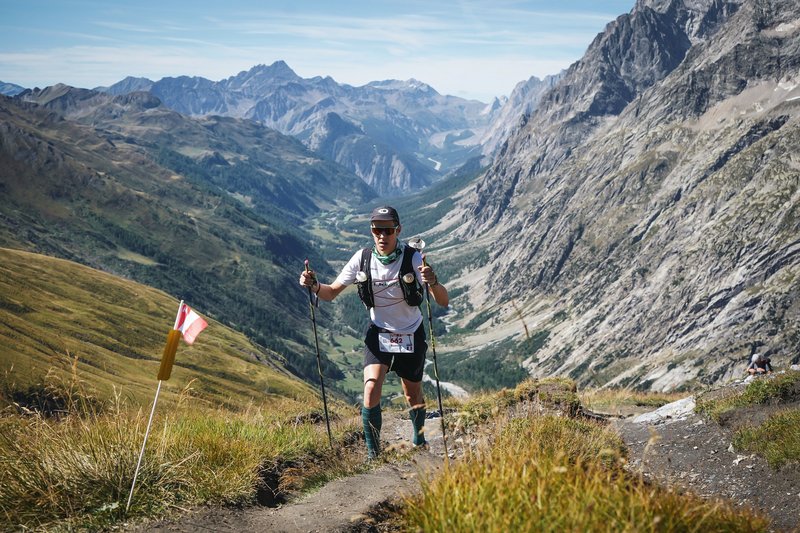
The comeback started there: 320th at Bertone, 305th at Arnouvaz, 291st at the Grand Col Ferret. The climb to the Grand Col Ferret was my slowest section (3.7 km/h), but I gained places at every checkpoint.
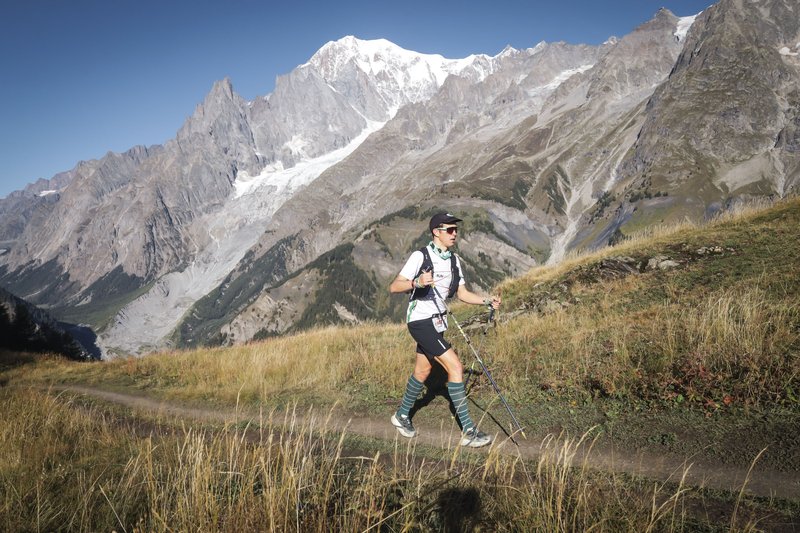
Champex-Lac, the turning point
At Champex-Lac, at kilometer 127, Vickie, Alex and Antoine were there. I left at 6′00″/km, feeling great. At that point I sensed that a good part of the race was behind me and that I could run a strong final 40 km. Three climbs and three descents remained: La Giète, Les Tseppes, then the Tête aux Vents towards La Flégère.
I had a superb finish. At Vallorcine, my parents, Michel and Françoise, were there too. Then came the last climb, the descent from La Flégère in the dark and the finish in Chamonix at 23:08, in 27h19′32″. Between leaving Courmayeur (334th) and the finish (192nd), I gained more than 140 places.
My split times
| Checkpoint | Km | Cumulative D+ | Time of day | Race time | Position |
|---|---|---|---|---|---|
| Col de Voza | 14.5 | 898 m | Fri 21:26 | 1h37 | 342nd |
| Les Contamines | 32.4 | 1535 m | Fri 23:26 | 3h37 | 349th |
| Croix du Bonhomme | 46.9 | 2924 m | Sat 01:59 | 6h09 | 321st |
| Col de la Seigne | 62.9 | 3977 m | Sat 04:33 | 8h43 | 343rd |
| Courmayeur | 81.3 | 4475 m | Sat 07:14 | 11h25 | 341st |
| Refuge Bertone | 86.6 | 5288 m | Sat 08:42 | 12h52 | 320th |
| Grand Col Ferret | 104 | 6487 m | Sat 11:48 | 15h59 | 291st |
| La Fouly | 114 | 6574 m | Sat 13:02 | 17h13 | 277th |
| Champex-Lac | 127.5 | 7086 m | Sat 14:56 | 19h07 | 258th |
| Trient | 144 | 7943 m | Sat 17:49 | 22h00 | 222nd |
| Vallorcine | 155.3 | 8734 m | Sat 19:49 | 23h59 | 202nd |
| La Flégère | 166.6 | 9687 m | Sat 22:10 | 26h21 | 194th |
| Chamonix (finish) | 173.6 | 9700 m | Sat 23:08 | 27h19 | 192nd |
In total, I spent 1h16 stopped over the whole race, mainly at Courmayeur, Champex-Lac and Vallorcine. That’s an area to work on, spending less time at aid stations, if I come back.
Beyond the finish time
There’s a lot of talk about that sub-28-hour time, because this is running and goals matter. But this UTMB was above all a team adventure: my family, my friends at the aid stations, Guillaume, my brother. The finish time is just the visible part.
My takeaways for preparing your UTMB
- Volume isn’t everything. I ran as much as in 2023 but with much more climbing and cross-training.
- Elevation gain counts, whatever the sport. Cycling and cross-country skiing built my climbing engine without wrecking my legs.
- Few races, but well timed. Lavaredo and the course recon were my two dress rehearsals.
- Start cautiously. Being 342nd at Col de Voza didn’t stop me from finishing 192nd, quite the opposite.
- Arrive fresh. Physical and mental freshness on race day is worth more than one last big week.
If you’re targeting UTMB or another race on the circuit, start with our UTMB Mont-Blanc training plan and our page detailing the training plan for every UTMB World Series race. And for a plan built around your race and your everyday life, start your 7-day free trial of RunMotion Coach, the official online coach of the UTMB World Series.