The Olympic triathlon, also known as the M or standard-distance format, is often a real turning point in your triathlon training journey.
With a 1.5 km swim, 40 km bike, and 10 km run, you step into a distance where endurance, effort management, and race strategy matter far more than in a Sprint.
Whether your goal is simply to finish your first Olympic-distance triathlon or to smash your PR, the principle stays the same, build a balanced plan across swimming, cycling, and running, without blowing up after three weeks.
In this article, you’ll find your 12-week Olympic triathlon training plan, plus guidance on how much time you need to prepare for an Olympic triathlon, the key workouts to prioritize, and how to structure your week.
Contents
- Olympic Triathlon, what should you expect?
- How long do you need to prepare for an Olympic triathlon?
- How to structure your Olympic-distance triathlon training
- The most important workouts to improve for an Olympic triathlon
- Nutrition and recovery, the most overlooked game-changers
- Your Olympic triathlon plan with RunMotion Coach
- FAQ, Olympic Triathlon
Olympic Triathlon, what should you expect?
The Olympic distance is, 1.5 km swim, 40 km bike, and 10 km run.
It’s the format raced at the Olympic Games (hence the name), and it’s also one of the most popular distances among age-group triathletes.
On average, experienced triathletes finish an M format in 2 to 2.5 hours, while beginners are more often around 3 to 4 hours, depending on their background and their level in each discipline.
Compared with a Sprint triathlon, the Olympic distance completely changes how you manage your effort. You can’t just rely on the adrenaline of the start or your ability to “hang on” to the finish. Here, you need to learn how to pace.
The bike becomes a key make-or-break segment, ride just a little too hard and that final 10 km can turn into a long, painful grind. On the other hand, smart race execution often saves a huge amount of time, simply by staying steady.
That’s exactly what makes this distance so exciting, it demands both fitness and race intelligence.
How long do you need to prepare for an Olympic triathlon?
If you’re training for your first Olympic triathlon, it’s best to allow 10 to 16 weeks of training.
The goal of the first few weeks is mainly to build a strong base, develop endurance, create a consistent training routine, and learn to link all three disciplines without stacking too much fatigue.
You don’t need massive weeks right away. In this kind of build-up, consistency almost always beats a huge training block that you can’t sustain over time.
Already running regularly? Cycling a lot? Got some basic swim fitness? In that case, 8 to 12 weeks can be enough to prepare for an Olympic-distance triathlon in solid conditions.
The work will simply become a bit more specific.
For experienced triathletes, the Olympic distance is often one of the most demanding formats.
Why? Because you have to hold a relatively high intensity for several hours without ever tipping into the red.
Training becomes more precise, with sessions focused on threshold, FTP, race pace, transitions, and nutrition strategy.
It’s also an excellent format to build toward a Half Ironman, or to sharpen speed endurance for longer races.
Did you know that on RunMotion Coach, you can set a main goal as well as intermediate goals?
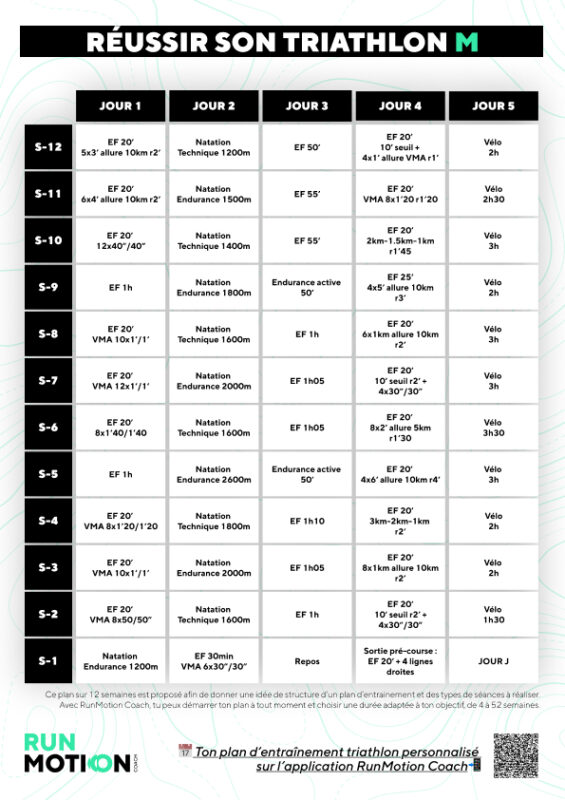
Discover your 12-week Olympic triathlon training plan
How to structure your Olympic-distance triathlon training
To prepare for an Olympic triathlon, most plans typically include 4 to 6 sessions per week.
At a minimum, we recommend:
- 3 run sessions, usually the easiest to fit into a busy schedule
- 1 swim session (you’ll need access to a pool or open water)
- 1 bike session (typically the longest).
This already gives you a solid training volume, around 5 to 7 hours per week.
If you want more long-term progress, a classic structure often looks like:
- 1 swim session (or 2 if you need to improve in the water)
- 2 bike sessions
- 3 run sessions,
- and optionally strength training or S&C.
All in, that’s roughly 7 to 10 hours of training per week depending on your level and goals.
But the hardest part isn’t necessarily training a lot. The real challenge is stacking consistent weeks without building up too much fatigue.
If you want to go deeper, check out our article on How to structure your triathlon training week?
In triathlon, recovery is a core part of progress. Your body has to handle three different sports with different muscular and energy demands. That’s why recovery days and lighter weeks are essential if you want sustainable fitness and better performance.
The most important workouts to improve for an Olympic triathlon
Build swim fitness without wasting energy
Swimming is often the most stressful discipline, especially if you’re new. But in an Olympic triathlon, the goal isn’t necessarily to exit the water as fast as possible. It’s to be efficient and relaxed, so you don’t burn matches before the bike.
Your sessions should focus on improving technique, breathing, relaxation, and swim economy.
To take it further, here are 12 technical drills to improve in triathlon.
For more experienced triathletes, open-water sessions become especially valuable to practice starts, drafting, and sighting. That said, no matter your level, we recommend you swim in open water before race day. It feels nothing like a pool workout.
Build endurance and power on the bike
The bike leg is the biggest chunk of your race time, and it often determines what kind of run you’ll be able to produce.
Bike workouts should develop both endurance and your ability to hold steady race intensity, using:
- threshold work,
- intervals,
- long rides,
- and race-pace blocks.
More advanced triathletes can also train with power and FTP to control intensity more accurately.
An indoor trainer can be a great option too, perfect for short, highly effective sessions when time is tight.
Learn to run well off the bike
For many athletes, the triathlon truly starts on the final 10 km.
Running after 40 km of cycling has nothing to do with a “normal” standalone 10K. Your legs are already fatigued, and you need to keep your stride efficient under pressure.
Run training should combine easy aerobic running, threshold work, 10K pace, intervals, and sometimes bike-to-run combinations.
On race day, you’ll usually be a bit slower than your open 10K pace. Plan for about 10 to 20 seconds per kilometer (roughly 15 to 30 seconds per mile) slower, because you’ll already have the swim in your legs and you won’t feel as fresh after the bike.
Pacing becomes especially important at this distance. Starting just a little too fast can cost you big over the final kilometers.
Triathlon pacing plans will be available soon on RunMotion Coach.
Brick workouts, the real triathlon-specific sessions
Brick workouts are back-to-back sessions across two disciplines, most often bike then run.
They’re a great addition to an Olympic triathlon training plan because they teach your body how to handle transitions and changes in effort.
At first, running off the bike often feels like heavy or “locked” legs. That’s completely normal, and it’s trainable.
A classic brick example, 1h15 on the bike with a few intensity blocks, then 15 to 20 minutes of a progressive run.
Brick workouts aren’t available yet in the RunMotion Coach app, but this feature is coming soon.
In the meantime, we suggest either adding 1 to 3 km (0.6 to 1.8 miles) of running right after your bike ride, or scheduling two sessions on the same day directly in the app.
Nutrition and recovery, the most overlooked game-changers
In an Olympic triathlon, nutrition already plays a real role in performance. Even though it’s shorter than a Half, starting dehydrated or with low energy stores can quickly derail your race.
The fundamentals are simple, sleep well, hydrate consistently, and eat enough to support your training load and bounce back after big sessions. Training is also the time to test your fueling plan, not race day.
Your Olympic triathlon plan with RunMotion Coach
Training for an Olympic triathlon? RunMotion Coach offers personalized triathlon training plans tailored to your level, your goal, and the time you have available each week.
The app automatically adapts your workouts based on:
- your fitness,
- your schedule,
- your personal constraints,
- your progress and intermediate results
You’ll get swim, bike, and run workouts, strength training, plus recovery and nutrition tips. All inside a flexible plan designed to fit real life, not just a perfect calendar.
Triathlon goals are available with the premium version.
Get 15 days free starting now!
FAQ, Olympic Triathlon
How long do you need to prepare for an Olympic triathlon?
Most beginner to intermediate triathletes prepare for an Olympic-distance race in 10 to 16 weeks, depending on their starting point. This time frame lets you progressively build endurance, improve technique, and learn to link all three disciplines without overload.
What is the biggest challenge in an Olympic triathlon?
The Olympic distance requires more endurance and smarter effort management than a Sprint, especially on the run after the bike. The challenge often comes down to holding a steady pace for more than two hours without fading.
Do you need to be a very strong swimmer to do an Olympic triathlon?
No, you don’t need to be an exceptional swimmer to finish an Olympic triathlon. What matters most is feeling comfortable in open water, being able to swim without stress, and managing your effort from the start. With consistent training and technique-focused sessions, beginner swimmers often improve quickly and get less fatigued as the weeks go by.
Can you prepare for an Olympic triathlon with only 4 training sessions per week?
Yes, you can prepare for an Olympic triathlon with four sessions per week, especially if your goal is to finish feeling strong. In that case, prioritize 2 run sessions, 1 swim session, and 1 bike session. Adding a bit of strength training or mobility work can also help.