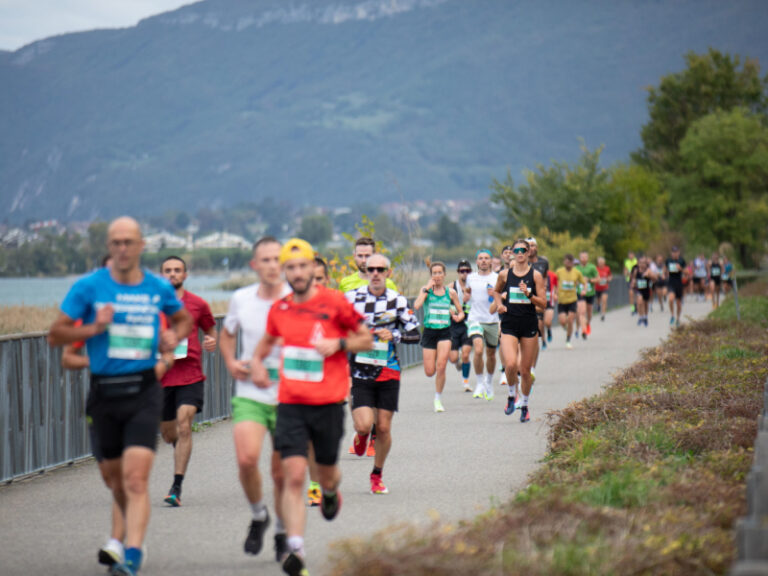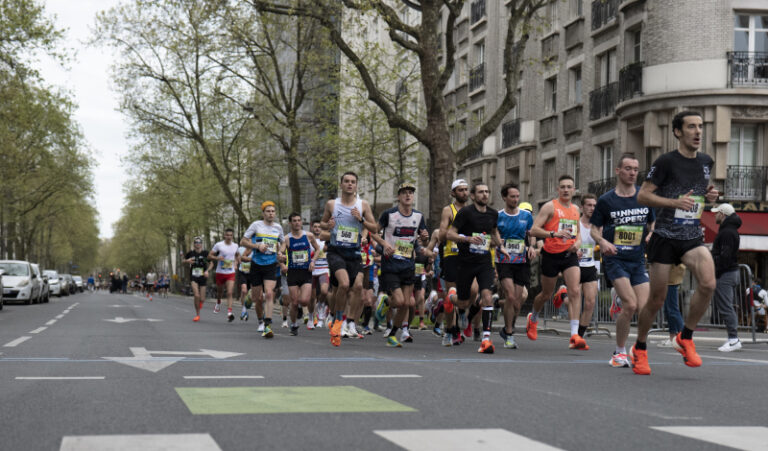
The ideal marathon temperature is around 5 to 12 °C (41 to 54 °F) at the start, and every degree above that costs you time. How much? It depends on your level: a few seconds for an elite runner, one to two minutes for an amateur marathoner. Altitude works in the same direction by reducing the oxygen available. Here’s what the research says, and how to adjust your pace.
The short answer
- Ideal range: between 4 and 10 °C depending on level in the largest study on the subject (1.8 million finishers), closer to 10-12 °C in other research.
- Time lost per degree: about 20 seconds per °C for Boston Marathon winners, but 1′47″ for all finishers, on average. The loss is small up to 15-16 °C, then speeds up sharply above 20 °C.
- Slower runners lose the most, both in time and in percentage, because they’re exposed for longer.
- Altitude: VO2max drops by about 6% per 1000 m, and middle- and long-distance performances fall by 2 to 4% above 1000 m.
- What works: acclimatize to the heat for 1 to 2 weeks, start slower and adjust your hydration strategy.
Why heat slows marathon runners down
When you run, your muscles produce a huge amount of heat. To get rid of it, your body sends blood to the skin and you sweat. In cool weather, that’s easy. When the air is hot, humid or the sun is beating down, heat loss becomes less efficient and your core temperature rises.
Your heart then has to serve two masters at once: the muscles that need oxygen and the skin that needs to cool the body. Add progressive dehydration, which reduces blood volume. The result: at the same pace, your heart rate drifts upward and perceived effort increases. Your brain makes you slow down to protect you, often before your temperature becomes dangerous.
Over 10 km, this process has little time to build up. Over a marathon, with 2 to 5 hours of effort, it weighs heavily. That’s also why slower runners are hit hardest: they spend more time out there, often during the hottest part of the day.
What is the ideal temperature for a marathon?
Several large studies have matched marathon results with race-day weather. They agree: marathons are run fastest in cool weather, much cooler than what feels pleasant in everyday clothes.
| Study | Data | Optimal conditions |
|---|---|---|
| El Helou et al., 2012 | 1,791,972 finishers, Paris, London, Berlin, Boston, Chicago, New York (2001-2010) | 3.8 to 9.9 °C depending on performance level |
| Mantzios et al., 2022 | 1258 championship races (1936-2019), top athletes | WBGT of 7.5 °C for the marathon |
| Ely et al., 2007 | 7 North American marathons, 6 to 36 editions each | Fastest times in the coolest WBGT range (5 to 10 °C) |
The El Helou study, partly carried out by France’s national sports institute (INSEP), is the largest: it shows that air temperature is the weather factor with the biggest impact on finish times. It also shows that above the optimum, speed drops and dropout rates rise. At the 2007 Chicago Marathon, run at around 25 °C, the dropout rate reached 30.7%.
In practice, aim for an ideal range of 5 to 12 °C at the start. Below that, the cold also ends up costing a little time, but much less than heat. If you feel the cold easily or run slower than 4 hours, the upper limit is probably lower than you think: you’ll finish around midday, when it’s warmer than at the start.
One thing to note: several studies use WBGT (wet bulb globe temperature), an index that combines temperature, humidity, solar radiation and wind. More on that below.
How many seconds do you lose per degree in a marathon?
The most telling figure comes from Knechtle et al. (2019), who analyzed 580,990 Boston Marathon results between 1972 and 2018. Each extra degree of average temperature adds 1′47″ for all finishers, compared with 20″ for the winners.
Read this figure carefully: it’s an average slope, calculated over nearly 50 editions, from the coolest to the hottest. But the loss isn’t linear. In Ely et al., the gap between the top men and the course record goes from 1.7% in the coolest WBGT range to 4.5% in the hottest, and the last step is the biggest. In other words, you lose little between 12 and 16 °C; above 20 °C, each degree costs more and more.
Level matters too. Ely observed that the slowdown gets bigger the further down the results you go, while Mantzios et al. found about 0.2% per degree of WBGT for championship athletes. An amateur runner is exposed for longer and often finishes during the hottest hours.
Estimate based on your target time
The table below is an estimate, not a direct measurement. It assumes no loss up to 12 °C, then a loss that grows with the square of the temperature difference: small at first, then larger and larger. It’s calibrated to match, on average between 12 and 32 °C, the orders of magnitude seen in Boston: about 20″ per degree for an elite runner, 1′30″ to 2′ for an amateur. Start temperatures, in dry and overcast conditions.
| Target time in cool weather | At 16 °C | At 20 °C | At 24 °C | At 28 °C |
|---|---|---|---|---|
| 2:15 | +15″ | +1′ | +2′30″ | +4′20″ |
| 3:00 | +50″ | +3′30″ | +7′45″ | +14′ |
| 3:30 | +1′10″ | +4′40″ | +10′30″ | +19′ |
| 4:00 | +1′30″ | +5′45″ | +13′ | +23′ |
| 4:30 | +1′45″ | +7′ | +15′30″ | +27′30″ |
Example: you’re aiming for 3:30 and the forecast says 22 °C instead of 12 °C. Expect about 7 extra minutes, so a realistic goal of around 3:37. At 28 °C, the cost approaches 20 minutes: at that point, managing your effort and staying safe matter more than your finish time.
Treat these numbers as a starting point. Individual sensitivity varies a lot depending on your build, acclimatization and how you sweat: fine-tune them with your own runs in hot weather.
To turn your new goal into paces, you can predict your marathon time and then calculate your split times with the new target.
Humidity, sun, wind: look beyond the thermometer
20 °C under cloudy skies and 20 °C in full sun are not the same race. The sun adds heat to your body, humidity slows the evaporation of sweat, and wind helps cool you down. That’s why researchers use WBGT, which takes these factors into account.
Across 1258 championship races, Mantzios et al. found that WBGT predicts performance better than temperature alone. Across all events, they place optimal performance between 7.5 and 15 °C WBGT, with a loss of about 0.3 to 0.4% per degree outside that range. In Boston, Knechtle et al. also observed that a tailwind improves finish times and that rain slows most runners down.
Humidity alone, however, had no significant effect in El Helou’s study of major marathons. It mainly matters when it comes on top of heat.
In practice, the day before your race, check:
- the temperature at the start and at your estimated finish time;
- the amount of sun and how much of the course is in the shade;
- the dew point or humidity, especially if it’s above 18 °C;
- the wind, especially on long straight sections.
If all four point the wrong way, expect your real loss to be at the high end of the table’s estimates.
Altitude: how does it affect your marathon time?
At altitude, the air still contains 21% oxygen, but the pressure drops. Each breath delivers less oxygen to your muscles, and your VO2max (your maximal oxygen uptake) decreases. For an endurance event like the marathon, this translates directly into a slower pace at the same effort.
Wehrlin and Hallén (2006) tested endurance athletes in a hypobaric chamber at simulated altitudes from 300 to 2800 m. Their VO2max dropped linearly, by about 6.3% per 1000 m (4.6 to 7.5% depending on the athlete). Notably, the drop was already measurable at 800 m.
In real races, the effect on performance is a little smaller than the drop in VO2max, because thinner air also offers less resistance. An analysis by Hamlin et al. (2015) of more than 132,000 elite performances shows losses of up to 2 to 4% above 1000 m in distance events. At the 1968 Mexico City Olympics, at 2240 m, the 5000 m and 10,000 m winners ran 4 to 6% slower than the world records of the time.
For a marathon run at around 1500 m, a 2 to 4% loss would mean, for example, 4 to 8 minutes on a 3:30 goal. That’s an order of magnitude, not a rule: the impact depends on your acclimatization and your sensitivity to hypoxia. And if the course is also hilly, as is often the case at altitude, the elevation adds to the bill.
Acclimatizing to altitude is much slower than acclimatizing to heat: it takes several weeks. If you can’t arrive well in advance, the most effective approach is to accept an adjusted goal and start cautiously, without trying to hold your usual paces.
How to adapt your marathon to the heat
Acclimatize 1 to 2 weeks before
Your body adapts to heat, and fairly quickly. The expert consensus published by Racinais et al. (2015) recommends repeated exercise-heat exposures over 1 to 2 weeks. You start sweating earlier, your blood volume increases and your heart rate drifts less.
If your marathon is likely to be hot and you train in cool weather, schedule a few easy runs during warmer hours in the two weeks before, staying at an easy endurance pace. The goal is adaptation, not performance: don’t put your race-pace sessions in the midday sun.
Revise your goal before the start
This is the most common mistake: sticking to the pace planned for 12 °C when it’s going to be 24. The price is paid after the 25th or 30th kilometer, and it’s often higher than the few minutes “lost” by starting sensibly. Use the table above to set a new target, then start slightly below it for the first few kilometers. On that day, your heart rate and how you feel are better guides than your watch.
To help you, Race Strategy recalculates your paces and fluid needs based on the heat, rain, wind or cold forecast for race day.
Drink and cool down smartly
The same consensus advises starting well hydrated and limiting dehydration during exercise, without drinking to excess. It also mentions pre-cooling strategies before the start. During the race, pouring water over the back of your neck and your forearms helps cool you down. If you struggle to drink and eat while running, practice it in training.
Dress for running in the heat
The goal is twofold: let sweat evaporate and limit the heat you absorb from the sun.
- Light-colored, thin, breathable clothing: light colors absorb less solar radiation. Choose a lightweight technical singlet or T-shirt and loose shorts. Avoid cotton, which stays soaked with sweat.
- A light-colored, ventilated cap or visor to protect your head and face. You can wet it at aid stations. If you tend to overheat, a visor leaves the top of your head open to the air.
- Sunglasses and sweat-resistant sunscreen, applied before the start on your shoulders, neck and face.
- Thin socks and anti-chafing protection (underarms, thighs, nipples): sweat and the water you pour over yourself increase chafing.
- While waiting at the start, if the morning is cool, wear an old T-shirt you can discard at the start rather than an extra layer for the whole race.
Golden rule: nothing new on race day. Test your full outfit on a long run in hot weather.
Know when to stop
Dizziness, chills in hot weather, confusion, no longer sweating: these signs should not be ignored. Slow down, walk and report to a first-aid station. No finish time is worth heatstroke.
FAQ
At what temperature does a marathon start getting slower?
Finish times start to suffer as soon as you leave the range of roughly 5 to 12 °C. The effect stays moderate up to 15-16 °C, then becomes clearly noticeable above that, especially in the sun and for runners who finish in more than 3:30.
Are women more or less affected by heat?
The findings differ. In Ely’s study, the top women slowed down in the heat following the same trend as the men, but the differences were not statistically significant. In El Helou’s study, the optimum for the top women was 9.9 °C, higher than for the first quartile of men (6 °C). Level and acclimatization matter more than sex.
Should you also slow down in training when it’s hot?
Yes. The same mechanisms apply to every session. In summer, base your easy runs on effort and heart rate rather than pace, and move your quality sessions to early morning or evening. Our guide to training paces helps you find each zone.
Is a marathon at 1000 m altitude much slower?
The effect is measurable but limited: VO2max already drops at 800 m, but performance losses only become really noticeable above 1000 to 1500 m. For most European marathons, altitude isn’t an issue; heat is much more often.
Conclusion
The ideal marathon is run between 5 and 12 °C. Above that, the loss is modest at first and then speeds up: for a 3:30 goal, expect about 5 minutes at 20 °C and nearly 20 minutes at 28 °C. Altitude adds its own cost above 1000 m.
You can’t choose the weather, but you can choose how you respond: acclimatize if the race looks hot, revise your goal the day before and start cautiously. A well-managed, adjusted time beats an original goal that falls apart at kilometer 30.
Ready to prepare for your next marathon? RunMotion Coach builds a marathon training plan tailored to your level and goal, and adjusts it week after week. Start your 7-day free trial.
Sources
- El Helou N. et al. (2012). Impact of environmental parameters on marathon running performance. PLoS ONE, 7(5), e37407. DOI: 10.1371/journal.pone.0037407
- Ely M.R., Cheuvront S.N., Roberts W.O., Montain S.J. (2007). Impact of weather on marathon-running performance. Medicine & Science in Sports & Exercise, 39(3), 487-493. DOI: 10.1249/mss.0b013e31802d3aba
- Mantzios K. et al. (2022). Effects of weather parameters on endurance running performance: discipline-specific analysis of 1258 races. Medicine & Science in Sports & Exercise, 54(1), 153-161. DOI: 10.1249/MSS.0000000000002769
- Knechtle B. et al. (2019). The role of weather conditions on running performance in the Boston Marathon from 1972 to 2018. PLoS ONE, 14(3), e0212797. DOI: 10.1371/journal.pone.0212797
- Wehrlin J.P., Hallén J. (2006). Linear decrease in VO2max and performance with increasing altitude in endurance athletes. European Journal of Applied Physiology, 96, 404-412. DOI: 10.1007/s00421-005-0081-9
- Hamlin M.J., Hopkins W.G., Hollings S.C. (2015). Effects of altitude on performance of elite track-and-field athletes. International Journal of Sports Physiology and Performance, 10(7), 881-887. DOI: 10.1123/ijspp.2014-0261
- Racinais S. et al. (2015). Consensus recommendations on training and competing in the heat. British Journal of Sports Medicine, 49(18), 1164-1173. DOI: 10.1136/bjsports-2015-094915