
Plenty of runners use a heart rate monitor and GPS to track their running sessions. These two tools can be really valuable for training, but beyond the raw numbers, what matters is knowing how to use them the right way. There’s a lot of bad advice out there, on the internet and sometimes even in magazines. So let’s clear things up with accurate, verified information.
Who am I? I’m Guillaume Adam, a high-level runner (29:31 for 10K), and I worked in a CNRS and MIT lab in Boston studying heart rate analysis at rest and during exercise. In my own training, I’ve used a chest strap and GPS daily for the past year to track progress. These two tools are useful, but they’re not mandatory to train well. In fact, I trained without them for many years 😉
Contents
What is a heart rate monitor for?
Heart rate is one of the easiest physiological metrics to measure. It helps quantify stress on the body, which means it’s a way to gauge training load and exercise intensity. When you run or do any physical activity, your body needs more oxygen, so cardiac output and heart rate rise.
A heart rate monitor records the time between each heartbeat, what’s known as the R-R interval. Then it averages several beats to calculate an instantaneous heart rate. If you have two beats in one second, your heart rate is 120 beats per minute.
At rest, the effort is basically zero, you’re at your resting heart rate. During a maximal effort (sustained for a bit more than 2 to 3 minutes), you’ll reach your maximum heart rate. The speed you can hold for a 5 to 6 minute maximal effort is your vVO2max.
Forget the 220 minus age formula!
Everyone is different, with their own resting heart rate (RHR) and maximum heart rate (HRmax). Forget the 220 minus age formula for estimating HRmax, it’s based on broad population statistics. If you’re 40, you’re statistically more likely to have a max heart rate around 180 bpm, but you could just as easily be at 160 or 200 bpm. In a future article, we’ll go through how to determine your RHR, HRmax, and your personal training zones.
Is my heart rate monitor data reliable?
Before you rely on a heart rate monitor, it’s better to check the reliability of the data. Otherwise, using it can become counterproductive. Some cardio GPS watches use an optical sensor on the wrist. Having tested the Garmin 935 (the high-end model released in 2017), the data was not reliable at all, with differences of up to 20 to 30 bpm compared to a classic chest strap. And that was even while wearing the watch tightly, as the brand recommends. From what many runners report, wrist-based optical sensors still have room for improvement.
Chest straps are far more reliable, and while Polar is the scientific reference for accuracy, most brands offer solid chest straps for measuring heart rate. For better precision, it’s recommended to wet the strap electrodes before heading out.
You can often spot a signal error like this, if you’re running at a steady pace on flat ground and your heart rate suddenly jumps up or drops by 10 to 20 bpm.
Heart rate, a physiological metric that isn’t that easy to interpret
Heart rate is a great indicator during steady effort, once you’ve held the intensity long enough.
However, it’s not very precise when pace changes frequently. The reason is simple, heart rate kinetics are fairly slow. Here’s an example from an interval session I did. One rep was 6 minutes long. Even running at a steady pace for those 6 minutes, my heart rate took about 2 minutes to reach a steady state (most runners need around 2 to 3 minutes). So it’s not really possible to “train by heart rate” for intervals shorter than 3 minutes, at least early in the workout.
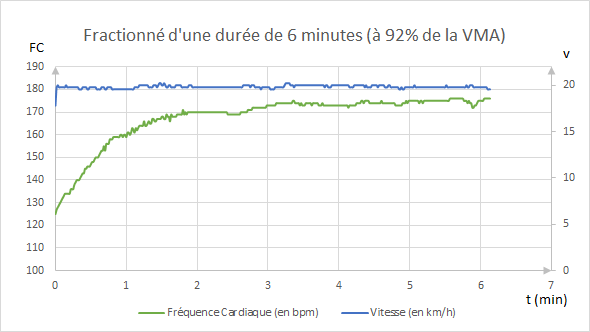
On top of that, there’s cardiac drift. At a constant speed, once steady state is reached, heart rate tends to creep upward over time. So during a longer threshold effort (around 70 to 92% of vVO2max depending on the runner), heart rate can rise by 5 bpm between minute 5 and minute 20, for example. Should you slow down to keep the same heart rate, or keep the same pace? Coaches don’t all agree, but personally I’d say it’s better to keep the same pace.
If heart rate reacts slowly and drifts, how do I use heart rate data in training?
In training, a heart rate monitor is useful as a speed limiter. Easy endurance runs (easy jogging) should help you recover and keep your muscles well oxygenated. Going too fast is counterproductive for endurance performance. Setting a heart rate ceiling is an excellent way to hold yourself back. It’s often more relevant than GPS pace because pace depends on elevation. You’re not going to surge uphill just to match your flat-ground pace 😉
For short intervals (less than 2 minutes), you can’t use heart rate to control speed for the reasons mentioned above, heart rate responds too slowly.
That said, where heart rate monitoring becomes really useful is during the recovery phases of a workout, to check whether your heart rate hasn’t dropped too much (in that case, you can run the recovery a bit faster or shorten it), or whether it’s still too high (then you extend the recovery).
During the classic vVO2max sessions (short intervals from 30 seconds to 2 minutes), the ideal is to spend as much time as possible close to HRmax to develop your VO2max, the maximum amount of oxygen your body can use during exercise. If heart rate falls too much during recovery, you won’t be able to reach HRmax during the vVO2max set.
How do I use heart rate data on race day?
For long-distance races (marathon or trail running), a heart rate monitor can play the same role as a speed limiter to help you avoid going out too fast. As in training, heart rate takes a few minutes to reach steady state. So there’s no need to stare at your heart rate during the first 3 minutes.
How do I analyze my progress using heart rate data?
After your run, you can analyze your sessions using GPS and heart rate data. First, it helps you confirm whether you stayed in the right training zones. Over the longer term, it lets you track how your metrics evolve throughout the year. If you’re a beginner, you’ll probably see your HRmax increase over time.
For all runners, at the same speed (measured on the same course), your heart rate will usually trend lower after a few weeks of training as your body adapts and the effort feels easier. On the other hand, for the same speed, a higher heart rate can signal inefficient training (time to revisit your training plan) or general fatigue, possibly caused by overtraining or a health issue.
In another article, I explain how to define your own training zones (no, anaerobic threshold isn’t 90% of HRmax for everyone) and why you shouldn’t confuse % of vVO2max with % of heart rate.
Here, we look at comment utiliser la fréquence cardiaquehow to use heart rate to measure your fitness day by day, and here’s another indicator to track fitness and see how your body responds to training: variabilité de la fréquence cardiaqueheart rate variability.