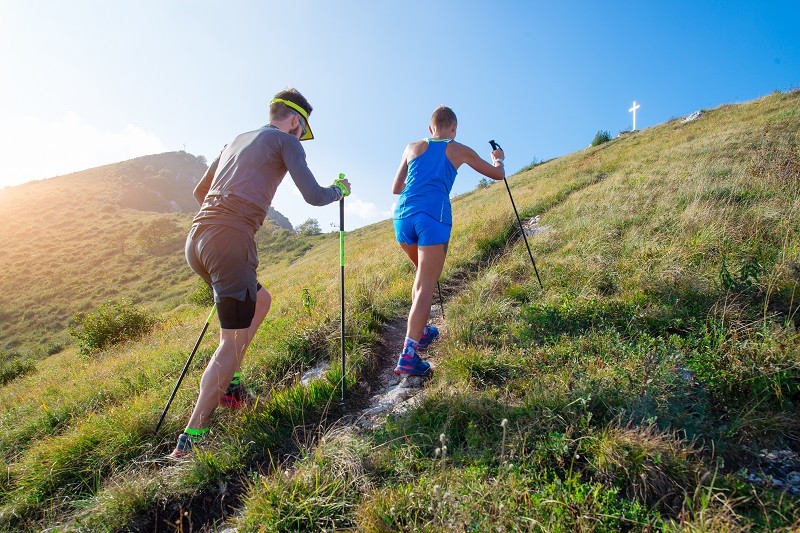
When you go trail running, in training or on race day, you might wonder whether it’s worth bringing poles. They’re especially recommended for long efforts and big elevation gain. Here are our tips to choose the trail running poles that fit your style, your terrain, and your performance goals.
The key criteria to pick the right trail poles include weight, material, grip, packability, and length.
Contents
The shaft, material and weight
The shaft material largely determines both the pole’s weight and its stability. Most trail running poles are made from aluminum or carbon fiber.
Aluminum
Aluminum is heavier, but often more durable, with solid, confidence-inspiring plant and push on rough ground.
Carbon
Carbon fiber is lighter, so it’s a favorite for runners chasing minimal weight and better running economy over long distances. That said, the added flex and occasional fragility, especially on folding poles, can feel less stable when you really need strong support.
At the end of the shaft is the pole tip. Check durability and whether the tip can be replaced, because it’s often the part that wears out the fastest.
How packable should your trail poles be?
You’ll find one-piece poles, folding poles, and telescopic poles, depending on whether you want to stash them on your back or in your pack during runnable sections, for example.
One-piece poles
In general, one-piece poles are best for continuous use throughout a trail run or race, while folding poles are more suited to occasional use when the course alternates between climbs and flats.
A one-piece trail pole is more stable and robust. It’s especially useful for a Vertical Kilometer (VK), because that format demands a lot of power. Check out our tips on using poles on climbs. The downside is that one-piece poles can feel bulky on flatter trails, or whenever you’ll need them less than about 60% of the race.
Three-section folding poles or telescopic poles
Folding or telescopic trail running poles are easier to carry and more versatile. Look for a simple, fast deployment system, and practice until opening and closing them becomes automatic. There’s nothing worse than struggling to unfold your poles when it’s freezing cold and your hands are numb, experience speaking, haha.
Make a habit of stowing your poles when you don’t need them, or when the terrain becomes very technical. Clip them to your pack or your running belt.
A committed runner will usually prefer folding poles for better mobility during training and racing.
Which grips should you choose?
Foam or cork?
Trail pole grips typically come in foam or cork. Cork’s main advantage is durability, and it absorbs less moisture. Then you can choose between wrist straps or glove-style straps.
Wrist strap or glove-style strap?
A classic wrist strap lets you adjust hand placement and switch it up if you start to feel hotspots, under the hand, lower on the grip, and so on. However, it can be more irritating because the pressure is concentrated in a smaller area.
Glove-style straps spread pressure more evenly, help you stay relaxed, and can improve push-off efficiency, similar to cross-country skiing. Most elite trail runners use them now.
Choosing the right length for trail running poles
For trail running poles, a common recommendation is the ratio 0.67 x your height. More precisely, choose a pole that, with your arms relaxed by your sides, puts your hand at grip height when your elbow is bent at 90 degrees, like a ski pole fitting.
Trail running pole size calculator
Enter your height to find the ideal length for your trail running poles. The calculator uses the commonly recommended formula: height x 0.67. Then it rounds to the nearest 5 cm, since most poles are sold in 5 cm increments.
What are the best trail running pole brands?
Leading trail brands include Leki, Black Diamond, and Guidetti.
We recommend Guidetti poles, a French brand based in the heart of the Alps. Aluminum or carbon, folding or one-piece, every option is available. Their folding system is fast and reliable, ideal for races and long training runs. We also like their local commitment, with production largely made in France, and the attention they put into product durability.
Get 15% off with the code RUNMOTION15 on the official Guidetti website.
Train regularly with poles to build good technique and avoid blisters or burning sensations in your hands. Also get used to the open and close system on folding poles, especially if you train in the city and don’t use them often. Don’t hesitate to try different models in-store.