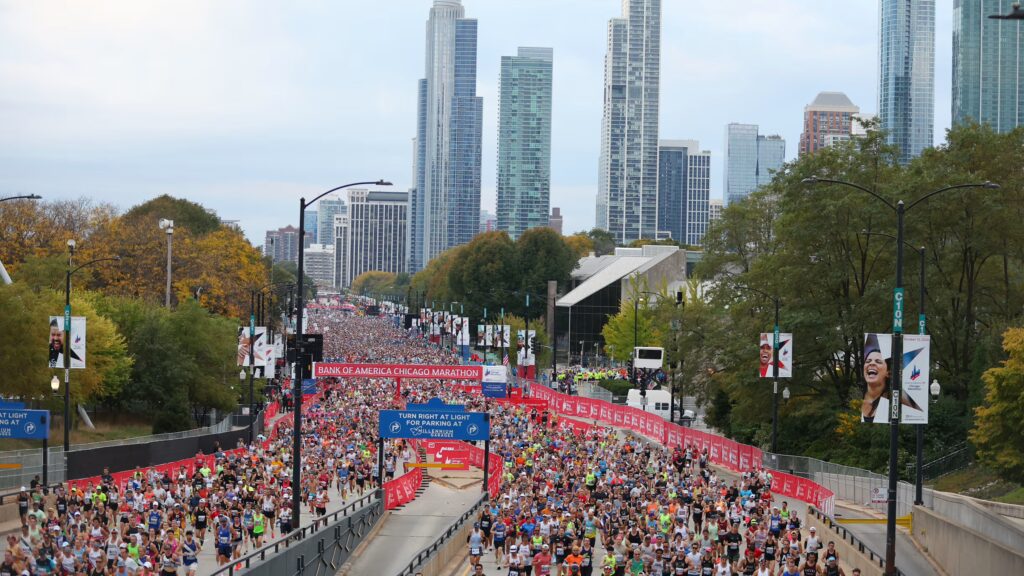
Live the American dream at the Chicago Marathon 2026! Alongside New York and Boston, Chicago is one of the most iconic marathons in the United States. Above all, it is one of the fastest marathon courses in the world.
The Bank of America Chicago Marathon 2026 will take place on Sunday, October 11, 2026. For this 48th edition, around 55,000 runners will take to the streets of Chicago on a course through 29 neighborhoods, cheered on by approximately 1.7 million spectators.
But how do you get a race entry? What is the course like? Is it really a fast marathon? What budget should you plan for? And most importantly, how should you pace and manage the 42.195 km?
Here is our complete guide to the Chicago Marathon 2026.
Contents
- The History of the Chicago Marathon
- Chicago Marathon 2026 Registration: Everything You Need to Know
- Is the Course Difficult? No, Chicago Is One of the World’s Fastest Marathons
- The Chicago Marathon 2026 Course
- How to Pace the Chicago Marathon Course
- What Is Chicago Weather Like in October?
- How Much Does the Chicago Marathon Cost?
- Chicago or New York: Which American Marathon Should You Choose?
- So, Should You Run the Chicago Marathon 2026?
- Tips for Training for the Chicago Marathon
The History of the Chicago Marathon
The first edition of the Chicago Marathon was held in 1977. Since then, the race has become one of the standout events on the international running calendar. Today, Chicago is part of the Abbott World Marathon Majors, alongside New York, Boston, London, Berlin, Tokyo and Sydney.
What makes Chicago special? Unlike New York, which is best known for its atmosphere and numerous bridges, Chicago is also a true stage for performance. The course has seen seven world records set, which says everything about its potential.
In 2026, the race will be held on Sunday, October 11, continuing the tradition of racing on the second Sunday of October.
Chicago Marathon 2026 Registration: Everything You Need to Know
This is probably the first question on your mind: how can you get a Chicago Marathon bib?
The good news is that there are several options.
The less good news is that the standard registration period for 2026 has already closed.
Applications for guaranteed entry and the lottery ran from October 21 to November 18, 2025, with lottery results announced on December 11, 2025.
For a future edition, you will need to plan ahead from the previous fall.
Enter the lottery
If you do not have a qualifying time and do not want to book through an agency, you can try your luck in the lottery. Lottery entry is free.
Be aware that submitting multiple applications will not help. Duplicate entries are removed before the drawing, so they do not give you any extra chance. The lottery is therefore the most accessible option, but there is no guarantee you will secure a bib.
Qualify with a time standard
Like New York, Chicago offers guaranteed entry through a qualifying time. The standards are especially appealing, as Chicago is more accessible than Boston for some runner profiles.
For 2026, these are the required times:
| Age | Men | Women / non-binary |
|---|---|---|
| 16–34 | 2:50 | 3:20 |
| 35–39 | 2:55 | 3:25 |
| 40–44 | 3:00 | 3:30 |
| 45–49 | 3:10 | 3:40 |
| 50–54 | 3:15 | 3:50 |
| 55–59 | 3:25 | 3:55 |
| 60–64 | 3:40 | 4:15 |
| 65–69 | 3:55 | 4:30 |
| 70–74 | 4:15 | 4:45 |
| 75–79 | 4:30 | 5:00 |
| 80 and over | 4:50 | 5:20 |
These times must have been achieved in an official, verifiable marathon on a course certified by a recognized governing body. For the 2026 edition, the qualifying marathon had to be run on or after January 1, 2024. Your age on race day at the 2026 Chicago Marathon is used.
👉 For example, if you can run 3:00 or faster as a man under 44, or 3:30 or faster as a woman under 44, Chicago becomes accessible without going through the lottery.
Book through a tour operator
For international runners, another option is to go through an official tour operator. Chicago’s official program includes more than 100 operators around the world. Some offer packages including race entry, hotel, flights and a range of services.
It is obviously more expensive than registering directly, but it is an especially worthwhile option if you want to organize your first American marathon without risking your race entry. Be careful, though: only operators listed in the official Chicago Marathon 2026 program have guaranteed bibs.
Run for a charity
One final option is to run for an official Chicago Marathon charity partner.
In 2026, runners entering through the official charity program had to commit to raising at least $2,200, with higher targets possible depending on the charity. It is an excellent way to secure a bib while giving your race a deeper purpose, but you need to feel comfortable with fundraising.
Is the Course Difficult? No, Chicago Is One of the World’s Fastest Marathons
If New York is known for its bridges, Chicago is almost the opposite. The course is famous for being flat and fast, with both the start and finish in Grant Park.
The route forms a large loop through 29 Chicago neighborhoods. You will experience the city’s different atmospheres and communities before heading back toward downtown Chicago and Grant Park. That is Chicago’s real strength: it feels like you are discovering the city while running a marathon course built for fast times.
The Chicago Marathon 2026 Course
The start and finish are located in Grant Park, right in the heart of Chicago. The course then takes in a large part of the city before returning downtown.
The organizers highlight:
- 29 neighborhoods visited
- around 55,000 participants
- around 1.7 million spectators
- 10,000 volunteers
- 20 aid stations along the course.
In other words, it is hard to feel alone in Chicago! The atmosphere is especially electric in certain neighborhoods and is one of the race’s biggest strengths.
How to Pace the Chicago Marathon Course
Now, let’s talk racing. The main trap at the Chicago Marathon 2026 is not a steep hill or a particularly tough bridge. The trap is thinking the course is easy. Because it is flat, fast and fueled by an incredible atmosphere, it is very easy to start too fast.
Trap No. 1: The start
The first few hundred meters are incredibly impressive. You are in the heart of Chicago, surrounded by tens of thousands of runners and a huge crowd. The risk is a classic one: starting 10 to 20 seconds per kilometer too fast because you feel amazing.
Do not fall into the trap.
The opening kilometers need to be perfectly controlled. If your goal is 3:00, do not try to run 4:10/km in the excitement of the start. You still have more than 40 kilometers ahead of you.
Trap No. 2: The atmosphere
The atmosphere is probably one of Chicago’s greatest assets. With around 1.7 million spectators, you will be cheered on almost constantly. But the crowd can also make you speed up without realizing it.
As in New York, you need to keep an eye on your watch and, above all, your effort level. The spectators do not know your race plan. You do.
Trap No. 3: The halfway mark
Reaching halfway can make it feel as if the marathon is almost over.
Wrong!
In Chicago, you may feel exceptionally comfortable over the first 20 kilometers. Enjoy it, but do not try to bank time. A marathon is mostly decided between kilometers 30 and 42. If you reach halfway slightly slower than your target pace, that is fine. If you go through two minutes too fast, you may pay for it much later.
The real test: kilometer 30
Because the route is so runnable, Chicago can make you feel confident. But the final kilometers are still marathon kilometers. From km 30 onward, muscular fatigue sets in and energy stores drop. This is where your training, fueling and pacing strategy will make the difference.
The marathon truly begins at km 30.
The final kilometers
As you approach Grant Park, you will gradually realize that the marathon is coming to an end.
This is the moment to let it rip… if you have anything left!
If you have managed the first 30 kilometers well, the final stretch can be extremely fast. Crossing the finish line in Grant Park after running through Chicago is, of course, an unforgettable moment.
Managing jet lag
If you are racing on Sunday morning, I recommend arriving ideally on Thursday, or even Wednesday if you want complete peace of mind.
That gives you enough time to:
- recover from the journey;
- gradually adjust your schedule;
- pick up your race bib;
- explore a little of Chicago;
- and, most importantly, avoid spending Saturday rushing all over the city!
Saturday: Watch the sightseeing
Chicago is incredibly tempting to explore. Millennium Park, the Riverwalk, skyscrapers, Lake Michigan, the different neighborhoods… But remember, you are running 42.195 km the next day. So avoid clocking up 25,000 sightseeing steps on Saturday.
The marathon should be your main activity.
Bib pickup
Unlike some European races, Chicago Marathon 2026 bib pickup must be completed in person.
Every participant must collect their own race bib and timing device at the Abbott Health & Fitness Expo, presenting an official ID that matches the name used during registration.
So, you cannot ask a friend to pick up your bib for you.
What Is Chicago Weather Like in October?
This is probably one of the biggest unknowns.
The Chicago Marathon takes place in mid-October, a time that can deliver absolutely perfect running conditions, but also far more challenging weather. Wind in particular can be a factor to watch. Check the forecast in the days before the race and adjust your target accordingly.
Do not set a finish-time goal in stone.
Your goal should be to run the pace that matches the conditions on the day.
How Much Does the Chicago Marathon Cost?
This is where the American dream starts to get a little more expensive!
Although your budget will naturally depend on where you are traveling from and the level of comfort you want, here is a rough estimate for a stay of four to five nights:
- Race entry: around $260 to $280
- Round-trip flights: around $100 to $1,800 depending on your departure point
- Accommodation: around $150 to $400 per night
- Food and transport: around $50 to $100 per day
👉 All in, budget around $1,500 to $3,500 per person for the full experience, with major variations based on where you travel from and where you stay.
International runners can also book through an official tour operator, with packages generally including race entry and accommodation, and sometimes flights. The price is higher, but the logistics are simpler.
Chicago or New York: Which American Marathon Should You Choose?
If you are deciding between the two, here is my take.
🗽 New York
Choose it if you are looking for:
- an iconic atmosphere;
- the five boroughs;
- an exceptional sightseeing experience;
- Central Park;
- the ultimate dream-marathon experience.
But the course is demanding and not ideal for a personal best.
🌆 Chicago
Choose it if you are looking for:
- a flat course;
- a serious time goal;
- a huge atmosphere;
- a superbly organized marathon;
- a spectacular American city;
- one of the Abbott World Marathon Majors.
Chicago is clearly the one I would prioritize if your main goal is to run a fast time.
And if your dream is to collect the World Marathon Majors, Chicago is an essential stop.
So, Should You Run the Chicago Marathon 2026?
Yes, absolutely.
The Chicago Marathon 2026 combines qualities that rarely come together in one race:
✅ a very fast course
✅ an exceptional atmosphere
✅ world-class organization
✅ an incredible city to discover
✅ a World Marathon Major
✅ a course that genuinely gives you the chance to chase a personal best
The only real problem is… getting a race bib!
For 2026, the lottery and standard registration are already closed. At this stage, the main remaining options are official charities, with a minimum fundraising commitment of $2,200, or select official tour operatorsthat still have race entries available.
And if you are targeting Chicago 2027, start monitoring registration from fall 2026.
Tips for Training for the Chicago Marathon
Chicago is a fast marathon, but that is precisely why: to make the most of it, you need to arrive well prepared.
On such a runnable course, gaining a few seconds per kilometer can make a huge difference to your final time. The goal is not simply to pile up mileage, but to build marathon training that matches your level, target and available time.
That is where RunMotion Coach can support you.
The running coach app offers personalized marathon training plans tailored to your level, finish-time goal and experience. The idea is to guide you week after week with the right sessions at the right time: easy running, intervals, threshold work, long runs, recovery and more.
For Chicago, this is especially valuable if you have a time goal. Since the course is so favorable to performance, structured training helps you reach race day with the endurance required to hold your pace all the way, while avoiding the mistake of starting too fast.
👉 Want to prepare for your marathon with a plan tailored to you? Discover RunMotion Coach marathon training plans based on your target time.
And if you are specifically preparing for the Chicago Marathon 2026, keep one rule in mind: do not let the extremely flat course profile fool you. A marathon is rarely decided in the first 10 kilometers. A well-built training plan should above all help you stay strong after kilometer 30 and, if your legs are still there, gradually accelerate all the way to Grant Park.
The goal: reach the start line with a plan, and cross the finish line with the time you came for.