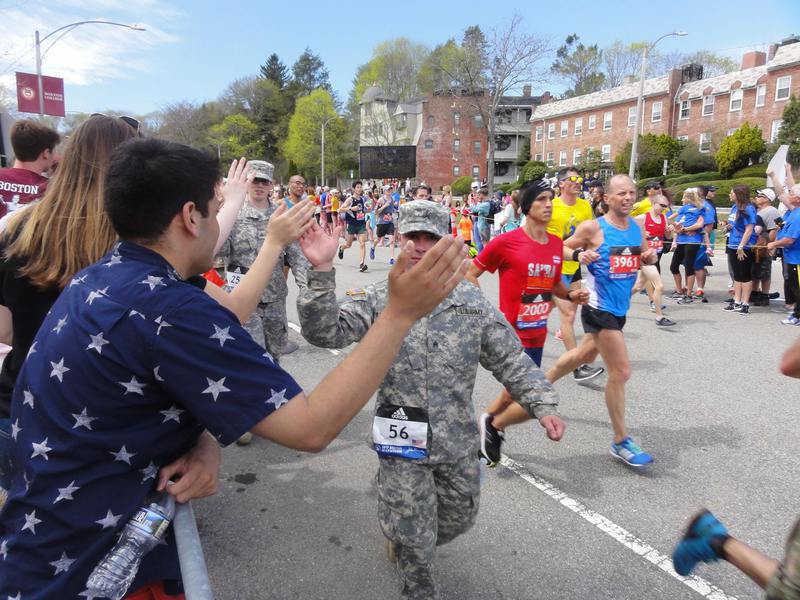
Running the Boston Marathon is a true milestone for thousands of runners. This iconic American race is a pioneer: it’s been held since 1897—long before the famous New York City Marathon, which first took place in 1970. Boston is one of the 6 World Marathon Majors alongside Tokyo, London, Berlin, Chicago, and New York. Every year, around 30,000 marathoners and 500,000 spectators come together for this incredible celebration of endurance running.
Contents
The Boston Marathon, the oldest annually held marathon
The marathon was introduced in 1896 at the first modern Olympic Games in Athens, created to reenact the legend of Pheidippides. John Graham, manager of the U.S. marathon team at those Games, decided to organize a marathon in Boston the following year.
Back then, the race started in Ashland, on the outskirts of Boston, and finished in downtown Boston. At the time, the Boston Marathon was 39.4 kilometers long.
From 1924 onward, the start moved to the town of Hopkinton to match the official marathon distance (42.195 km), set by the international federation in 1921. Since the beginning, the Boston Marathon has always been held on Patriot’s Day—so it’s always the third Monday in April.
The Boston Marathon course is demanding
From the suburbs to downtown Boston
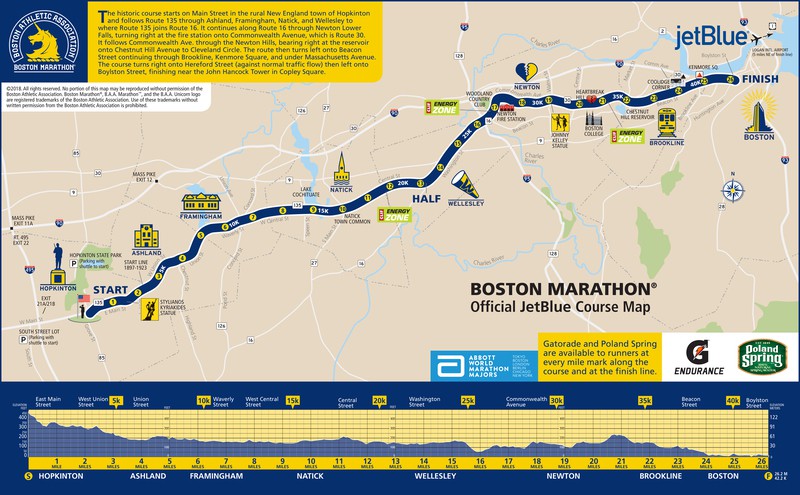
The Boston Marathon is a point-to-point race. The start and finish lines are nearly 40 kilometers apart. Even though the course trends downhill overall, the total elevation gain is 165 m and the total elevation loss is 280 m—making the course profile far from “easy.”
The toughest stretch is almost certainly the series of four climbs in Newton between kilometers 26 and 33. And the final one, Heartbreak Hill, definitely lives up to its name!
A course that can’t be certified for a world record
In 2011, Kenyan runner Geoffrey Mutai ran a blistering 2:03:02—faster than the official marathon world record at the time. But it wasn’t ratified as a world record. For a record to be valid, the elevation drop between start and finish must be less than 42 m. Those two points also can’t be more than 21 km apart—rules designed to account for factors like a strong tailwind, which played a role that year.
That said, if you run a personal best, it will still count as your official PR through the French Athletics Federation (FFA) or other national athletics federations.
How to enter the Boston Marathon: a highly coveted bib
In 1970, the club that organizes the race, the Boston Athletic Association, introduced qualifying standards. Unlike most marathons where anyone can register, you need to hit a qualifying time to be eligible: under 3:05 for men under 35, and under 3:35 for women under 35, to be allowed to sign up for the Boston Marathon.
Boston’s qualifying time gets more generous with age, of course. But even running the exact standard isn’t always enough depending on how many people apply. In 2018, runners had to be about three minutes faster than the stated time to secure a spot.
“Running Boston,” as locals say, is a real achievement for thousands of runners.
If you truly want in, there are also charity entries, where you can earn a bib by raising $1,500 for a nonprofit.
Memorable Boston Marathon editions
Kathrine Switzer, one of the pioneers who ran in 1967
Women weren’t officially allowed to run the Boston Marathon until 1972, after the U.S. federation decided the year before to authorize women in long-distance races. At the time, many still claimed women were physiologically incapable of covering such distances.
The fight led by women like Kathrine Switzer undoubtedly helped women earn the right to race. In 1967, the American registered using a men’s bib under the name “K. V. Switzer.” During the marathon, the race director tried to rip off Switzer’s bib and stop her from continuing.
The incident caused a national scandal. Kathrine Switzer finished in 4:20, an hour after another American, Bobbi Gibb, who ran without a bib. Bobbi Gibb had already run in 1966 and was later retroactively recognized as the women’s winner of the 1966, 1967, and 1968 editions.
Even so, Kathrine Switzer remains the symbol of women’s fight to be allowed to run marathons—and she inspired thousands of runners around the world.
“Boston Strong” after the 2013 bombing
On April 15, 2013, two homemade bombs exploded just meters from the Boston Marathon finish line as thousands of marathoners were still crossing. The attack killed 3 people and injured 264. One of the terrorists was killed during a chase two days later. The other was captured after a five-day manhunt that held America in suspense.
Boston’s residents showed incredible resilience and united around a new motto: Boston Strong. “They failed because Bostonians refused to be intimidated,” said U.S. President Barack Obama. The films Patriot’s Day (released in 2016) and Stronger (released in 2017) recount the events.
The brutal weather at the 2018 Boston Marathon
On April 16, 2018, brutal conditions—pouring rain and violent wind—completely reshaped the race. A huge number of runners had to drop out because of the cold, with some suffering hypothermia.
Japan’s Yuki Kawauchi won the 2018 Boston Marathon in 2:18:59. A non-professional athlete, he’s famous for racing around ten marathons a year—often in outstanding times. He’s the runner with the most sub-2:15 finishes (over 60) and is closing in on 100 marathons under 2:20.
That day changed his life. Legend has it he handed in his resignation the next day to devote himself fully to running.
That urge to run the Boston Marathon
As for me, watching the Boston Marathon in 2017—when I was an athlete with the Boston Athletic Association—made me want to take on the marathon distance. I was working at MIT in Boston on predicting running performance.
At that time, I was racing shorter distances, especially the 1500 m. I became the sixth athlete in the club’s history to run under 4 minutes for the mile (1609 m). But it was at the Boston Marathon that I knew I’d one day jump into the marathon adventure!
And you—do you dream of running the Boston Marathon one day? 🏃♂️ If you’re looking to prepare for this once-in-a-lifetime event or to qualify for Boston, the RunMotion Coach Running app is there for you! It will build your personalized, progressive marathon training plan. Perfect for showing up ready to have an unforgettable race day experience.