Training for a marathon this fall or next spring? Now is the ideal time to think about your running shoes.
During marathon training, your feet will rack up plenty of miles: long runs, marathon-pace workouts, intervals, recovery runs… And over 26.2 miles, poorly suited shoes can quickly turn a great training block into a real ordeal.
But do you really need carbon-plated shoes? Which model should you choose for your first marathon? Should you prioritize cushioning or responsiveness? And most importantly, should you use the same pair for training and race day?
We have selected the best marathon running shoes for 2026, with models suited to different runner profiles and race-time goals.
Our advice: do not choose your shoes based on weight or technology alone. For the marathon, comfort and the ability to maintain an efficient stride after 30 km are at least as important as responsiveness.
Contents
- Which shoes should you choose for marathon training?
- Our top marathon running shoes
- The best carbon-plated marathon shoes
- Which shoes should you choose for your first marathon?
- Which shoes for a sub-3-hour marathon?
- Which shoes for a 3 to 4-hour marathon?
- Which shoes for a marathon over 4 hours?
- FAQ: marathon running shoes
Which shoes should you choose for marathon training?
There is no single “best marathon shoe.”
The ideal model depends on several factors:
- your time goal;
- your running level;
- your marathon experience;
- your running gait;
- your weight and build;
- your cushioning preferences;
- your need for stability;
- your budget;
- and above all, how the shoe feels on your feet.
A very lightweight shoe with a carbon plate can be exceptional for chasing a personal best, but it is not necessarily ideal for a runner preparing for their first marathon and logging 50 to 70 km per week.
Conversely, a highly comfortable and protective shoe may be perfect for long runs, but lack the responsiveness you want on race day.
That is why we recommend separating your training shoes from your race shoes.
Our top marathon running shoes
When preparing for a marathon, you do not necessarily need to use the same pair of shoes for every workout.
In fact, rotating between two pairs can be especially beneficial: a comfortable, protective training shoe for building mileage, and a lighter, more responsive shoe for marathon-pace workouts and race day.
With that approach in mind, we selected the eight models in our ranking. Some shoes are designed primarily for training, while others are built for racing. A few can handle both roles.
| Shoe | Use | Profile | Strengths |
|---|---|---|---|
| Adidas Adizero Adios Pro 4 | 🏁 Racing | Performance | Responsiveness, energy return, lightweight |
| Saucony Endorphin Pro 5 | 🏁 Racing | Performance / versatility | Balance of comfort and responsiveness |
| HOKA Rocket X 3 | 🏁 Racing | Marathon | Cushioning, stability, propulsion |
| PUMA Deviate Nitro Elite 4 | 🏁 Racing | Performance | Lightweight, responsiveness, fast turnover |
| ASICS Superblast 2 | 🏃 Training | Versatility | Cushioning, responsiveness, long runs |
| New Balance 1080 | 🏃 Training | Comfort | Cushioning, comfort, endurance |
| ASICS Gel-Nimbus | 🏃 Training | Maximum comfort | Protection, cushioning, long runs |
| HOKA Bondi | 🏃 Training | Maximum cushioning | Comfort, protection, stability |
💡 Our advice for your marathon training
You do not need to buy two premium pairs of shoes. A solid training shoe for 70 to 80% of your mileage, paired with a faster shoe for your specific workouts and marathon, can make an excellent shoe rotation.
Why use two pairs of shoes for marathon training?
A marathon training block can easily add up to several hundred kilometres. So it would be a shame to focus all your attention on the shoes you will wear on race day.
Your training shoes will be with you for most of your mileage: easy runs, long runs, recovery runs and sometimes marathon-pace workouts. Above all, they should be comfortable, sufficiently cushioned and suited to your running gait.
Your race shoes, on the other hand, are used less often. Lighter and more responsive, they are particularly useful for specific workouts and races. Carbon-plated models generally fall into this category.
This rotation has several benefits: it preserves your race pair, lets you match your shoes to the workout, and ensures you reach marathon day in a pair you know inside out.
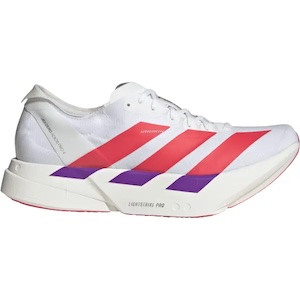
Adidas Adizero Adios Pro 4: our pick for performance
🏁 Racing
The Adidas Adizero Adios Pro 4 is one of today’s benchmark marathon racing shoes.
Lightweight, responsive, and built with highly energetic foam combined with EnergyRods, it is particularly well suited to runners looking to hold a fast pace over 42.195 km.
It is a model worth considering for experienced runners who already have several marathons under their belt and want to improve their time.
Why do we like it?
- excellent energy return;
- highly efficient at marathon pace;
- a propulsive feel;
- low weight;
- especially suited to marathon-pace workouts and racing.
Who is it for?
The runner chasing a time goal who wants a high-performance shoe for race day.
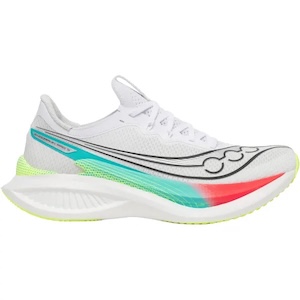
Saucony Endorphin Pro 5: the balance of performance and comfort
🏁 Racing
The Saucony Endorphin Pro 5 is an excellent alternative for runners who want the benefits of a carbon-plated shoe without choosing the most aggressive model on the market.
It combines a carbon plate with highly responsive foam while retaining a relatively accessible ride. Its main strength for the marathon is its balance.
It offers enough responsiveness to run fast while maintaining an appealing level of comfort as the miles add up.
Why do we like it?
- a good balance between comfort and responsiveness;
- carbon plate;
- suited to long distances;
- a relatively versatile ride;
- a great option for discovering carbon-plated shoes.
Who is it for?
The marathon runner looking for a fast race shoe that is not overly demanding.
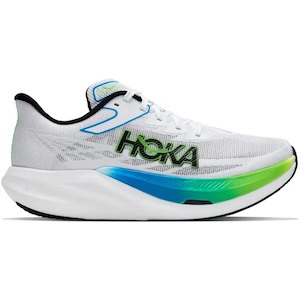
HOKA Rocket X 3: run fast without sacrificing comfort
🏁 Racing
HOKA has been a major name in marathon running for several years, and the Rocket X 3 is a particularly compelling option for long-distance racing. Its ride blends responsiveness, cushioning and stability.
It can be especially suitable for runners who find some carbon-plated shoes too aggressive or unstable.
Why do we like it?
- smooth transitions;
- good cushioning;
- confidence-inspiring stability;
- carbon plate;
- marathon-ready.
Who is it for?
The runner who wants a comfortable, confidence-inspiring carbon-plated shoe for 42.195 km.
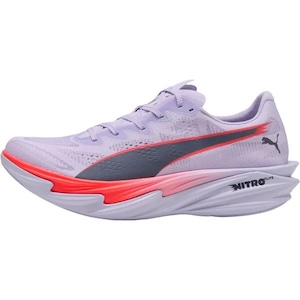
PUMA Deviate Nitro Elite 4: lightweight and responsive
🏁 Racing
The PUMA Deviate Nitro Elite 4 is a carbon-plated running shoe focused on low weight and responsiveness.
It is an appealing choice for runners who enjoy a pronounced propulsive feel without necessarily opting for a model as extreme as some top-tier supershoes.
It can also be used for the half marathon or for certain fast workouts during your marathon build-up.
Why do we like it?
- very lightweight;
- responsive foam;
- strong propulsion;
- versatile on the road;
- a great option for chasing a new personal best.
Who is it for?
The runner who wants a fast, lightweight shoe for racing.
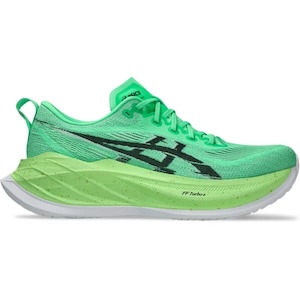
ASICS Superblast: the ideal shoe for marathon training?
🏃 Training
While carbon-plated shoes get plenty of attention, they are not necessarily the best choice for building mileage.
For marathon training, the ASICS Superblast is particularly compelling.
Its generous cushioning, responsiveness and versatility mean you can use it for easy runs, long runs and certain sustained-pace workouts alike.
It can become an excellent go-to shoe throughout a marathon training block.
Why do we like it?
- highly versatile;
- generous cushioning;
- responsive without a carbon plate;
- suited to long runs;
- a strong training option.
Who is it for?
The marathon runner looking for one shoe that can handle almost every workout in their training plan.
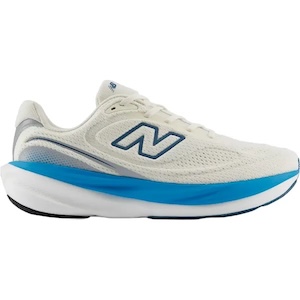
New Balance 1080: comfort first
🏃 Training
The New Balance 1080 is a trusted choice for runners who put comfort first.
It is not designed to replace a racing supershoe, but it can play its role perfectly throughout the long weeks of marathon training.
For easy outings, recovery runs or relaxed long runs, its cushioning is especially enjoyable.
Why do we like it?
- comfortable;
- generous cushioning;
- enjoyable on long runs;
- versatile;
- suited to a wide range of runners.
Who is it for?
The runner who simply wants to build mileage in a comfortable shoe.
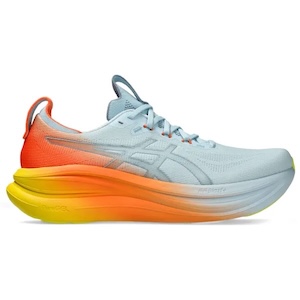
ASICS Gel-Nimbus: maximum comfort
🏃 Training
The ASICS Gel-Nimbus is aimed at runners primarily looking for protection and comfort.
During marathon training, it can be especially useful for easy runs and relaxed long runs.
Its generous cushioning reduces the feeling of impact as the miles accumulate, which can be welcome when training fatigue starts to build.
Why do we like it?
- excellent comfort;
- substantial cushioning;
- enjoyable on long runs;
- reassuring for beginner runners.
Who is it for?
The runner preparing for their first marathon who wants to prioritize comfort over outright performance.
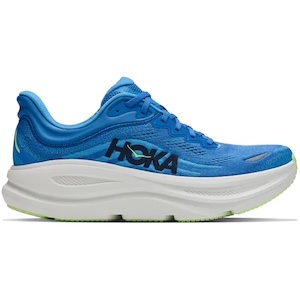
HOKA Bondi: the maximum-comfort choice
🏃 Training
With its exceptionally generous cushioning, the HOKA Bondi is worth considering for runners who prioritize protection and comfort over long distances.
It is not designed to set speed records, but that is not necessarily its role.
For a marathoner who simply wants to finish their race in the best possible conditions, a highly comfortable shoe can be an excellent choice.
Why do we like it?
- maximum cushioning;
- a highly protective feel;
- comfortable on long runs;
- suited to moderate paces.
Who is it for?
The finisher who puts comfort and protection ahead of the clock.
The best carbon-plated marathon shoes
Carbon plates have become essential in elite competition and are now widely used by recreational runners.
What is the benefit? Combined with modern foam and the right geometry, they create a highly responsive shoe that promotes smooth transitions and energy return.
But be careful: a carbon-plated shoe is not automatically better for everyone.
Carbon-plated models can be particularly useful for:
- marathon-pace workouts;
- races;
- runners seeking a performance boost;
- ambitious time goals.
However, wearing a highly demanding shoe for every run is not always the right approach.
For marathon training, we generally prefer a rotation of training shoes + race shoes.
This approach lets you save your highest-performance models for the sessions where they truly make a difference.
For our full selection, also check out our guide to the best carbon-plated running shoes of 2026.
Which shoes should you choose for your first marathon?
For a first marathon, we would not necessarily advise starting straight away with the most aggressive carbon-plated shoe on the market.
The most important thing is to find a shoe that is:
- comfortable;
- sufficiently cushioned;
- stable;
- suited to your running gait;
- comfortable enough to wear for several hours.
For a first marathon, models such as the ASICS Superblast, New Balance 1080 and ASICS Gel-Nimbus can be particularly suitable, depending on your profile.
If you are already used to carbon-plated shoes and chasing a time goal, the Saucony Endorphin Pro 5 or HOKA Rocket X 3 can also be considered.
Which shoes for a sub-3-hour marathon?
Below three hours, your needs change.
At an average pace of 4:16/km, every detail counts. Shoe weight, energy return and the ability to maintain an efficient stride become especially important.
Models to consider include:
- Adidas Adizero Adios Pro 4: an excellent choice for experienced runners chasing performance.
- PUMA Fast-R Nitro Elite 3: a very lightweight and particularly aggressive model, better suited to experienced runners.
- Saucony Endorphin Pro 5: an appealing alternative for those looking for a little more versatility.
Which shoes for a 3 to 4-hour marathon?
For a target time between three and four hours, the balance between responsiveness and comfort becomes especially important.
You will be running between 4:16/km and 5:41/km for several hours.
A shoe that is too demanding can become uncomfortable in the final miles.
We would therefore prioritize:
- Adidas Adizero Adios Pro 4 for performance;
- Saucony Endorphin Pro 5 for its balance;
- HOKA Rocket X 3 for extra comfort;
- ASICS Superblast for training and potentially racing if you prefer running without a carbon plate.
Which shoes for a marathon over 4 hours?
Beyond four hours, comfort matters even more.
The goal is no longer necessarily to gain a few seconds per kilometre with an ultra-lightweight shoe. Above all, you need a model you can wear for several hours without pain, rubbing or hot spots.
For this runner profile, we would particularly prioritize:
- ASICS Gel-Nimbus;
- New Balance 1080;
- HOKA Bondi;
- ASICS Superblast, for runners who enjoy a more responsive shoe.
A carbon-plated shoe can of course be worn by a runner targeting over four hours if they enjoy it and are used to it. Your finish time alone should never determine your choice.
FAQ: marathon running shoes
Do you need two pairs of shoes for marathon training?
No, it is not essential. One versatile pair can work perfectly throughout an entire training block. However, using training shoes for easy and long runs and race shoes for fast workouts and the marathon lets you match your gear to each session and preserve your race-day pair.
Which shoes should you choose to run a marathon?
Your choice primarily depends on your level, goal and preferences. For racing, carbon-plated shoes such as the Adidas Adizero Adios Pro 4, Saucony Endorphin Pro 5 or HOKA Rocket X 3 prioritize responsiveness and energy return. For training, models like the ASICS Superblast 2, New Balance 1080 and ASICS Gel-Nimbus focus more on comfort and cushioning.
Can you run a marathon in training shoes?
Yes, absolutely. A comfortable training shoe that suits your running gait can be perfectly suitable for a marathon. Carbon-plated shoes are not essential, especially if your priority is to finish the race in good condition rather than chase maximum performance.
When should you test your marathon shoes?
Ideally, test your pair several weeks before the race and use it for several sessions, including a long run and a marathon-pace workout. This allows you to check comfort, lockdown and the absence of rubbing or blisters. Above all, avoid running your first marathon in a brand-new pair that you have never tested over a long distance.