
Are you planning to run a 4:30 marathon and looking for a training plana training plana training plana training plan? You are in the right place. Discover our best tips to run your marathon in 4 hours 30 minutes.
Contents
Running a 4:30 Marathon: The Essentials
- Running a marathon in 4:30 means maintaining a pace of 6:23 min/km, or 10:16 min/mile, equivalent to 5.83 mph.
- The ideal first marathon trainingtraining period for a first marathon is usually 16 to 20 weeks. You need to build your training load and running paces progressively to avoid injury.
- The official marathon distance is 26.2 miles, or 42.195 kilometres. It may seem like a lot at first, but do not worry, with training, you can do it. Especially on race day, when the atmosphere is truly exceptional.
- To target a 4:30 marathon, you should be able to run 10K comfortably and ideally have already completed a 20K race or half marathon.
Calculate your vVO2max, endurance level and predicted time for your next marathon with our calculator.
Our Best Tips to Prepare for a 4:30 Marathon
Nutrition and Hydration Strategy
Nutrition is key when training for a marathon. Before training, eat carbohydrates for energy. During your run, stay hydrated and consume energy gels or bars every 30 to 45 minutes. Start fuelling from mile 3 with foods such as bananas or bars, then use energy gels from around mile 18. After training, support recovery with a snack rich in protein and carbohydrates, such as a protein smoothie or Greek yogurt with fruit.
If you want to take things further and build your race strategy, we have developed a tool that lets you create a personalised race plan, including split times, paces, nutrition and hydration management. Everything you need to manage your race on the big day.
👉 Visit Race StrategyRace StrategyRace StrategyRace StrategyRace Strategy.
Equipment and Gear
Choosing the right gear is crucial. Wear running shoes suited to your feet, ideally recommended by experts at a specialist running store, and make sure they are well broken in before race day. Choose technical clothing to manage sweat and prevent chafing, and avoid cotton. You can wear a running belt to carry your fuel, and if you feel more comfortable carrying water, you can even use a hydration pack. A GPS watch is ideal for tracking your pace and distance throughout the marathon.
Strength and Conditioning for a Marathon
For optimal preparation, include strength exercises such as squats, lunges and core work to build stronger legs, core and arms. Prepare mentally with visualisation and breathing techniques, and set intermediate goals such as half marathons or 10K races to stay motivated. Both of these preparation methods are available in the RunMotion Coach app, helping you arrive in the best possible shape on race day.
4:30 Marathon Training: A Typical Week
We are regularly asked for examples of marathon training plans, with two, three or four sessions per week, over 6, 8 or 12 weeks. Here are a few sample training plans to help you prepare for a 4:30 marathon.
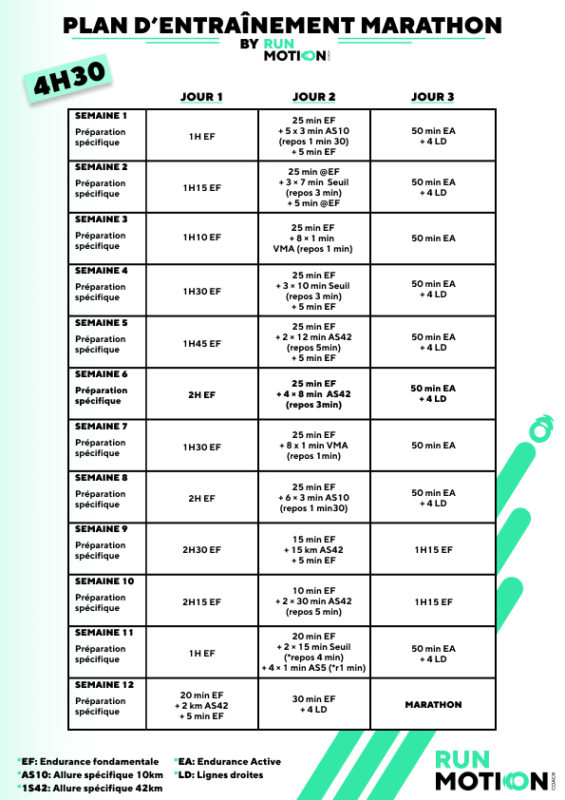
Here is an extract from your 12-week 4:30 marathon training plan, shown below:
Week 1, Specific Preparation
Session 1: 1 hour easy run
Session 2: 25 min easy run + 5 x 3 min at 10K pace, 1 min 30 recovery + 5 min easy run
Session 3: 50 min steady endurance run + 4 strides
Week 7, Specific Preparation
Session 1: 1 hour 30 min easy run
Session 2: 25 min easy run + 8 x 1 min at vVO2max, 1 min recovery
Session 3: 50 min easy run
Week 10, Specific Preparation
Session 1: 2 hours 15 min easy run
Session 2: 25 min easy run + 2 x 30 min at marathon pace, 5 min recovery
Session 3: 1 hour 15 min easy run
4:30 Marathon Training Plan: 3 Sessions a Week for 12 Weeks
4:30 Marathon Training: 4 Sessions a Week for 8 Weeks
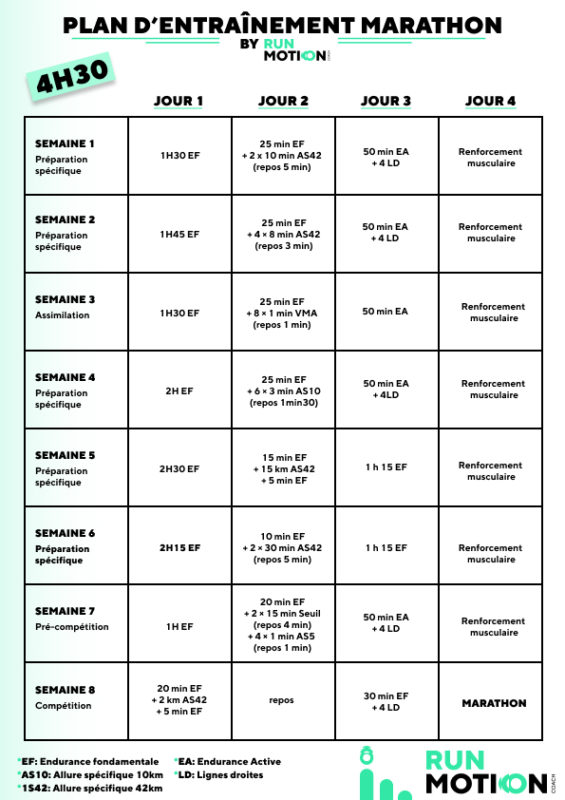
We still recommend that you download RunMotion to benefit from a personalised training plan tailored to your needs, fitness level and goal.
Your 4:30 Marathon Training Plan With the RunMotion Coach App
Training for a 4:30 marathon is an exciting challenge, whether it is your first marathon or not. It requires patience and determination, but it is well worth the effort. What a feeling when you reach your goal.
Rather than following a static PDF training plan, we recommend using the RunMotion app. It provides a personalised marathon training plan based on your availability and fitness level. Enjoy expert advice and discover dedicated modules, including strength training, for complete marathon preparation.
We wish you great success with your 4:30 marathon training, and we hope to see you again soon for 4:15 marathon training 😉
You may also be interested in these articles:
- What makes 4-hour marathon training unique
- 3:45 marathon goal: Our tips
- 3:30 Marathon Training Plan
- 3:15 Marathon: Tips and Advice
- Sub-3 marathon training
4:30 Marathon Training Plan FAQs
What marathon pace do I need to maintain?
To finish a marathon in 4:30, you need to maintain an average pace of around 10:18 per mile, or 6:24 per kilometre. During your training, marathon-pace workouts help you learn to sustain this rhythm over time and arrive at the start line feeling confident.
What half marathon time suggests a 4:30 marathon is realistic?
A runner who can complete a half marathon in between 2:05 and 2:10 will generally have the fitness needed to target a 4:30 marathon. Of course, endurance and the ability to manage your effort over 26.2 miles remain decisive.
Can I train for a 4:30 marathon with 3 runs per week?
Yes, a 4:30 goal is absolutely achievable with three training sessions per week. The key is to combine a long run, an endurance-building session and a more dynamic workout to make steady progress.
How long should my long run be?
Long runs are a key part of marathon preparation. For a 4:30 goal, they can gradually build to 2:30 to 3:00, helping your body adapt to running for a long time and manage fatigue more effectively.
How can I avoid hitting the marathon wall?
To reduce the risk of a major slowdown late in the race, it is important to respect your target pace, fuel properly throughout the event and complete enough long runs during your marathon training.