Breaking 1:30 in the half marathon is one of the most popular goals among runners. Running 1:29:59 over 21.1 km already requires a solid level, consistent training, and a structured plan. With an average pace of 4:16 per kilometer, every detail matters if you want to hit your goal on race day.
The good news is that with the right preparation and several weeks of smart, consistent training, this target is within reach for many amateur runners who already run regularly. It is also a major stepping stone if you want to break 3 hours in the marathon one day.
In this article, you will discover what level you need to run a 1:30 half marathon, which training paces to use, and a complete 12-week training plan.
Contents
What level do you need to run a 1:30 half marathon?
A 1:30 half marathon is not something you can wing. This goal is usually aimed at runners who already have some experience in running and train consistently.
If you already run three to four times per week and 90-minute long runs are part of your routine, you have a strong foundation for this goal. Most runners capable of running a 1:30 half marathon also have a 10K time of around 40 to 42 minutes.
That does not mean you absolutely need to have already run that time, but it is a useful benchmark of the level that is usually seen.
What pace should you run for a 1:30 half marathon?
To finish a half marathon in 1:30, you will need to hold an average pace of 4:16 per kilometer for the entire race.
One common mistake is training only at that pace. In reality, effective half marathon training is built around several workout intensities.
Easy runs should be done at a comfortable pace that lets you talk without getting out of breath. Threshold sessions are slightly faster and help improve your ability to sustain a strong effort. Finally, half marathon specific workouts gradually teach your body to handle your goal pace of 4:16/km.
Week after week, that pace should start to feel more and more natural.
How long should you train for a 1:30 half marathon?
The ideal length of your preparation depends on your experience and your current fitness level.
For most runners, a 10 to 12 week build gives you enough time to develop the fitness you need without rushing the process. It leaves enough room to build endurance, include race-specific workouts, and arrive fresh on race day.
If you are already coming off a consistent training cycle, you may sometimes aim for this goal with a shorter build. On the other hand, after a break from training, it is better to give yourself more time before starting a specific half marathon plan.
Key workouts to nail your half marathon
If you are aiming for 1:30 in the half marathon, simply stacking miles is no longer enough. Progress comes from the right balance of endurance, speed, and race-specific work. Ideally, you should include 4 running sessions in your training week, plus 1 strength training session.
Easy aerobic runs remain the foundation of your preparation. Done at low intensity, they build cardiovascular fitness, support recovery, and help you handle quality sessions without too much fatigue.
vVO2max work still matters as well. Sessions such as 10 × 400 m or 6 × 800 m improve running economy and make half marathon pace easier to sustain.
Threshold workouts then take on an important role. They improve your ability to maintain a strong effort for a long time and prepare you effectively for the demands of the half marathon.
Finally, goal pace training and long runs are essential in the final weeks. Running regularly at your target pace of 4:16/km builds confidence, while long runs develop the muscular and mental endurance you need to perform on race day.
12-week 1:30 half marathon training plan
The plan below is designed for a runner who can train four times per week. It alternates endurance development, speed work, and half marathon specific sessions so you can arrive in the best possible shape on race day.
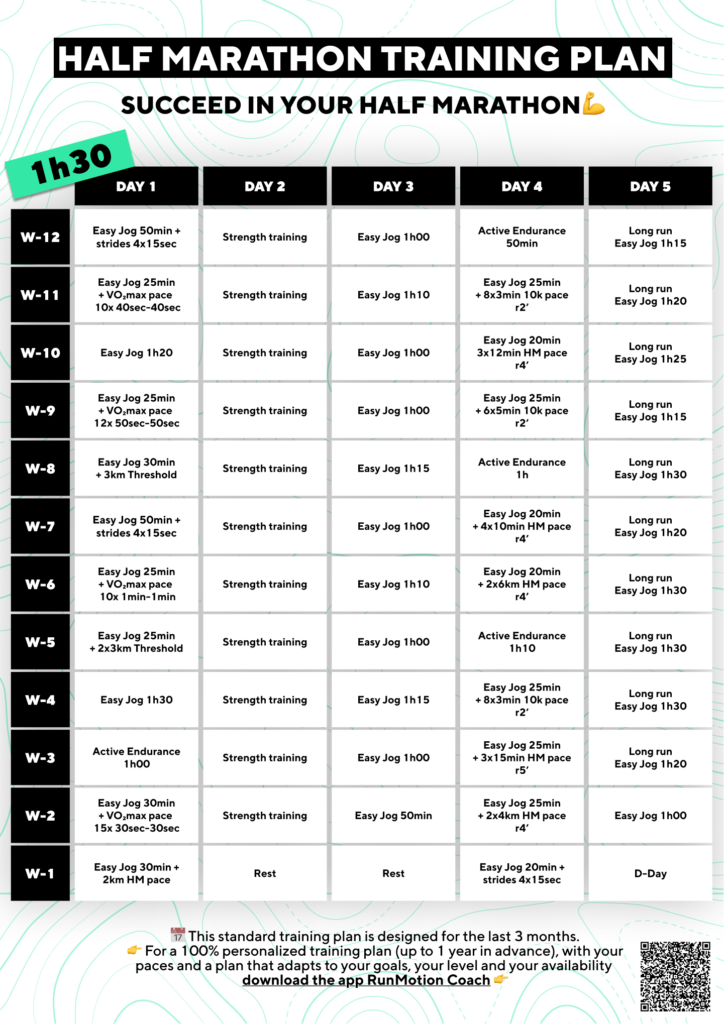
The goal is not to execute every session perfectly, but to stay consistent throughout the training block. Missing a few workouts will have little impact. What really makes the difference is putting together week after week of smart, consistent training.
How should you pace yourself on race day?
Success in the half marathon is not only about training. Race execution also plays a key role.
Over the first few kilometers, the atmosphere and adrenaline often make your goal pace feel easy. That is exactly when you need to stay patient.
Starting too fast is one of the most common mistakes. Gaining a few seconds per kilometer early in the race can cost you several minutes over the second half of the course.
Ideally, stay close to your target pace through the first 15 kilometers. If you still feel good in the closing kilometers, you can always gradually speed up, or even run a negative split.
Nutrition and hydration, do not neglect them
Even though a half marathon lasts less time than a marathon, nutrition still matters.
In the weeks leading up to the race, focus on a balanced diet and make sure you recover well after your toughest sessions.
On race day, stick to what you know. Avoid last-minute experimentation, whether it is breakfast or the energy products you use during the effort.
The long runs completed during your training block are the perfect opportunity to test your nutrition strategy.
Mistakes that often stop runners from breaking 1:30
The first mistake is running every workout too fast. Many runners think they will improve more by pushing hard all the time. In reality, this often creates excessive fatigue and limits physiological adaptations.
Another common mistake is neglecting long runs. Yet they are an essential part of half marathon preparation.
Finally, some runners try to make up for a missed session by adding extra volume or intensity over the following days. That strategy rarely leads to good results. It is better to simply get back to the planned schedule.
Why follow a personalized training plan?
Every runner has different constraints. Some have four or five training slots each week, while others have to work around a busy schedule.
Your starting level, sporting background, injury history, and intermediate goals also influence your preparation.
That is why a personalized plan usually delivers better results than a generic one. It adapts each workout to your profile and your progress throughout the build.
With RunMotion Coach, your plan automatically adapts to your availability, the workouts you complete, and your race goal. Download the RunMotion Coach app to get your personalized half marathon training plan.
FAQ, 1:30 half marathon training plan
What 10K time do you need to target a 1:30 half marathon?
Most runners capable of running a 1:30 half marathon record a 10K between 40 and 42 minutes.
Can you run a 1:30 half marathon with only three sessions per week?
Yes, it is possible for an already experienced runner. However, four weekly sessions generally make the preparation more comfortable.
What vVO2max do you need to run a 1:30 half marathon?
A vVO2max between 17 and 18 km/h is often a good foundation for reaching this goal.
How many kilometers should you run each week?
Most runners prepare for a 1:30 half marathon with a weekly volume of 40 to 60 kilometers.
What pace do you need to hold to finish a 1:30 half marathon?
To cross the finish line in 1:30, you need to maintain an average pace of 4:16 per kilometer over the full 21.1 kilometers.