
Running a 10K in 40 minutes is a goal many runners dream about. Holding 15 km/h for 10 kilometers takes serious preparation, consistency, and a solid understanding of your body.
If you’re chasing this goal, you’ve probably been running for a few years already, or you’ve put down some strong results over 5K or the half marathon. The good news is that breaking 40 minutes is still realistic for many amateur runners, as long as you follow a smart, adapted training plan.
Here’s how to build your training and stack the odds in your favor to break that iconic barrier.
Contents
- Running a 10K in 40 minutes, what pace do you need to hold?
- What level do you need before aiming for 40 minutes?
- Why is the 40-minute barrier such a big deal?
- Key qualities to build to run a 10K in 40 minutes
- How many sessions per week?
- Example weekly structure
- Most common mistakes
- What strategy should you use on race day?
- Strength training and injury prevention
- Prepare your sub-40 goal with RunMotion Coach
- FAQ: 10K sub-40 training plan
Running a 10K in 40 minutes, what pace do you need to hold?
To finish a 10K in under 40 minutes, you need to average 4:00 per km from start to finish. That’s 15 km/h, or about 6:26 per mile.
On paper, 4:00/km can feel pretty close to 4:10 or 4:15. But over 10 kilometers, that gap is massive. Every second you shave off requires targeted work and a gradual improvement in your physiological capacity.
So the goal of training is to make this pace feel more and more natural, so you can lock it in without instantly going into the red.
What level do you need before aiming for 40 minutes?
The sub-40 goal is generally aimed at already experienced runners.
If you’re currently running 10K in 41 to 44 minutes, the goal is a natural next step. A 5K time under 20 minutes is also a good indicator, and ideally under 19 minutes. Likewise, runners who can race a half marathon around 1:28 to 1:35 often have the potential to go after this milestone.
But don’t try to skip steps. It’s better to move progressively from 45 to 43, then 41 minutes before targeting 39, rather than trying to drop five minutes overnight. That’s how you build lasting fitness and avoid blowing up your training.
Why is the 40-minute barrier such a big deal?
At this performance level, your margin for error shrinks fast. Poor recovery, an incomplete build-up, or going out too hard can quickly ruin the attempt.
Your ability to sustain an effort close to threshold for forty minutes becomes decisive. Speed work still matters, but 10K-specific endurance plays a central role in getting it done.
This is often the moment when runners truly feel the value of structuring training around different intensity zones to boost endurance performance.
Key qualities to build to run a 10K in 40 minutes
Aerobic base training is still the foundation. Even with an ambitious time goal, a large part of your training should be done at an easy pace. This base lets you build volume without piling on excessive fatigue. It also improves cardiovascular efficiency and helps you recover between hard workouts.
Developing your anaerobic threshold also becomes especially important. Workouts run slightly slower than 10K race pace improve your ability to sustain a hard effort for a long time.
Finally, 10K-specific sessions are the heart of the build. They teach your body to handle 4:00/km pace step by step, and they build the confidence you’ll need on race day.
How many sessions per week?
To seriously target sub-40, four sessions per week are usually a strong baseline. Three sessions can work for some very consistent runners, or naturally fast profiles, but most runners will progress more with four well-spaced workouts.
The point isn’t just adding mileage. That extra session also helps active recovery and allows you to increase training load progressively without making every workout brutally hard.
Example weekly structure
A typical week can be built around four complementary sessions.
The first session focuses on easy endurance with a 50 to 60-minute run.
The second session targets vVO2max development. For example, sets like 10 to 12 repeats of 400 meters, or 8 repeats of 500 meters.
The third session directly targets 10K race pace. Workouts like 5 x 1000 m, 4 x 2000 m, or 3 x 3000 m help you progressively match the demands of the race. You can also alternate with threshold sessions using blocks of several minutes at a strong but controlled pace.
Finally, strength training is really valuable if you want a more efficient stride and better running economy.
All together, this creates the right balance between speed, endurance, and recovery.
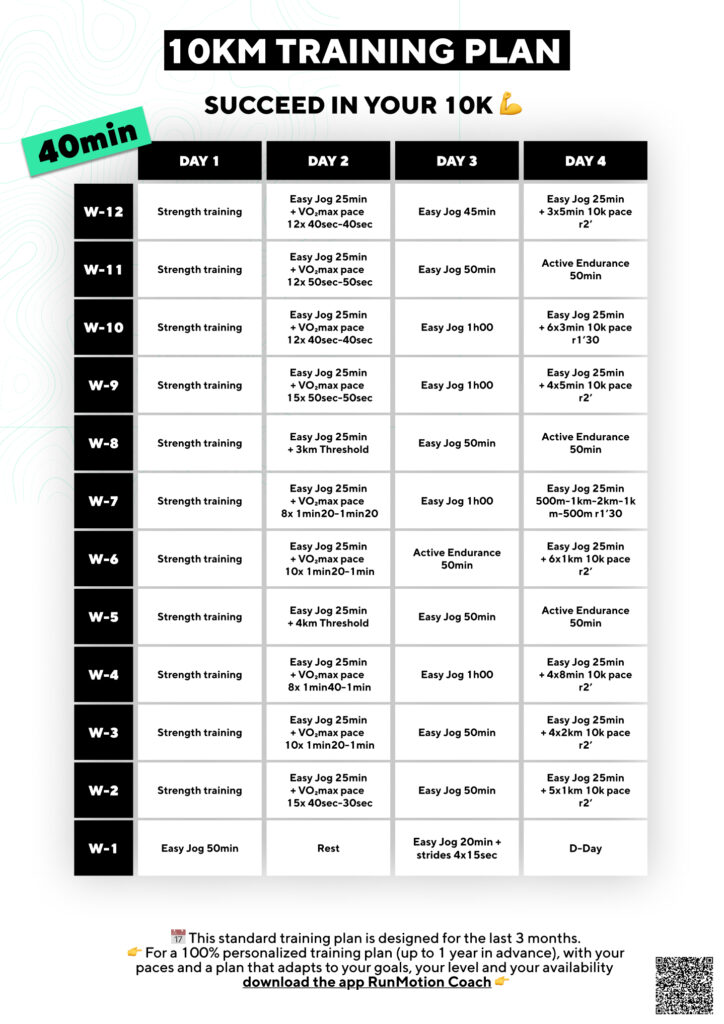
Here’s an excerpt from your 12-week 10K sub-40 training plan (you’ll find it below):
Week 1
Session 1: Strength training
Session 2: Easy endurance 25 min + vVO2max 12×40/40 sec
Session 3: Easy endurance 45 min
Session 4: Easy endurance 25 min + 3×5 min at 10K pace (rest 2 min)
Week 7
Session 1: Strength training
Session 2: Easy endurance 25 min + vVO2max 10 x 1min20 / 1min
Session 3: Steady endurance 50 min
Session 4: Easy endurance 25 min + 6 x 1 km at 10K pace (rest 2 min)
Week 10
Session 1: Strength training
Session 2: Easy endurance 25 min + vVO2max 10 x 1min20 / 1min
Session 3: Easy endurance 50 min
Session 4: Easy endurance 50 min + 4 x 2 km at 10K pace (rest 2 min)
Most common mistakes
The first mistake is turning every run into a hard workout. A lot of runners think you have to run fast to improve fast. In reality, progress comes from alternating hard sessions and easy sessions. Easy runs are what let you absorb training load and keep improving.
Another common mistake is neglecting race-specific work, doing lots of short intervals but very few sessions close to 10K pace. Yet on race day, that’s the exact pace you’ll need to hold for forty minutes.
Finally, some runners forget how crucial recovery is. At this level, recovery is a performance factor in its own right.
What strategy should you use on race day?
For a 40-minute 10K goal, every kilometer matters. Your start has to be controlled. Going out at 3:45/km because your legs feel great is often a mistake that’s hard to fix later.
The ideal approach is to settle in quickly around 3:55/km to 4:00/km and keep that steady rhythm until kilometer seven or eight.
If you’re feeling good at that point, you can gradually accelerate to grab the final seconds that push your time under 40 minutes.
Race execution is often what separates a runner who clocks 40:20 from one who crosses the line in 39:50.
Strength training and injury prevention
The more ambitious the goal, the more stress your body has to handle. Strength training helps improve running economy, stability, and fatigue resistance. It also lowers the risk of injuries linked to increasing volume or training intensity.
One to two weekly sessions of core work, leg strengthening, and mobility training can bring real benefits over the long term.
Prepare your sub-40 goal with RunMotion Coach
Breaking 40 minutes requires preparation that matches your profile and your current level. Every runner has different strengths and areas to improve.
With RunMotion Coach, your training plan adapts to your schedule, your experience, and your progress. Sessions evolve week after week to help you reach your goal in the best possible conditions.
With consistency, patience, and structured training, the 40-minute barrier can become reality at your next 10K.
FAQ: 10K sub-40 training plan
What pace do you need to hold?
A 40-minute 10K requires an average pace of 4:00 per kilometer, about 6:26 per mile. It’s an ambitious target that takes months, sometimes years, of progression for many runners. The key is consistent training.
What vVO2max is usually needed to aim for 40 minutes in the 10K?
A vVO2max close to 18 km/h is often associated with this performance level. That said, 10K-specific endurance and your ability to sustain a hard effort are still decisive. A well-structured training plan helps you maximize your potential.
What 5K time suggests you can break 40 minutes?
A 5K time around 19 minutes is usually a strong indicator that sub-40 in the 10K is within reach. It’s a practical benchmark to confirm your base speed is high enough for the goal.
Which interval workouts are most effective to reach this goal?
Interval sessions like 400 m, 800 m, or 1000 m repeats, run at paces close to your target, are especially effective. They improve speed, running economy, and fatigue resistance. These workouts should be added progressively within your 10K training plan.
How do you optimize your taper before the race?
The taper is about gradually reducing training volume in the days leading up to the race. It helps you arrive physically fresh while keeping the fitness gains from your training block. A well-executed taper can make a significant difference in performance.