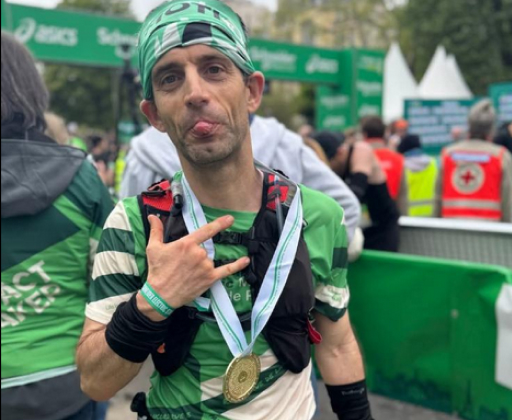
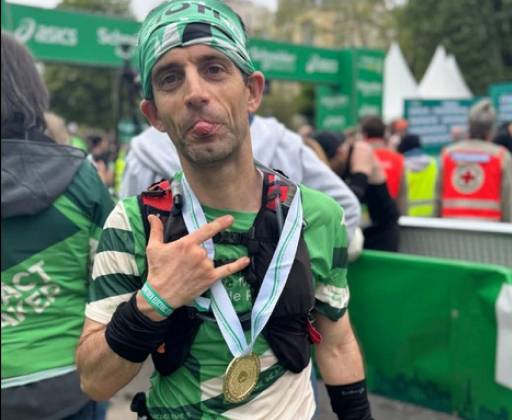
A few days ago, Eric toed the start line of the Paris Marathon 2025 with one goal in mind and his motivation fully intact. Living with ankylosing spondylitis, an inflammatory disease that affects the joints, Eric keeps running despite pain, limitations, and real risks. Once again, he took on this challenge head-on, with grit and determination. After several marathons, trail races, and half marathons, he looks back on his Paris experience today, his race-day feelings, and what it truly means to keep running when no one expects you to.
How did this goal go?
I had a marathon PR of 3:32 from the Saint-Denis Marathon on October 27, so I jumped into a 3:20 training plan. I honestly wasn’t sure I could improve that time. It was my second marathon, I ran my first one in Paris in 2023. Back then, I was 6 kg lighter, and that extra weight this year held me back a bit, even though I still improved by one minute. My real goal was to feel comfortable and run 3:30 this year. In the end, I absolutely crushed that target, I ran on April 13 in 3:16:47 on my watch, 3:17:32 officially.
Everything felt like a dream. The moment I stepped into the start corral, I felt a surge of excitement mixed with a tiny bit of pressure because I really wanted to nail it. I was bouncing in place, slapping my thighs, like a live wire. My buddies teased me and told me to relax. But it wasn’t stress, it was just that hunger to take on those 42 km.
Then at the start, I ended up right behind the rope, the Champs-Élysées felt like it was mine alone. My friends thought I’d go out way too hard. But knowing I tend to start too fast because of the opening-race buzz, I surprisingly stayed fully in control, and I think that was the right strategy.
All race long, the crowd support and the music spots on the course carried me. I managed to hold a pace between 4:20 and 4:45 per km the whole way. I also had a hydration and fueling strategy, one sip of electrolytes every 10 minutes, and a chew or a sip of gel every 30 minutes. I never felt a real dip in energy.
Throughout the race, I didn’t have any real doubts, except around the 5th kilometer. We had “planned” to meet up on the course with my wife, my daughter, and a Paris-based colleague around km 5 and km 27. But between km 5 and 6, no matter how much I scanned the crowd, I saw no one. I wanted to see them so badly that at one point I drifted toward someone with the same hairstyle as my partner. Luckily, I realized my mistake before making a fool of myself.
At the finish, I found out my colleague had stayed in the countryside for the weekend, and my girls had trouble with transport. But the km 27 plan worked perfectly, seeing them on the roadside gave me a real boost. Those few seconds recharged my batteries.
I told myself that if my legs were there, I’d try to push from the 40th kilometer. And then a kind of “miracle” happened, in the middle of the crowd noise, I heard my nickname. I turned around, didn’t recognize anyone, but it was Nath and Swany who had managed to get close to the finish. Even though I didn’t actually spot them, I accelerated. I ran km 40 in 4:20, km 41 in 4:14, and I crossed the finish line under 4:00 per km.
The finish was the perfect ending. The time was the cherry on top of an amazing weekend built around this race: the “Paris-Run-For-All” solidarity event on Saturday morning with an incredible vibe, the photo shoots on the Champs de Mars and at the running expo with the #SEgreenrunner ambassadors, the great conversations on the stands at Run Expérience (especially chatting with Romain at the RunMotion stand), everything we lived as ambassadors. I’m going to be dreaming about it for a long time.
How did you handle the build-up to this goal?
When I signed up for this race, I was a bit late, so I filled out an online questionnaire on Schneider Electric’s social media to try to become an ambassador and potentially get a bib. Not really believing in it, I also went for a charity bib by supporting an association. As I was getting close to the minimum fundraising amount to secure the bib, I got the huge surprise of being chosen as a #SEgreenrunner ambassador for the marathon. My unusual profile, I live with an invisible disability, ankylosing spondylitis, interested them.
I joined an amazing team that pushed me throughout my marathon training block. On top of that, since I was sharing my training on social media, a journalist noticed my profile and wrote an article about me that was published in the Journal du Runner right before the Paris Marathon. It’s a testimonial about my running despite a disease affecting my lower back and sacroiliac joints.
This training block lasted 15 weeks, mixing treadmill sessions at the gym, indoor cycling sessions (RPM and Sprint classes), outdoor runs on weekends, strength training (TRX and circuit training at the gym, plus solo sessions at home), and stretching every morning where I work for 35 to 45 minutes. In total, in a typical week, I had 5 running sessions, 2 cycling sessions, 3 strength sessions, and 5 stretching sessions. The plan didn’t call for that many sessions, but I chose to run a calorie deficit at the same time to reach my race weight.
I also added two half marathons in March, the Villepinte Half Marathon and the Saint-Witz Half Marathon. Even though I wanted to run them controlled, I managed to improve my times in both races, and I even set a new half marathon PR at 1:32.
After those two races, probably from fatigue, things felt less easy in the following weeks, and I had to cut one long run short. I got lost on a new route and for once my mind said stop. It only took a few seconds for me to call my wife to come pick me up. After a small week of doubts, the good sensations came back, and I was even surprised by how strong they were: my last marathon-pace sessions were faster than the goal, with an HR lower than the target. Even though I was thrilled, I kept telling myself to stay attentive to my sensations at the start.
What motivates you to run?
I run for several reasons. First, physical activity helps me a lot day to day because it reduces the stiffness caused by my disease. Even if doctors don’t always highlight it, running triggers endorphins for me, which helps me avoid taking anti-inflammatories every day to manage the pain linked to my condition.
I also run to show that a physical disability doesn’t stop you from having ambitious sports dreams, like running a marathon.
And yet, when I was younger and played as a goalkeeper, I hated running. I got into running almost by chance and as a personal challenge a while back. In fact, when I started sharing my training and races, my former teammates and coaches thought my posts were fake. I learned to love running as I trained more and more.
I also run to show the people who used to call me “the chubby kid” and made fun of my physical abilities that I’m not as hopeless as they thought. Yes, you can be almost 50 and still improve race after race, and aim to run a sub-3-hour marathon soon. Right now the progress is heading that way, but I’ve got to stay humble and take it step by step.
How did you discover the RunMotion Coach app?
I discovered the RunMotion Coach app a while ago. I tested it, then my “tech-lover” side made me want to try other apps. I trained for a marathon with a competitor app, and I bet on coming back to RunMotion to compare. Turns out I made the right call, given my 16-minute improvement over the marathon distance.
What encouraged you to download and test the app?
I started with your app because I kept seeing ads in specialized magazines.
What do you like most about the app? (Personalization, coach choice, design…)
The app is really packed with features.
The first super useful feature in the paid version is how easy it is to export workouts to my Garmin watch.
Then I like how precisely you can personalize the plans. It supports different race formats, since I’m both a trail runner and a road runner. The post-workout feedback is also great advice to keep improving. Even though I haven’t used them, I’m a gym member, and the strength training programs with video tutorials look very interesting.
The recent addition of the RunMotion community is also a great way to create motivation and encourage exchanges between us amateur athletes.
What’s your next sports challenge?
Now, one week after the marathon, I’m starting a new training block for a 35 km trail with 500 m of elevation gain on June 8, the Trail du Pays de l’Ourcq.
On June 1, I’ll race a 10 km close to home, Les Foulées de Saint-Pathus.
I’m also planning to enter La Nanteuillaise, a 21 km nature race on September 7.
Finally, I think I’ll also sign up for the 30 km race with 800 m of elevation gain at the Trail du Soldat de la Marne, which should take place on October 5. In between, it’s possible I’ll jump into other races too.
Thank you, Eric, for your inspiring story and your mental toughness. Congrats on this new performance, on your perseverance, and on continuing to run despite the obstacles. A powerful example of determination that earns huge respect.