Breaking 50 minutes for 10K is a major milestone for many runners. It means holding an average pace of 5:00 per kilometer from the gun to the finish line.
In this article, you’ll learn how to build toward your goal, which key workouts to prioritize, and how to stack the odds in your favor for your next race.
Contents
- Running a 10K in 50 minutes, what pace should you target?
- What fitness level do you need to aim for 50 minutes?
- How long do you need to train for a 50-minute 10K?
- Example 50-minute 10K training plan
- How to manage your pace on race day?
- Why strength training matters
- Don’t neglect recovery
- Train for your 10K with a personalized plan
- FAQ: 50-minute 10K training plan
Running a 10K in 50 minutes, what pace should you target?
To finish a 10K in 50 minutes, you need to hold a steady 5:00 min/km pace, which equals an average speed of 12 km/h.
On paper, that pace can look manageable. The real challenge is being able to sustain it for all 10 kilometers. The first kilometers often feel easy when you’re fresh, but effort management gets trickier from kilometer six or seven.
Your training goal is to build both your endurance, your cardiovascular fitness, and your ability to lock into that specific pace even when fatigue hits.
Estimate your next 10K time, plus your vVO2max and endurance with our calculator.
What fitness level do you need to aim for 50 minutes?
The 50-minute goal is usually within reach for a runner who has been training consistently for a few months.
If you’re already running two to three times per week and you can comfortably string together an hour-long run, you’ve got a solid base. Likewise, a 5K time between 23 and 25 minutes is often a strong indicator that you can break 50 minutes for 10K with the right training.
You don’t need to be an elite profile to get there. Consistency matters far more than natural talent.
How long do you need to train for a 50-minute 10K?
The ideal build-up depends on your current fitness. For a runner who already trains regularly, eight weeks can be enough to prepare effectively for a 50-minute 10K. If you’re new to running or coming back after time off, a ten to twelve week plan is often a better fit.
The goal is not to pile up as many kilometers as possible, but to build progressively the specific qualities you need to succeed. Keep the progression sensible to reduce injury risk and to keep running enjoyable.
Example 50-minute 10K training plan
A build based on 3 sessions per week works perfectly for most runners.
The first session is usually dedicated to easy endurance running. A 45 to 60 minute easy run develops your aerobic base while supporting recovery.
The second session focuses on speed development. For example, you can run intervals of 400 to 1000 meters faster than your goal pace. These workouts are tough, but highly effective for improving running performance and overall fitness.
The third session is often centered on race-pace work. The goal is to run several reps at 5:00 min/km so that this pace gradually feels natural.
Week after week, volume increases slightly, then you taper in the final days before race day.
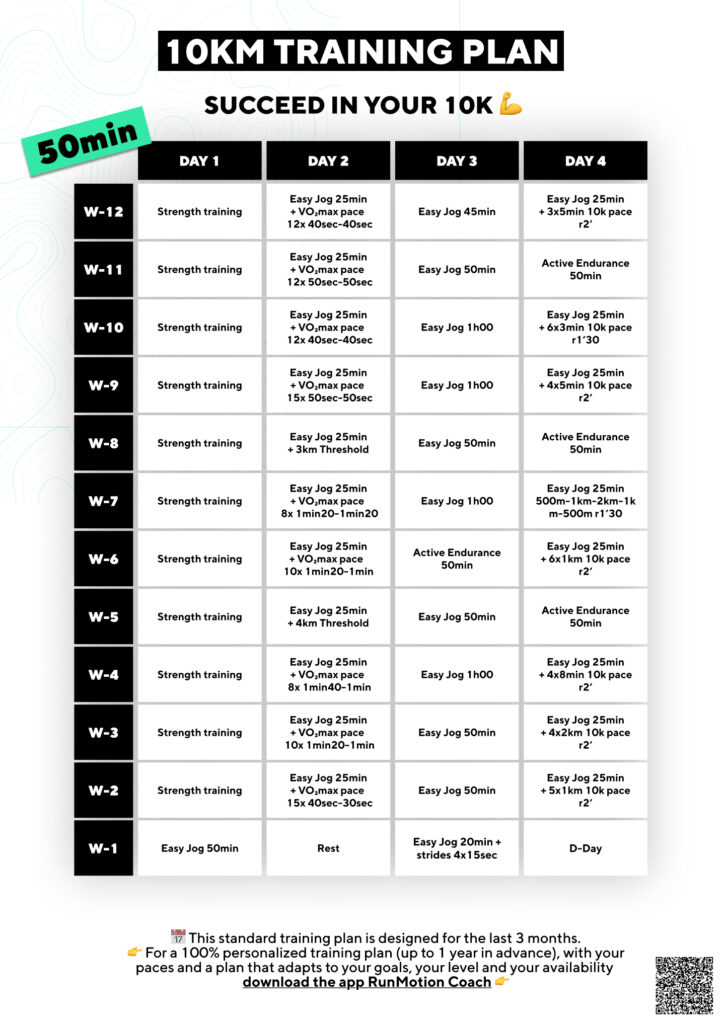
Here’s an excerpt from your 12-week 50-minute 10K training plan (available below):
Week 1
Session 1: Strength training
Session 2: Easy endurance 25 min + vVO2max 12×40 sec hard / 40 sec easy
Session 3: Easy endurance 45 min
Session 4: Easy endurance 25 min + 3×5 min at 10K pace (rest 2 min)
Week 7
Session 1: Strength training
Session 2: Easy endurance 25 min + vVO2max 10 x 1 min 20 / 1 min
Session 3: Steady endurance 50 min
Session 4: Easy endurance 25 min + 6 x 1 km at 10K pace (rest 2 min)
Week 10
Session 1: Strength training
Session 2: Easy endurance 25 min + vVO2max 10 x 1 min 20 / 1 min
Session 3: Easy endurance 50 min
Session 4: Easy endurance 50 min + 4 x 2 km at 10K pace (rest 2 min)
How to manage your pace on race day?
One of the most common mistakes is starting too fast because of pre-race excitement. When the gun goes off, the pace can feel effortless and you end up running a few seconds quicker per kilometer. It seems harmless, but it can be brutally expensive in the final kilometers.
Try to stay close to your target pace from the first few hundred meters. Hitting roughly 25 minutes at the 5K mark is usually an excellent checkpoint.
If you’ve managed your effort well, you’ll be able to pick it up slightly over the last two kilometers and really enjoy your finish.
Why strength training matters
Many runners focus only on running workouts and overlook strength work.
Still, a few exercises each week can make a real difference. Core stability, squats, lunges, and balance work can improve running economy and reduce injury risk. Two short sessions per week, around 15 to 20 minutes, are often enough to notice benefits.
Don’t neglect recovery
Progress doesn’t happen during workouts, it happens during the recovery that follows.
Quality sleep, balanced nutrition, and solid hydration all directly support your running performance. Rest days are part of the training plan, they’re not wasted time.
Train for your 10K with a personalized plan
Every runner has a unique background, schedule constraints, and training history. A standard plan is a great starting point, but it doesn’t account for your calendar, your availability, or your sports experience.
With RunMotion Coach, you get a personalized training plan that adapts to your level, your goal, and your progress. The app adjusts sessions based on your fitness and guides you all the way to the finish line.
Download the RunMotion Coach app to get your personalized 10K training plan.
So, ready to break 50 minutes for 10K?
FAQ: 50-minute 10K training plan
What pace per kilometer do you need to run 10K in 50 minutes?
A 50-minute 10K equals an average pace of 5:00 per kilometer. This pace already requires consistent running training. The plan’s race-pace sessions teach you how to hold that rhythm more comfortably.
What vVO2max is usually needed?
A vVO2max around 14 to 15 km/h is often seen in runners who can hit this goal. That said, performance also depends on endurance and your ability to sustain a high percentage of your vVO2max on race day. Smart training can compensate for a slightly lower vVO2max.
What 5K time suggests you can run 50 minutes for 10K?
A 5K time close to 24 minutes is generally a good indicator for aiming at 50 minutes over 10K. It helps estimate your potential on a shorter distance. Then, the specific endurance work lets you transfer that fitness to the full 10 kilometers.
How should you structure your training weeks?
A balanced week typically includes an easy endurance run, one quality session, and a longer run. This structure develops all the key qualities needed for performance. Recovery also remains a crucial part of improvement.
What are the most common mistakes?
The most frequent mistakes include starting too fast, not recovering enough, or increasing training load too aggressively. These errors can stall progress and raise injury risk. A gradual approach is still the best strategy.