Running a 10K in 1 hour is often the first big goal beginner runners set for themselves. It’s an achievable challenge that gives purpose to your training and helps you improve in a structured way. Whether you’re lining up for your first 10K or you want to beat a previous time, breaking the 60-minute barrier is a fantastic milestone in your running journey.
To hit this goal, you’ll need to hold an average pace of 6:00 per kilometer throughout the race, that’s a steady 10 km/h. It can feel easy for a couple of kilometers, but keeping it going for the full 10K takes the right preparation. With consistency, a few weeks of smart training, and solid pacing on race day, this is within reach for a lot of runners.
Contents
- Running a 10K in 1 hour: what pace do you need?
- Who is this goal for?
- How long does it take to train for a 10K in 1 hour?
- The foundations of an effective training plan
- How many sessions per week should you plan?
- Example of a weekly structure
- Do you need interval training?
- How to pace yourself on race day
- Why recovery matters
- Can strength training help?
- Train for your 10K with RunMotion Coach
- FAQ: 10K training plan for 1:00:00
Running a 10K in 1 hour: what pace do you need?
To finish a 10K in exactly 1 hour, you need to average 6:00 min/km. That pace equals a speed of 10 km/h.
For many runners, it’s a comfortable rhythm for a few minutes, but it becomes more demanding when you have to sustain it for a full hour.
The goal of your training block is to build endurance so this pace gradually feels natural, until running at 10 km/h no longer feels like you’re forcing it.
Who is this goal for?
The 60-minute 10K goal is mainly aimed at beginner runners or people returning to running after a few years away.
If you can already run 40 to 50 minutes without stopping, you’ve got a solid base to train for a sub-1-hour 10K. You don’t need to be exceptionally fast or an elite athlete. What matters most is training consistency.
Plenty of runners hit this goal in their very first season. With two to three runs per week, progress can come quickly.
How long does it take to train for a 10K in 1 hour?
In general, an eight to twelve week training plan is enough. If you already run regularly, eight weeks is often plenty to be ready on race day. If you’re starting from scratch or still mixing run and walk, it’s smart to allow a few extra weeks to steadily build your aerobic endurance.
The key is not trying to rush it. Running progress comes from stacking consistent training weeks, not from a handful of brutally hard workouts.
The foundations of an effective training plan
When you’re aiming for a 1-hour 10K, the priority isn’t high-intensity intervals every week or complicated sessions. The main quality to develop is endurance. The better you get at running longer at an easy intensity, the easier it becomes to hold your target pace on race day.
That’s why comfortable easy runs are the base of your training. They allow your heart, muscles, and breathing system to adapt gradually to the effort, and they teach your brain what this pace and effort feel like.
Then, a few slightly faster sessions complete the build-up. They help improve your running form, cardiovascular fitness, and confidence when you step on the gas.
How many sessions per week should you plan?
Three runs per week is an excellent sweet spot for most runners. It’s frequent enough to improve while still leaving plenty of time to recover. It also fits more easily into a busy schedule.
A typical week can revolve around an easy endurance run, one more dynamic workout, and a longer run on the weekend. If you can only run twice per week, you can still make progress.
Example of a weekly structure
Your first session can be a 45-minute easy run at a comfortable pace. You should be able to chat for the whole run without getting out of breath.
The second session can include a few pick-ups or short fast repeats to gradually develop speed and running efficiency without creating too much fatigue.
The third session is usually a longer run, between 55 minutes and 1 hour 15 depending on your level. This is the session that most builds your aerobic base and your ability to sustain an effort over time.
As the weeks go by, the difficulty increases gradually while staying manageable.
Do you need interval training?
Yes, but in moderation.
For beginner runners, intervals should stay simple and fun. A few 30-second fast reps followed by recovery already bring real benefits.
The goal isn’t to crush yourself with brutal workouts. It’s mainly about learning to change pace and gradually improving your cardiovascular fitness.
The most important sessions are still your easy runs and your long runs.
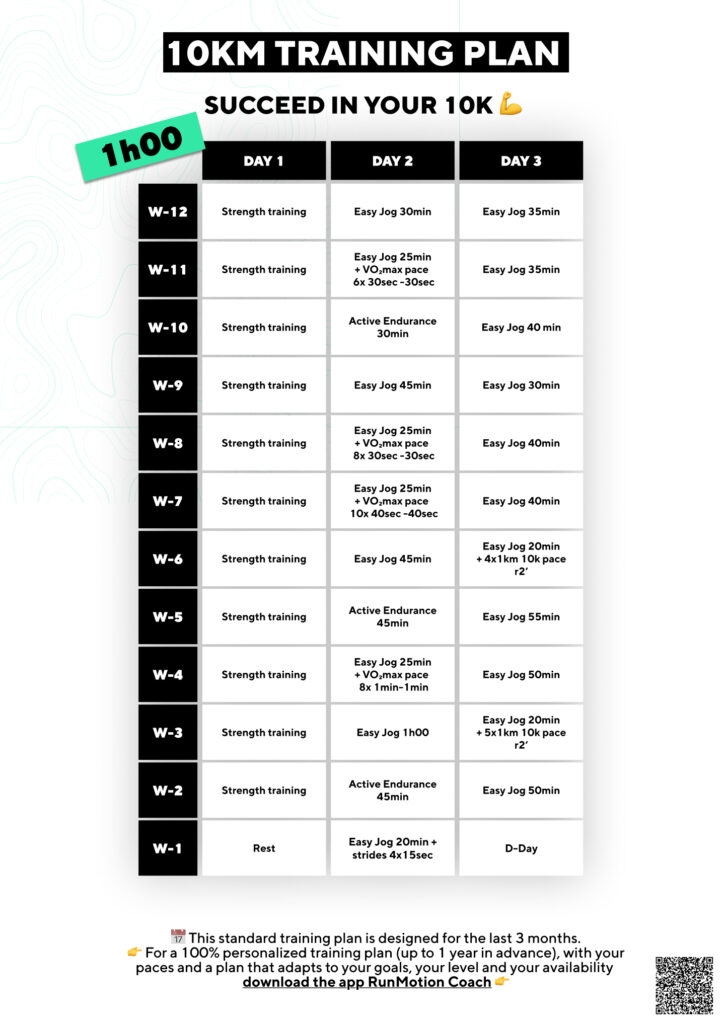
Here’s an excerpt from your 12-week 10K training plan for 1 hour (full plan below):
Week 1
Session 1: Strength training
Session 2: Easy endurance 30 min
Session 3: Easy endurance 35 min
Week 7
Session 1: Strength training
Session 2: Easy endurance 45 min
Session 3: Steady endurance 20 min + 4×1 km at 10K pace (2 min recovery)
Week 10
Session 1: Strength training
Session 2: Easy endurance 1h
Session 3: Steady endurance 20 min + 5×1 km at 10K pace (2 min recovery)
How to pace yourself on race day
One of the most common mistakes is starting too fast. With the excitement of the start line, it’s easy to run the first kilometers quicker than planned. But that approach often leads to a big pace drop in the second half of the race.
Try to lock into your target pace quickly around 6:00 min/km. If you hit the 5K mark in about 30 minutes, you’re perfectly on track. From the 8th kilometer onward, if you still feel strong, you can gradually speed up all the way to the finish.
A well-paced race almost always feels far more enjoyable than an overly ambitious start.
Why recovery matters
Rest days are a real part of your training plan.
Training places stress on your body. It’s during recovery that your body rebuilds and gets fitter. Neglecting sleep or trying to run every day can slow your progress and increase injury risk.
Listen to how you feel. If unusual fatigue shows up, it can be smarter to swap a session for rest or a gentler activity.
Can strength training help?
Absolutely. Even a few minutes of strength training per week can make running feel smoother. Simple exercises like planks, squats, or lunges strengthen your legs and core. You’ll gain stability, improve running economy, and lower your risk of injury.
No need to spend hours in the gym, fifteen to twenty minutes twice a week is more than enough.
Train for your 10K with RunMotion Coach
Every runner improves at their own pace. Some need more endurance, others need to build speed or consistency.
With RunMotion Coach, you get a personalized training plan that adapts to your level, experience, and availability. Sessions evolve with your progress so you can reach your goal in the best conditions.
Whether you want to finish your first 10K or break 60 minutes, a progressive plan built around endurance, pacing, and smart workouts will help you cross the finish line with a smile.
Download the RunMotion Coach app to get your personalized 10K training plan.
So, ready to take on the 1-hour 10K challenge?
FAQ: 10K training plan for 1:00:00
What average pace equals a 1-hour 10K?
To run 10K in 1 hour, you need to hold an average pace of 6:00 minutes per kilometer. This goal is achievable for many beginner runners or those getting back into running. Regular aerobic base training makes this pace feel more and more comfortable as the weeks go by.
How do you break the symbolic 1-hour barrier?
Breaking 60 minutes usually requires consistent, progressive running training. Adding interval workouts or specific 10K pace sessions can speed up improvement. Smart pacing on race day also plays a major role in reaching this target time.
What level should you have before following this training plan?
It’s recommended that you can run at least 45 minutes continuously before starting a specific 10K training block. This helps you handle the workouts in good conditions and reduces injury risk. Even with limited experience, this goal is still achievable with consistency.
How many weekly sessions do you need to aim for 1 hour?
Three sessions per week are usually a good balance between performance gains and recovery. It lets you include different types of training while giving your body enough time to absorb the work. Two runs per week can also be enough for some beginner profiles.
Which workouts help you get faster?
Interval training, 10K-specific pace workouts, and progressive accelerations are especially effective for building speed. Combined with consistent endurance training, they improve running economy and help you maintain a faster pace across the full 10 kilometers.