
Breaking 45 minutes for a 10K is a seriously motivating goal. For many runners, it’s the moment you step up from “running now and then” to a more consistent and structured training routine. Running a 10K in 45 minutes means holding an average pace of 4:30 per kilometer (about 7:14 per mile), which requires building your endurance, your speed, and your ability to sustain a strong effort for nearly three quarters of an hour.
The good news is that this target is within reach for a lot of runners with a few months of focused training and a well-built plan. If you already run regularly and want to level up, this article will help you prepare for your next 10K race.
Contents
- Running a 10K in 45 minutes: what pace should you aim for?
- Do you have the level to target 45 minutes?
- Why is 45 minutes such a big milestone?
- The most important workouts to reach your goal
- How many sessions per week?
- Example of a weekly structure
- How should you manage your pace on race day?
- Strength training: an often underrated ally
- Recovery is part of training
- Train for your 10K goal with RunMotion Coach
- FAQ: 10K training plan for 45 minutes
Running a 10K in 45 minutes: what pace should you aim for?
To finish a 10K in 45 minutes, you need to maintain an average pace of 4:30 per kilometer, which is around 13.3 km/h.
This pace should feel like a hard but controlled effort. In a well-prepared 10K, you want to feel switched on from the gun without immediately redlining. The challenge is finding the sweet spot between ambition and smart pacing.
The goal of your training block is to make this pace progressively more comfortable, so you can hold it from kilometer one to kilometer ten.
Do you have the level to target 45 minutes?
There’s no absolute rule, but a few benchmarks can help you see if this goal makes sense. If you already run three times per week and can run a 5K in around 21 to 22 minutes, you usually have the key qualities to start aiming for 45 minutes. Likewise, a half marathon between 1:40 and 1:50 is often a solid foundation.
Of course, every runner is different. Some naturally have more speed, others more endurance. What matters most is building a progression that fits your current level rather than comparing yourself to everyone else.
Why is 45 minutes such a big milestone?
At this performance level, training becomes more specific. Easy mileage is still essential, but it’s no longer enough on its own to keep improving.
To keep dropping your 10K time, you need to develop several physiological qualities in parallel. Your endurance has to carry a high effort for the entire race. Your cardiovascular system needs to deliver enough oxygen to working muscles. Finally, your running economy must become more efficient so each stride costs less energy.
The most important workouts to reach your goal
The foundation of your training is the easy run. Even when your goal is to run faster, a large share of your weekly kilometers should be done at a comfortable pace. These sessions improve recovery, strengthen aerobic adaptations, and help you build volume without excessive fatigue.
Interval training is also a key piece of the puzzle. Workouts made of short to mid-length reps help improve your vVO2max speed and your ability to sustain hard efforts. Over the weeks, you can rotate sessions like 400 m, 800 m, or 1,000 m repeats.
10K race-pace sessions are probably the best indicator of your progress. The idea is to run several repeats at your target pace of 4:30/km. The easier this pace feels in training, the closer you are to going under 45 on race day.
How many sessions per week?
To aim for 45 minutes, three weekly sessions are a sensible minimum. With that frequency, you can already make big improvements in 10K performance.
If your schedule allows it, a fourth run often adds an extra boost. It helps you gradually increase training volume while still keeping enough recovery.
The most common mistake is trying to do too much. Three consistent sessions every week for several months beats an overload phase followed by injury or a loss of motivation.
Example of a weekly structure
A typical week can be built around three complementary pillars.
The first session focuses on the easy run with 45 to 60 minutes at a comfortable pace. This run develops your aerobic base and gets your body ready for tougher workouts.
The second session targets speed development. Depending on your training phase, it might look like 10 x 400 m, 8 x 500 m, or 6 x 800 m.
The third session works your specific 10K pace. For example, you can do 3 x 2,000 m or 2 x 3,000 m at 4:30/km with short recovery between reps.
Week after week, these workouts gradually build the fitness you’ll need on race day.
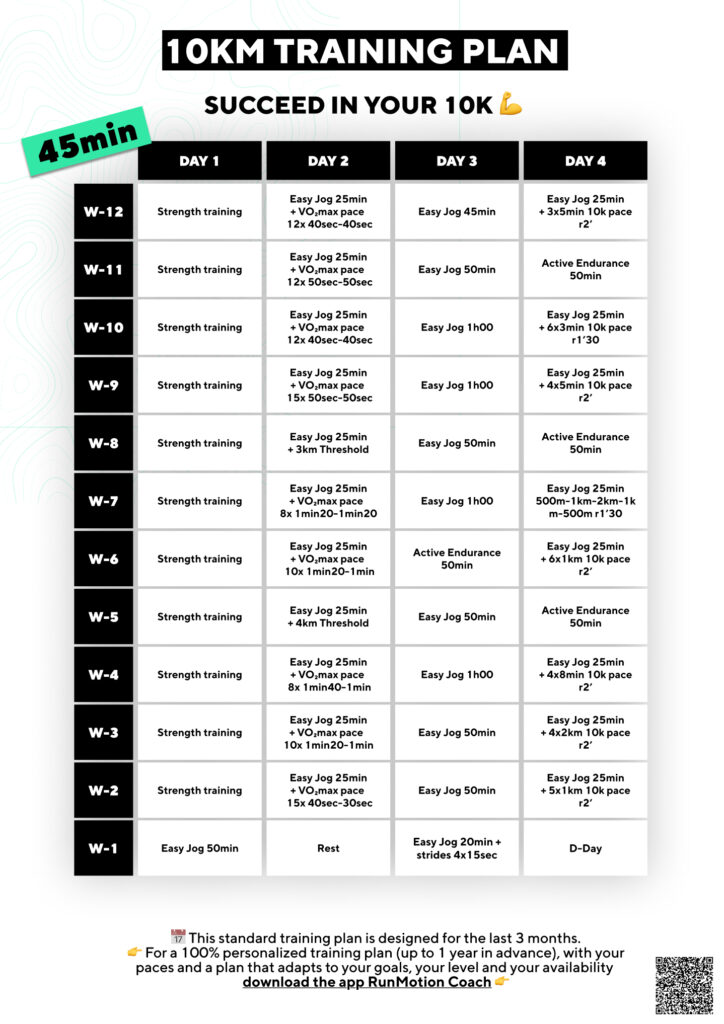
Here is an excerpt from your 12-week 10K training plan to run 45 minutes (available below):
| DAY 1 | DAY 2 | DAY 3 | DAY 4 | |
| Week 1 | Strength training | easy run 25 min + vVO2max 12×40/40 sec | easy run 45 min | easy run 25 min + 3×5 min at 10K pace (rest 2 min) |
| Week 7 | Strength training | easy run 25 min + vVO2max 10x1min20 / 1min | Steady endurance 50 min | easy run 25 min + 6x1km at 10K pace (rest 2 min) |
| Week 10 | Strength training | easy run 25 min + vVO2max 10x1min20 / 1min | easy run 50 min | easy run 25 min + 4x2km at 10K pace (rest 2 min) |
How should you manage your pace on race day?
Pacing can make or break a 10K. A lot of runners go out too fast, carried by the adrenaline at the start. A few seconds gained in the first kilometers can feel harmless, but you usually pay for them heavily in the second half of the race.
Ideally, start slightly slower than your target pace for the first kilometer, then settle in smoothly around 4:30/km.
If you hit the 5K mark in about 22:30, you’re perfectly on track to reach your goal.
From kilometer 8, it’s time to tap into what you have left. If your training has been solid, you should be able to lift the pace slightly all the way to the finish line.
Strength training: an often underrated ally
When you’re chasing a time goal, you naturally think about running workouts. But strength training plays a major role in performance. Stronger muscles help you apply force more effectively into the ground, improve stability, and reduce muscle fatigue late in the race.
A few exercises like core work, squats, or lunges done each week are often enough to bring real benefits. These sessions are also a great way to prevent common running injuries.
Recovery is part of training
Progress isn’t built only during hard sessions. It shows up when your body recovers and adapts to the work you’ve done.
Sleep, nutrition, and stress management have a direct impact on your endurance performance. Good recovery helps you string together consistent weeks of training and arrive fresh on race day.
Don’t hesitate to back off when fatigue starts piling up. A few lighter days can be far more beneficial than squeezing in one extra workout.
Train for your 10K goal with RunMotion Coach
Every runner improves at their own pace. Your experience, your availability, your sports background, and your current fitness all shape the best way to prepare for a 45-minute 10K.
With RunMotion Coach, you get a personalized training plan that adapts to your profile and your constraints. Your workouts evolve with your progress so you can hit the start line in the best possible shape.
Download the RunMotion Coach app to get your personalized 10K training plan.
So, ready to break 45 minutes in the 10K?
FAQ: 10K training plan for 45 minutes
What average pace do you need to hold?
To run 45 minutes for a 10K, you need to hold an average pace of 4:30 per kilometer. This performance requires a strong mix of endurance and speed. Specific 10K pace sessions help you progressively lock in the feel of this rhythm.
What vVO2max is recommended for a 45-minute 10K goal?
A vVO2max between 16 and 17 km/h is generally a solid base for aiming at this goal. However, your ability to sustain the effort for the full race matters just as much. Specific training is what develops that essential quality.
What 5K time suggests this goal is realistic?
A time close to 21 to 22 minutes for 5K usually suggests that a 45-minute 10K is achievable. This estimate varies depending on your runner profile and experience over longer distances. A solid training block will confirm that potential.
How do you work on your threshold to improve?
Threshold workouts involve running at a strong but controlled intensity for several minutes. They improve your ability to sustain a fast effort while delaying fatigue. This type of training often plays a key role in 10K training plans.
How many kilometers should you run each week to target 45 minutes?
Depending on your level, a weekly volume between 30 and 50 km can be appropriate. The key is to increase your training load gradually to drive progress while reducing the risk of injury.