For many triathletes, open water swimming is the most daunting part of the race. No lane lines, limited visibility, deep water and starting among other competitors can quickly raise stress levels. Yet, with a little preparation, you can approach the experience with confidence.
Whether you are preparing for your first triathlon or a longer event such as a Half Ironman or Ironman, learning to swim in open water is a great way to build confidence and enjoy race day to the fullest.
Contents
Why is open water swimming so different from pool swimming?
A swimming pool provides a highly reassuring environment. The water is clear, the temperature is comfortable, lane lines help you swim straight, and every wall gives you a brief moment to recover.
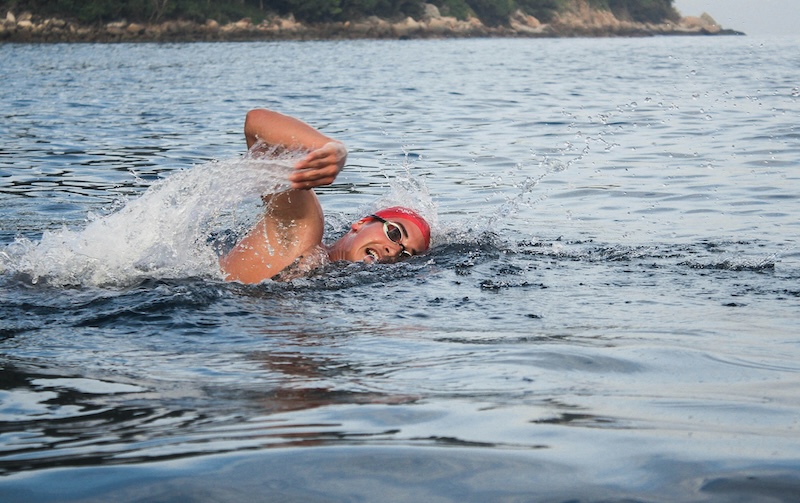
In open water, all of these reference points disappear. You need to learn how to move through an open environment, sometimes with wind, waves or a current. Visibility is often limited, and you need to lift your head regularly to stay on course.
These new sensations are completely normal, and they explain why many triathletes feel less comfortable during their first open water sessions.
Accept that stress is normal
Feeling stressed before an open water swim is not a sign of weakness. Even experienced triathletes can feel apprehensive when they discover a new body of water or line up at the start of a major race. The goal is not to eliminate stress entirely, but to learn to manage it. The more open water experience you gain, the more your confidence will grow.
As is often the case in sport, familiarity is the best antidote to anxiety.
Start gradually
For your first session, there is no need to recreate triathlon race conditions. Choose a calm body of water with no strong current, and pick a day with favourable weather.
Enter the water gradually to get used to the temperature.
Start with a few minutes close to shore, then swim at an easy pace with no target for speed or distance.
The aim is simply to discover new sensations and build confidence.
If possible, do this first session with a training partner or as part of a group workout.
Learn to breathe calmly
Stress often triggers rapid breathing, which can make you feel short of breath. This is especially common during the first few minutes of an open water swim.
Before trying to speed up, take a few moments to restore deep, steady breathing. Do not hesitate to stop for a few seconds if needed, roll onto your back or take a few breaststroke strokes to regain your calm.
Once your breathing has settled, you will be able to resume your freestyle stroke with far greater confidence.
Look ahead regularly
Unlike in a pool, there is no line on the bottom to guide you. To swim efficiently in open water, it is essential to learn how to sight.
Every six to ten breaths or so, lift your eyes slightly to spot a buoy, tree or building ahead of you. Try to raise only your eyes rather than your whole head, helping you maintain a strong body position in the water.
With a little practice, this movement will become natural and will barely interrupt your swimming rhythm.
Get used to the triathlon swim start gradually
The start is often the most intimidating moment of a triathlon. Dozens, or even hundreds, of swimmers set off at the same time, which can lead to some physical contact.
To avoid unnecessary stress, you do not need to start on the front line. Positioning yourself slightly to the side or a few metres behind the fastest swimmers will usually help you find your rhythm more easily.
Remember that a cautious start rarely costs much time, while starting too fast can drain a lot of energy.
Test your gear before race day
A new wetsuit or a pair of goggles you have never used can quickly become a source of stress.
Before your race, take the time to complete several open water sessions in your full race kit. This will allow you to check that your wetsuit is comfortable, your goggles remain watertight, and you feel at ease with your equipment.
Include open water sessions in your RunMotion Coach plan
Open water swimming confidence is built gradually through the right training. RunMotion Coach triathlon training plans include varied swim workouts to develop technique, endurance and confidence in the water.
By combining these sessions with a few open water swims before your goal race, you will arrive on race day feeling calmer, better prepared and ready to enjoy every moment of your triathlon.