Have you penciled in a trail race goal on your competition calendar this year? Want to level up your trail running and feel stronger on the climbs and more confident on the descents? Here are our best tips to improve in trail running, boost endurance performance, and train smarter for the mountains.
Contents
Hike-and-run: the secret weapon to improve in trail running
No need to sprint, the key is pacing it right. Either way, you will reach the summit. Hike-and-run is one of the best ways to progress in trail running. Think of it as the trail equivalent of an easy aerobic run on flat ground.
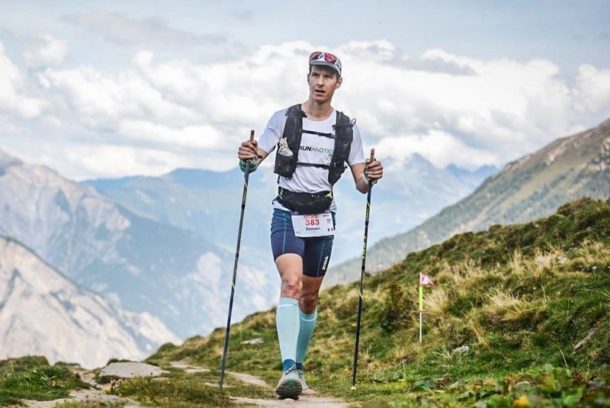
So what is hike-and-run? Just like the name suggests, it is a mix of hiking and running. Running uphill quickly spikes your heart rate. To keep your effort under control, you simply switch to power hiking on the climbs, just like on a hike. The goal is to build a strong aerobic base, like fundamental endurance training. On flatter sections or downhills, you can run at an easy to moderate pace.
TIP: even if you feel comfortable running uphill, walking can actually be more efficient, especially on very steep gradients.
Choose trail running shoes made for the terrain
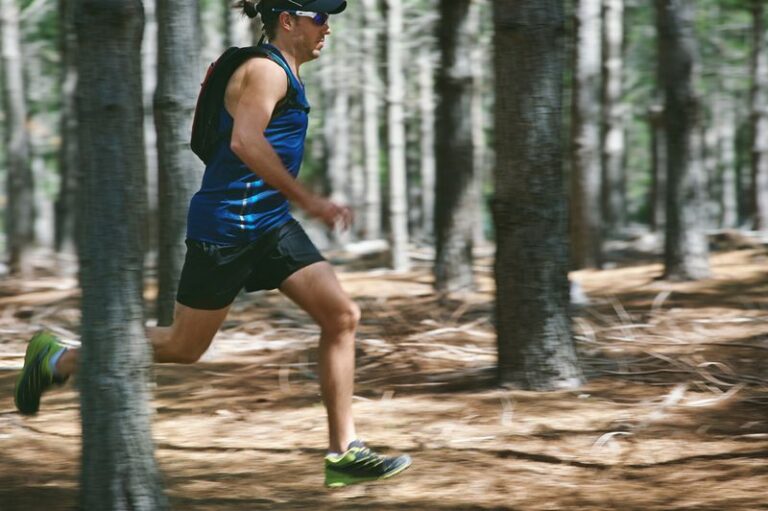
To feel good on the trails, you need to feel good in your shoes. Unlike road running shoes, trail shoes come with aggressive lugs for better grip and traction on dirt, rocks, mud, and technical terrain. They also offer more lateral support, and some models include a rock plate or toe bumper to protect your big toe from impacts on rough trails.
Picking the right pair of trail running shoes matters when you head into the mountains. First, it reduces injury risk. Second, it helps you move faster through technical sections. With the right shoes, you can commit more on the descents, stay more relaxed, and improve faster overall.
You can use our trail shoe buying guide.
Add strength-focused conditioning
Trail running can be tough on your leg muscles. On climbs, your calves and quads do most of the work. On descents, your quads absorb a huge amount of impact with every step as they control your body weight.
That is why you should include strength and conditioning to improve in trail running. Core work, both static and dynamic, helps stabilize your trunk and reduces the load on your legs. General strength training focused on force production helps toughen your muscles and makes you more powerful, both uphill and downhill.
Trail-specific workouts to go further
If you are training for a trail race, you will find trail-specific sessions in your RunMotion Coach trail training plan. These workouts are crucial to help you improve uphill, downhill, and on runnable flat sections.
Uphill-specific training
Here we are talking about hill sessions. There are different types of workouts to improve your uphill performance.
– Workouts to build strength and power: steeper hills, faster pace, short intervals (15 seconds to 2 minutes)
– Workouts to build endurance: less steep hills, moderate or threshold effort, longer intervals (3 minutes to 20 minutes).
Downhill-specific training
To get better on descents, the best training is simply to run the downhills fast during your trail outings. There is not really a single “perfect session”. You just need to get used to it by building it into your runs. Early in the season, even 500 m of downhill elevation on a run can leave you sore. Then your body adapts, and you can gradually handle longer runs with more elevation loss.
Always look up and plan your steps several meters ahead. On descents, the trail comes at you much faster, and if you stare at your feet the whole time you can get caught out by technical obstacles.
You can also add proprioception exercises to strengthen your ankles and knees, and to improve balance and stability.
TIP: here is gear checklist we recommend when you head out for a longer trail run.
- A running belt or hydration pack
- At least 500 ml of water
- Energy bars or fruit purees
- An emergency blanket
- A tick remover
- A waterproof jacket
- A phone
Now that you have everything you need to improve in trail running, you can start building towards your next goal. RunMotion Coach offers tailored, personalized training plans to prepare for your next trail race.