You’re looking for a 2:15 half marathon training plan to prepare for your next goal? Running a half marathon in 2:15 is a great challenge if you’re new to running or simply want to finish your first half marathon feeling strong.
With an average pace of 6:24 per kilometer, this goal is within reach for many runners, as long as you follow a progressive and consistent training plan.
In this article, you’ll discover what level you need to target a 2:15 half marathon, which training paces to use, the most important workouts, and our 2:15 half marathon training plan over 12 weeks.
Contents
- What fitness level do you need to run a 2:15 half marathon?
- What pace do you need to hold for a 2:15 half marathon?
- How many weeks do you need to prepare for a 2:15 half marathon?
- The most important workouts in a 2:15 half marathon training plan
- 12-week 2:15 half marathon training plan
- How to manage your half marathon on race day
- Nutrition and hydration: plan your fueling too
- Mistakes to avoid during your training
- Why choose a personalized training plan?
- FAQ: 2:15 half marathon training plan
What fitness level do you need to run a 2:15 half marathon?
The 2:15 half marathon training plan is mainly designed for beginner runners or those preparing for their first half marathon.
You don’t need years of experience. That said, it helps to have been running regularly for a few months and to be able to run for about an hour without stopping.
If you’ve already raced a 10K, a time between 58 minutes and 1:05 is usually a solid starting point for aiming at a 2:15 half marathon. But it’s not a requirement.
Some runners are naturally more endurance-oriented and perform better over longer distances than over shorter races. What matters most is being consistent with your training.
And this goal is far from trivial. Today, the average half marathon time worldwide is about 2:14:58. So if you finish under 2:15, you’ll be right around the global average for runners crossing the finish line.
What pace do you need to hold for a 2:15 half marathon?
To finish your half marathon in 2:15, you’ll need to run at an average pace of 6:24 per kilometer.
That may feel comfortable at first, but holding that pace for more than two hours still requires solid endurance.
The goal of your training is precisely to make that speed feel easier and easier as the weeks go by.
During training, most of your sessions will be slower than race pace. That’s normal, most progress comes from easy endurance runs, which help build your heart, muscles, and ability to run longer without tiring too quickly.
Specific sessions at half marathon pace will then help you gradually get used to the rhythm you want to hold on race day.
How many weeks do you need to prepare for a 2:15 half marathon?
A 12-week build-up is ideal for most runners.
It gives you enough time to gradually increase your training volume, improve your endurance, and arrive at the start line feeling confident.
If you’re completely new to running, it can be worth spending a few extra weeks building your base before starting this plan.
On the other hand, if you’ve already been running regularly for several months, these 12 weeks will usually be enough to prepare for your goal.
The key is always the same, progress gradually and avoid trying to do too much.
The most important workouts in a 2:15 half marathon training plan
When you’re training for your first half marathon, there’s no need for overly complicated workouts.
The most important thing is to build mileage without creating excessive fatigue.
Easy runs therefore make up the biggest part of the half marathon training plan. They steadily build your endurance and strengthen your whole system.
Long runs help you learn to run longer, build confidence, and prepare your body for the demands of the half marathon.
The program also includes a few slightly faster workouts with segments at half marathon pace. They help you improve gradually without making the build-up too difficult.
Finally, strength training, included every week, helps reduce the risk of injury and improves running economy.
For a 2:15 goal, endurance is clearly the priority, not speed. To get there, try not to walk, or if you do walk briefly to recharge, keep it to no more than a few minutes over the whole race. For example, you can walk into an aid station and get back to your pace right after.
12-week 2:15 half marathon training plan
This 2:15 half marathon training plan is designed for a runner who can train four times per week.
It alternates between:
- one strength training session;
- one quality session with a bit more intensity (vVO2max, threshold, or half marathon pace depending on the week);
- one easy endurance run;
- one long run or one race-specific session.
The goal of this 2:15 half marathon training plan is to build your endurance progressively while adding a few touches of speed so you arrive ready on race day.
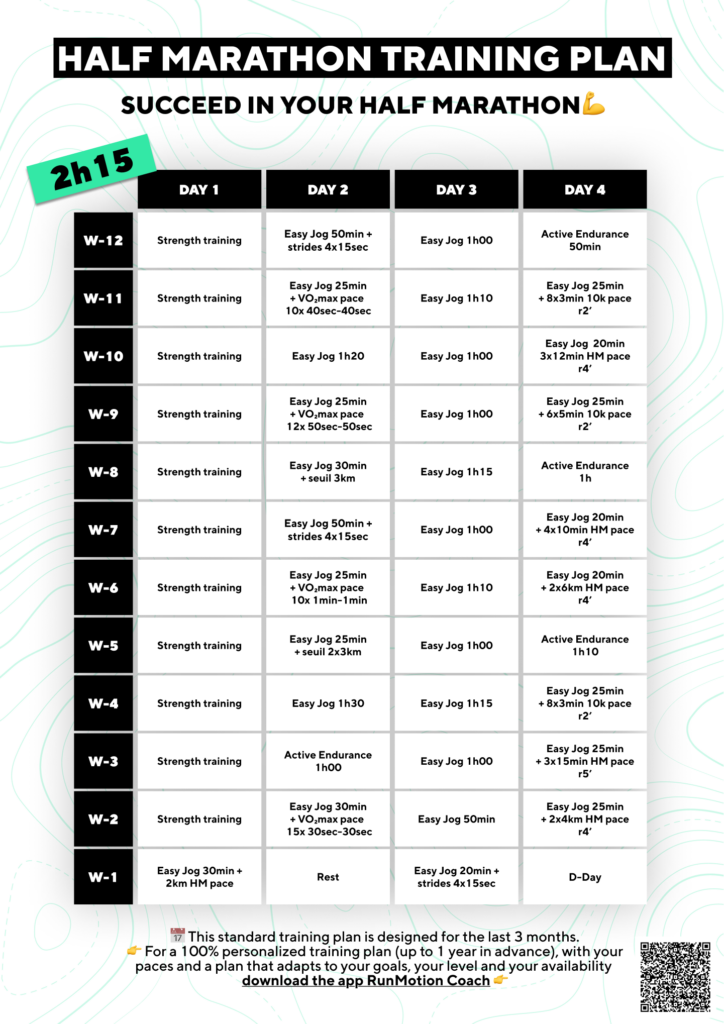
If you can only run three times per week, prioritize the easy run, the long run, and the specific session. Strength training can be done on the days you don’t run.
Before you start, it can also be useful to do a vVO2max test so you can fine-tune your training paces. But if you’re a beginner, don’t worry, listening to your body is often more important than following an exact pace down to the second.
How to manage your half marathon on race day
The most common trap is starting too fast.
The excitement at the start often makes the pace feel easy. And yet, a few extra seconds per kilometer in the early stages can cost you dearly in the final kilometers.
Try to stay close to your target pace of 6:24/km from the very first kilometers.
If you still feel good after the 15 km mark, you can speed up slightly.
It’s better to finish fast than to suffer through the last few kilometers.
Nutrition and hydration: plan your fueling too
Even for a 2:15 half marathon, nutrition plays an important role.
In the weeks before the race, prioritize a varied diet and make sure you recover well between sessions.
On race morning, eat a breakfast you already know works for you.
During the half marathon, remember to hydrate at every aid station. If you want to use an energy gel or sports drink, test them beforehand during your long runs.
Race day is never the right time to try something new.
Mistakes to avoid during your training
The first mistake is running every session too fast.
Many beginners think they’ll improve faster by pushing hard on every run. In reality, that mostly leads to fatigue and increases the risk of injury.
Another common mistake is neglecting long runs. They are essential in a build-up for a 2:15 half marathon.
Finally, some runners suddenly increase their mileage as the race approaches. That abrupt jump in volume is one of the main causes of injury.
Your progression should stay gradual from the first week to the last.
Why choose a personalized training plan?
Every runner has their own fitness level, personal constraints, and availability.
A personalized half marathon training plan allows you to adapt each session to your profile, experience, and goal.
If you’re preparing for your first half marathon or you sometimes struggle to find enough time to train, a tailored plan will always be more effective than a generic program.
With RunMotion Coach, your plan updates automatically based on the training you’ve completed, your level, and your availability.
That way, you benefit from a build-up that is truly tailored to you, right up to race day.
Download the RunMotion Coach app and get ready for your next half marathon with a personalized training plan that evolves with you!
FAQ: 2:15 half marathon training plan
What 10K time do you need to run a 2:15 half marathon?
Most runners targeting a 2:15 half marathon run 10K somewhere between 58 minutes and 1:05. This is only a guideline, some runners with stronger endurance profiles perform very well over the half marathon with a slower 10K time.
Can you follow a 2:15 half marathon training plan with only three sessions per week?
Yes. Many runners reach this goal with three weekly sessions, as long as they stay consistent and keep one long run every week.
What vVO2max do you need to run a 2:15 half marathon?
A vVO2max between 12 and 13 km/h is generally a good base for targeting a 2:15 half marathon.
How many kilometers should you run each week?
Most runners cover between 20 and 35 kilometers per week during a 2:15 half marathon training block.
What pace do you need to hold to run a 2:15 half marathon?
To run a half marathon in 2:15, you need to maintain an average pace of 6:24 per kilometer over the full 21.1 km.
Download the RunMotion Coach app to get your personalized half marathon training plan.