The 70.3 triathlon, also known as the L distance or Half, often marks a real milestone in a triathlete’s journey.
With 1.9 km swim, 90 km bike, and 21.1 km run, you step into a distance where endurance sports take on a whole new meaning. It’s no longer just about stacking three disciplines, you have to manage your energy for several hours, stay sharp, fuel well, and still have legs left to run a half marathon… after 90 km on the bike. This format rewards consistency, patience, and smart race execution.
Whether you’re training for your first Half distance triathlon or you want to drop your PR, this article will help you build a training approach that’s effective and realistic. We’re also sharing a 12-week 70.3 triathlon training plan.
Contents
- Half triathlon: what should you expect?
- You’re training for your first Half triathlon
- How to organize training for a 70.3 triathlon
- Key workouts to nail your Half triathlon
- Nutrition and recovery: two pillars of Half triathlon performance
- Your personalized 70.3 training plan with RunMotion Coach
- FAQ: Half triathlon training plan
Half triathlon: what should you expect?
The 70.3 format (the IRONMAN-branded distance), also called L or Half, is a total of 1.9 km swimming, 90 km cycling, and 21.1 km running.
For most amateur triathletes, race time ranges from 4h30 to 7h, depending on fitness and experience.
Compared with an Olympic triathlon, everything scales up, and every pacing mistake can cost you. A start that’s too hard, poor hydration, or nutrition you haven’t mastered can quickly turn the second half of the race into damage control.
The bike leg often becomes the centerpiece of a 70.3. It sets up the rest of your day. Ride just a little too hard and you can turn the final half marathon into a long survival shuffle. Manage it well and you’ll often be able to run strong all the way to the finish.
You’re training for your first Half triathlon
For a first Half distance triathlon, it’s best to plan 12 to 20 weeks of training, depending on your background and your level in all three disciplines.
The first weeks are mainly about building a big aerobic base and gradually getting your body used to training volume. At this distance, progression is everything. Jumping too quickly into long rides or stacking intense sessions is often the fastest way to feel cooked before race day even arrives.
If you already train consistently in running, cycling, or triathlon, a 10 to 14-week build can be enough.
Training becomes more specific, with more race-pace sessions, long bike rides, and more meaningful brick workouts. From 70.3 onward, nutrition is also fully part of training. It’s not enough to be fit, you also need to fuel well during long efforts.
For experienced triathletes, the L distance becomes a format that’s demanding both physically and mentally. Training focuses more on pacing, bike power, and managing effort over time.
The Half is also commonly used as a key prep race before a Full (3.8 km swim, 180 km bike, and 42 km run).
Did you know that on RunMotion Coach, you can set a main goal as well as intermediate goals?
Check out your 12-week Half triathlon training plan
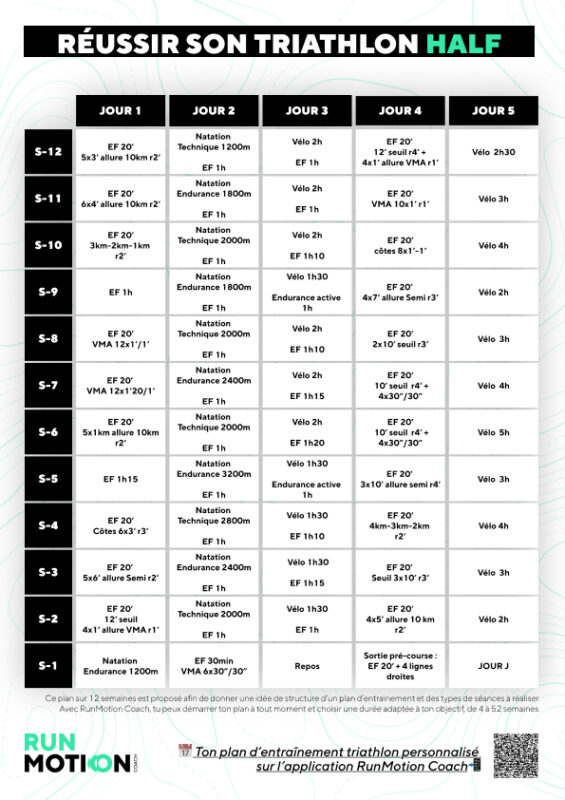
How to organize training for a 70.3 triathlon
A Half distance build usually includes 6 to 9 sessions per week.
A classic breakdown often looks like:
- 1 to 2 swim sessions,
- 2 to 3 bike sessions,
- 3 to 4 run sessions,
- and optionally strength training.
Weekly volume typically ranges from 8 to 14 hours of training, depending on your level and goals.
If you want to go deeper, check out our article: How to organize your triathlon training week?
The real challenge is absorbing the training load over several months without piling up too much fatigue. That’s why easier recovery weeks are essential if you want consistent progress.
Key workouts to nail your Half triathlon
Build an efficient, relaxed swim
In a 70.3, the swim should never be a major source of fatigue. You want to exit the water feeling smooth, with controlled heart rate and plenty of energy for the long hours of cycling ahead.
Swim sessions will mainly develop endurance, technique, efficiency, and open-water confidence.
To go further on technique, check out 12 technical drills to improve in triathlon.
For more advanced triathletes, some sessions can also include drafting practice, fast starts, or sighting work.
Develop real cycling endurance
The bike leg often represents more than half your total race time in a Half. It’s also where a big part of your run performance is decided.
That’s why bike training often includes long rides, threshold work, Half race-pace blocks, and cadence drills. The goal is simple: ride efficiently without burning through your energy stores before the run.
Learn to run on tired legs
After several hours of racing, muscle fatigue hits hard, and you still need to hold a steady effort for 21 km. Run sessions therefore combine easy aerobic running, half marathon pace, threshold work, and short runs straight off the bike.
The goal isn’t necessarily to run blazing fast, it’s to stay consistent all the way to the finish line.
Long brick workouts
In 70.3 training, brick sessions help you simulate the bike-to-run transition.
They teach your body to switch disciplines while also improving pacing, nutrition strategy, and your ability to handle fatigue.
A classic example is a 3-hour ride with race-pace blocks, followed by 30 to 45 minutes of progressive running.
These workouts are tough, but extremely useful, and often essential to prepare for race-day sensations.
Brick workouts aren’t available yet in the RunMotion Coach app, but this feature is coming soon.
In the meantime, we suggest either adding a 5 to 8 km run right after your bike ride, or scheduling two sessions on the same day directly in the app.
Nutrition and recovery: two pillars of Half triathlon performance
From the Half distance onward, nutrition becomes a true performance factor.
You can’t sustain hours of endurance effort without a solid hydration and fueling strategy. You need to learn to drink consistently, take in carbohydrates during the race, and test your nutrition in training long before race day.
Recovery is just as critical. Sleep, recovery weeks, and smart fatigue management help you handle months of training without breaking down physically or mentally.
Your personalized 70.3 training plan with RunMotion Coach
RunMotion Coach offers personalized Half triathlon training plans based on:
- your schedule,
- your current fitness,
- your personal constraints,
- and your other sports activities and progression
You’ll get swim, bike, and run sessions, strength training, plus guidance on recovery, endurance nutrition, and pacing.
All within a flexible plan designed to help you improve steadily up to race day.
Triathlon goals are available with the premium version.
Get 15 days free starting now!
FAQ: Half triathlon training plan
How long do you need to prepare for a Half?
Training for a Half triathlon usually takes 12 to 20 weeks, depending on your starting level, your endurance background, and your goals. If you already run or ride regularly, you’ll often progress faster. If you’re new to endurance training, it’s smarter to give yourself extra time to build a solid aerobic base and reduce injury risk.
How many hours per week do you need for a Half?
Most triathletes train between 8 and 14 hours per week to prepare well for a 70.3. Training volume varies across the plan, with bigger weeks as you get closer to race day and essential recovery phases to absorb the work.
Can you train for a Half without triathlon experience?
Yes, it’s absolutely possible to train for a Half distance triathlon without having raced a triathlon before. The key is to progress gradually, build endurance across swim, bike, and run, and follow a sensible training load so you arrive ready on race day.
Is nutrition important in a 70.3?
Yes, nutrition plays a major role in a Half triathlon because the effort lasts for hours and heavily drains your energy reserves. Fueling well before, during, and after training helps prevent energy crashes, boosts performance, and supports recovery.
Do you need long sessions?
Yes, long sessions are essential in a Half training plan to build the physical and mental endurance you’ll need on race day. They also help your body learn to manage long efforts and let you test your hydration and fueling strategy in conditions close to competition.
How do you manage the bike-to-run transition in a Half?
The transition from cycling to running is one of the toughest parts of a Half triathlon. To prepare your body for that switch, it’s recommended to regularly include “brick” workouts that combine a bike ride followed immediately by a run. This helps you manage sensations, pace, and fatigue on race day.