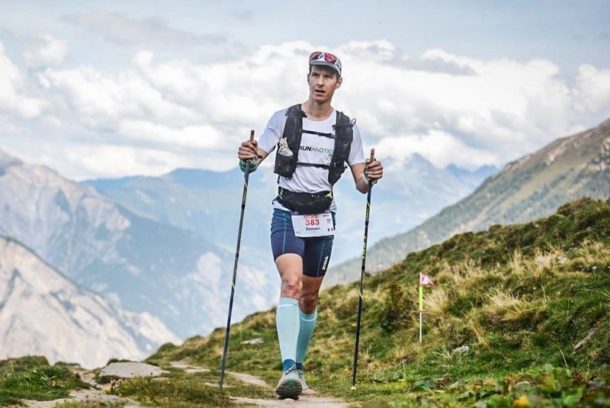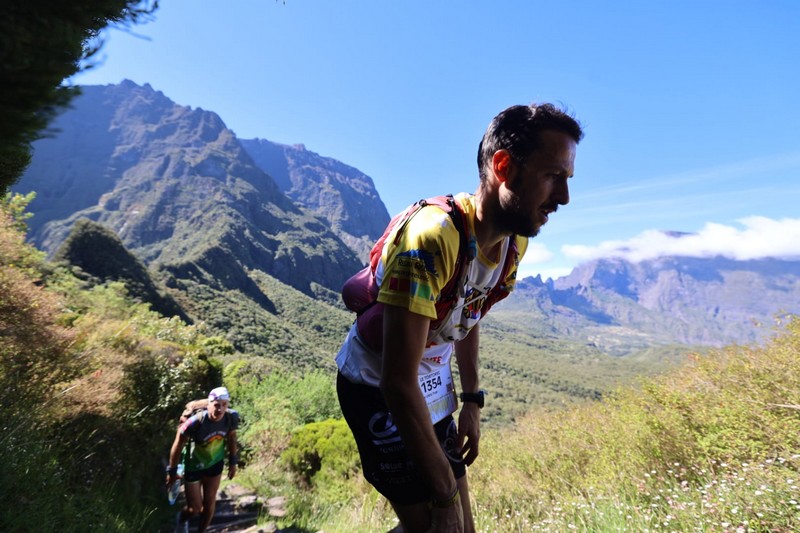
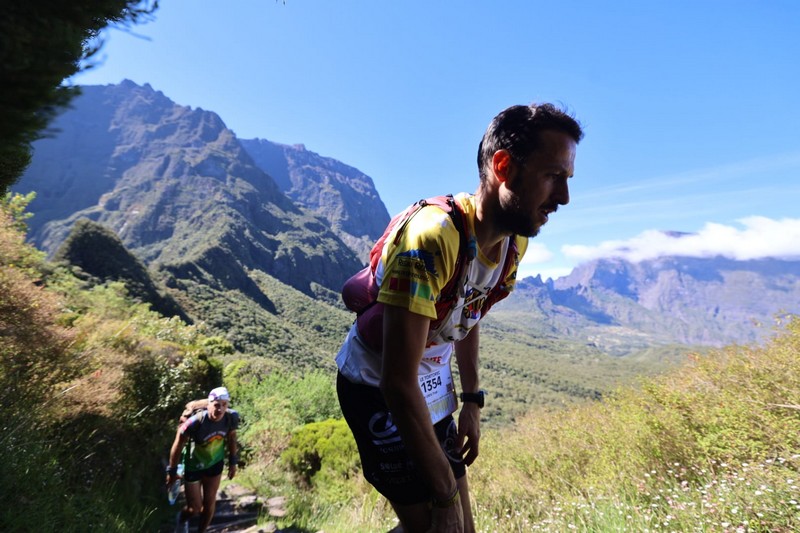
Have you signed up for one of the Grand Raid de La Réunion races, the Diagonale des Fous (165 km, 10,200 m D+), Trail de Bourbon (109 km, 6,000 m D+), Mascareignes (72 km, 3,900 m D+), or Zembrocal Trail (149 km, 8,000 m D+, four-person relay)? This legendary trail has a few unique demands, including a no-poles rule and highly technical terrain. Training with a Grand Raid de La Réunion training plan is therefore essential!
Whichever race you choose, you will experience a one-of-a-kind adventure in an incredible atmosphere, from the start line to the course and the finish at the famous Stade de la Redoute in Saint-Denis. It is one of the toughest trail races in the world, due to its huge elevation gain and dramatic temperature swings, hot during the day and cold at night. On the Diagonale des Fous, sleep deprivation often leads to major performance breakdowns or even hallucinations…
Contents
The foundations of an ultra trail training plan
To build the aerobic base and resilience needed for an ultra trail, you will need at least 10 hours of training per week for the Diagonale des Fous, or up to 15 hours if possible. Most of that volume should generally come from running, to help your body handle the impact and elevation gain. You can complement it with road cycling or mountain biking.
For the Trail de Bourbon, aim for 8 to 12 training hours per week. For the Mascareignes, 5 to 10 hours per week may be enough. Naturally, this depends on the individual, especially your previous training volume and your race ambitions. If you want to increase your training hours compared with last year, make sure you do so gradually.
How to adapt your training for the Grand Raid de La Réunion and Diagonale des Fous
The Grand Raid de La Réunion races require specific preparation. Your training needs to be varied, and you should prepare for the unique demands of these trails as early as possible. First, do not use poles too often in training. They are prohibited on race day, so it is better to get used to climbing and descending without them.
Weather conditions can be challenging, often hot and humid during the day, then cold at night. Since the heart of your training block will be in July, August and September, do not hesitate to train in the heat, although not on every run to avoid excessive fatigue.
Pole-free hike-and-run sessions for the Diagonale des Fous
Hike-and-run training is usually the foundation of an ultra trail training plan. This is even more true for the Diagonale des Fous, as most of the race is hiked, even by runners in the top 50! You therefore need to get used to walking as much as possible, and without poles. When the climb gets too steep, do not hesitate to place your hands on your thighs to help yourself move uphill.
For the Diagonale des Fous, you can build up to 5- to 6-hour hike-and-run outings, potentially adding another long bike ride over the weekend. Beyond that, the fatigue created can become counterproductive in a structured training plan.
From time to time, you can train very early in the morning to simulate the fatigue you may feel as the race progresses. However, we do not recommend spending an entire night outdoors in training, as it is simply too exhausting. You can also look for a preparation race with a very early start to rediscover the sensations of night trail running.
Hill workouts
There are two main types of hill workouts, short hills and long hills. With short hill repeats, you develop strength and running form. Jog back down, then either start again immediately or add a 30-second wall sit at the bottom to work your quads even harder. Examples of short hill sessions include 12 x 30 seconds up to 8 x 1 minute 30 seconds. Their advantage is that you can do them almost anywhere, including in the city, and they fit easily into a busy schedule.
Long hills build muscular endurance, with sessions such as 4 x 6 minutes or 3 x 10 minutes. Ideally, choose a climb with 500 to 1,000 metres of elevation gain, so you do not have to run back down after every repetition.
Train for technical descents
Every trail runner knows that trail descents are usually what destroy your legs. This is even more true on the Diagonale des Fous! Think of the feared Chemin des Anglais, an old paved route that climbs and descends over uneven stones, creating a brutal challenge for your quads and ankles. Other descents feature irregular high steps that put tired thighs and knees under serious pressure.
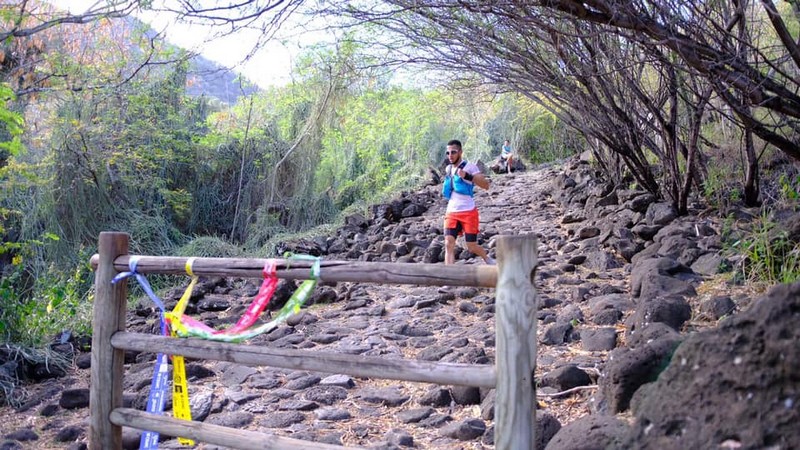
It is therefore important to include downhill running in your training, for example 10 x 1 minute at a strong pace on a descent. You can also target continuous descents with 500 to 1,000 metres of elevation loss. If you can find technical descents or large steps, even better. Focus on looking ahead and planning your line to avoid falls.
Trail-specific strength and conditioning
For ultra trail efforts, tailored strength and conditioning is essential. This is even more important for the Diagonale des Fous, where muscular strength is a key factor because of the huge elevation gain and technical trails.
Focus on varied strength training exercises, such as the strength training exercises available in the RunMotion Coach app. If you live in a city, stairs can be an excellent way to include plyometric work.
You can also add cycling or indoor trainer workouts to develop strength and muscular endurance. This can mean maximum efforts over short durations, or riding uphill in a big gear for longer blocks.
Plan preparation races before the Grand Raid de La Réunion
To accumulate substantial training volume, there is nothing quite like racing. You benefit from organised aid stations, safety support, and the chance to test your gear and nutrition strategy. It is effectively a full dress rehearsal and an opportunity to assess your current fitness. The good news is that summer offers plenty of trail races for your preparation!
As the Grand Raid de La Réunion takes place in October, you can find trail races in July or August to prepare. Ideally, choose a race between 50% and 80% of your target distance, no more. Of course, there can be exceptions, but if you want to reach peak form at the Grand Raid de La Réunion, it is best to follow this guideline.
Select one or more trail races with a significant elevation gain ratio or long descents to properly simulate the difficulty of the Grand Raid de La Réunion events. Good examples include the 6000D, Verbier Saint Bernard by UTMB, Ultra Tour du Beaufortain, Challenge du Montcalm in the Pyrenees, or on Réunion Island, the Ultra Marathon des Cirques trail race in June and CimasaRun in August. This is far from an exhaustive list!
However, if you are racing the Diagonale des Fous, running UTMB® is not recommended because the gap between the two events is short, usually eight weeks, and only seven weeks in 2023. It is possible, but the risk of injury and overall fatigue is very high. The CCC® (100 km, 6,000 m D+) is already a more suitable preparation race for the Diagonale des Fous.
Test your gear thoroughly before the Grand Raid de La Réunion
As conditions on Réunion Island are often hot and humid during the day, it is essential to thoroughly test your gear in training. Pay particular attention to your shoes, socks, underwear, T-shirt and shorts to avoid chafing.
Your shoes need reliable grip to handle the technical terrain. For clothing, wearing several layers is recommended. For example, a technical base layer T-shirt, a technical long-sleeve layer, plus a waterproof windproof jacket. Check the mandatory kit carefully to avoid any unpleasant surprises when you collect your race bib.
Plan your race strategy
One of the biggest challenges of the Diagonale des Fous is sleep management, with several nights outdoors for most trail runners. On the Diagonale des Fous, it is recommended to take 15- to 20-minute micro-naps from the second day onwards when you are truly exhausted. If possible, plan to sleep at lower points on the course or near an aid station, so you do not end up freezing at the top of a pass.
Whichever Grand Raid de La Réunion race you are running, carefully plan your nutrition and hydration. Make sure you get the right nutritional intake and have tested your strategy during hike-and-run training outings.
Good training should make you ready for race day. When you stand on the start line, you should be able to tell yourself that your preparation has been solid. There is always more you could do, but you should not arrive at the start doubting your ability or regretting that you did not complete the right training to be ready.
And one month before the Diagonale des Fous, it is time to shift from preparation to strategy. How should you manage the first climbs? What pace should you start at to avoid blowing up? When should you hike on the ascents? What split times should you target at the different aid stations? When and how should you fuel?
To help you answer these questions, Race Strategy allows you to create a personalised race plan based on your level and goal. You can visualise your split times, pace and effort management throughout the Diagonale des Fous, arriving on race day with a clear strategy.
👉 Create your Diagonale des Fous race plan one month out and prepare every stage of your ultra with Race Strategy.
We wish you the very best for your adventure on Réunion Island. Take in the spectacular views of the cirques of Cilaos, Salazie and the legendary Mafate cirque! You will quickly understand why the Diagonale des Fous inspires so many trail runners.
If you want to maximise your chances of success and need a personalised Grand Raid de La Réunion training plan for the Diagonale des Fous, Trail de Bourbon, Mascareignes or Zembrocal Trail, download the RunMotion Coach app!
Photo credits: Grand Raid de La Réunion (Facebook)