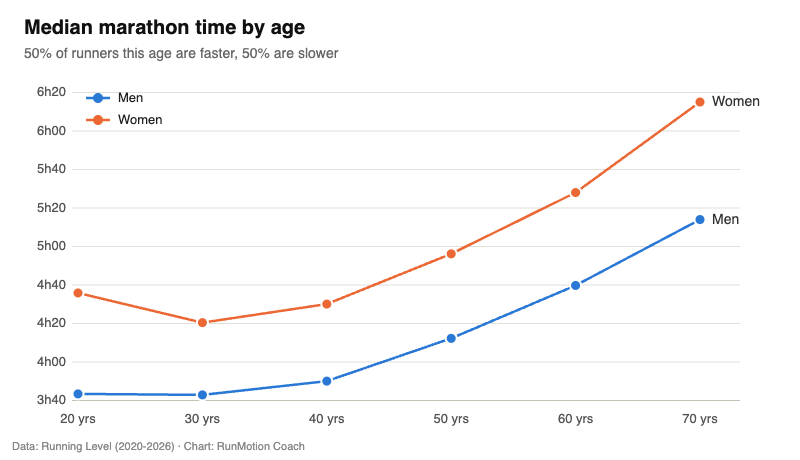
Average marathon times go up with age, but far more slowly than you might think before 50. At the 2026 Paris Marathon, the median time was 3h59′11″ for men and 4h27′27″ for women, with an average age of 38. Among regular runners, the median time goes from 3h42′39″ for a 30-year-old man to 4h12′01″ at 50 and 4h39′30″ at 60. Here is all the data by age and sex, plus marathon world records in every age group.
The short answer
- At the 2026 Paris Marathon, the average time was 4h04′41″ for men and 4h32′09″ for women (4h13′24″ for all runners).
- Worldwide, runners aged 30 to 50 are the fastest on average (4h24), ahead of under-30s (4h32) and 50-60s (4h34).
- After 40, the median time rises by roughly 10% per decade, and a little more after 60.
- A 3h45 marathon at 30 is equivalent to about 4h11 at 50 and 4h36 at 60 for a man, according to the age-grading tables.
- World records: 1h59′30″ for men (Sabastian Sawe, 2026) and 2h09′56″ for women (Ruth Chepngetich, 2024).
Contents
- Average marathon time: a big-city snapshot and the global picture
- Average marathon time by age group
- Marathon times by age for men
- Marathon times by age for women
- At what age do you run your best marathon?
- Your age-graded marathon time
- Marathon world records
- Marathon world records by age group
- How to prepare well for a marathon after 40, 50 or 60
- FAQ
- Sources
Average marathon time: a big-city snapshot and the global picture
As one of the world’s largest marathons, Paris gives a useful snapshot of a big-city field. In 2026, it had 57,464 finishers, 33% of them women and 49% running their very first marathon.
| Paris Marathon 2026 | Average time | Median time |
|---|---|---|
| All runners | 4h13′24″ | 4h08′46″ |
| Men | 4h04′41″ | 3h59′11″ |
| Women | 4h32′09″ | 4h27′27″ |
Sources: official race organiser figures (averages, average age) and results analysis by Running with Rock (medians).
A few other benchmarks from that edition: only 4.17% of finishers went under 3 hours, the average age was 38, and the oldest runner in the race, aged 92, crossed the line in 7h21′37″.
Globally, RunRepeat’s “The State of Running” study (107.9 million results, 1986-2018) puts the average marathon time at 4h32′49″, compared with 3h52′35″ in 1986. The marathon has gone mainstream: there are far more runners simply aiming to finish than there were forty years ago. For a broader look at times by ability, also read our article What is a good marathon time?.
Average marathon time by age group
The large studies of race results show how the average time changes from one age group to the next.
| Age group | Average time worldwide (2018) |
|---|---|
| Under 30 | 4h32 |
| 30-50 | 4h24 |
| 50-60 | 4h34 |
| 70 and over | 5h40 |
Source: RunRepeat, “The State of Running 2019”.
US data, more recent and more detailed, shows the same curve:
| Age group | Average time in the United States (2024) |
|---|---|
| 18-24 | 4h19 |
| 25-34 | 4h27 |
| 35-44 | 4h29 |
| 45-54 | 4h38 |
| 55-64 | 4h58 |
| 65 and over | 5h35 |
Source: RunRepeat, “The State of US Marathons 2025”.
First takeaway: 30 to 50-year-olds run faster on average than under-30s. It’s not that they’re physiologically stronger; they train more and manage their race better. The marathon rewards experience. Second takeaway: the real drop-off comes after 55.
Runners aged 40-50 also make up the largest group of marathoners: 28.6% of finishers worldwide in 2018, compared with 24.7% in 1986.
Marathon times by age for men
To go further, here are times by age for runners who log their results on Running Level (10,576 marathons, 2020-2026). These runners are more consistent than average, which is why their times are faster than those in the large studies.
| Age | Median time | Top 20% | Top 5% |
|---|---|---|---|
| 20 | 3h43′10″ | 3h11′57″ | 2h48′05″ |
| 30 | 3h42′39″ | 3h11′31″ | 2h47′42″ |
| 40 | 3h49′48″ | 3h17′39″ | 2h53′05″ |
| 50 | 4h12′01″ | 3h36′46″ | 3h09′49″ |
| 60 | 4h39′30″ | 4h00′25″ | 3h30′31″ |
| 70 | 5h13′44″ | 4h29′51″ | 3h56′18″ |
Source: Running Level, 8,252 men’s marathons (2020-2026).
A 50-year-old man who runs 3h30 is in the fastest 20% for his age. At 60, going under 4h00 has the same effect.
Marathon times by age for women
| Age | Median time | Top 20% | Top 5% |
|---|---|---|---|
| 20 | 4h35′36″ | 3h57′54″ | 3h28′16″ |
| 30 | 4h20′11″ | 3h44′36″ | 3h16′37″ |
| 40 | 4h29′50″ | 3h52′55″ | 3h23′55″ |
| 50 | 4h55′56″ | 4h15′27″ | 3h43′38″ |
| 60 | 5h27′46″ | 4h42′55″ | 4h07′41″ |
| 70 | 6h14′48″ | 5h23′31″ | 4h43′14″ |
Source: Running Level, 2,324 women’s marathons (2020-2026).
For women, the best median time comes at around 30, and 40-year-olds are still faster than 20-year-olds. A 50-year-old woman who finishes in 4h15 is in the fastest 20% of her category.
At what age do you run your best marathon?
A study of 312,342 men who ran the Stockholm Marathon between 1979 and 2014 puts the average performance peak at around 34. More importantly, it shows that age explains only 4.5% of the differences in finish times between runners (Lehto, 2016). Your training, weight, experience and race management matter far more.
A German study of around 900,000 marathon and half marathon results points the same way. It found no significant drop in average performance before 55, and showed that 25% of runners aged 65 to 69 were faster than half of 20 to 54-year-olds (Leyk et al., 2010).
Here’s what you lose on average, decade by decade, based on Running Level median times:
| Period | Men | Women |
|---|---|---|
| From 30 to 40 | +7′09″ (+3.2%) | +9′39″ (+3.7%) |
| From 40 to 50 | +22′13″ (+9.7%) | +26′06″ (+9.7%) |
| From 50 to 60 | +27′29″ (+10.9%) | +31′50″ (+10.8%) |
| From 60 to 70 | +34′14″ (+12.2%) | +47′02″ (+14.3%) |
RunMotion calculation based on Running Level median times.
Your age-graded marathon time
Age grading lets you fairly compare a 30-year-old marathoner with a 60-year-old. Alan Jones’s 2025 road tables, adopted by USA Track & Field, give these equivalents.
For men:
| Time at 30 | Equivalent at 40 | at 50 | at 60 | at 70 |
|---|---|---|---|---|
| 3h15′00″ | 3h19′20″ | 3h37′34″ | 3h59′28″ | 4h26′17″ |
| 3h45′00″ | 3h49′59″ | 4h11′02″ | 4h36′19″ | 5h07′15″ |
| 4h15′00″ | 4h20′39″ | 4h44′30″ | 5h13′09″ | 5h48′13″ |
For women:
| Time at 30 | Equivalent at 40 | at 50 | at 60 | at 70 |
|---|---|---|---|---|
| 3h15′00″ | 3h21′27″ | 3h36′43″ | 4h04′49″ | 4h44′18″ |
| 3h45′00″ | 3h52′26″ | 4h10′03″ | 4h42′29″ | 5h28′02″ |
| 4h15′00″ | 4h23′26″ | 4h43′24″ | 5h20′09″ | 6h11′46″ |
RunMotion calculation based on the 2025 road age-grading tables (Alan Jones), marathon factors.
So a 60-year-old man who runs 3h59′28″ is producing a performance equivalent to 3h15 at 30. Something to keep in mind next time you look at your finish time.
To estimate a realistic time for you today, use the marathon time predictor, then work out your split times.
Training for a marathon after 40 or 50 calls for a plan that respects your recovery. RunMotion Coach adjusts your training load every week to your level and how you feel. Try the app free for 7 days.
Marathon world records
| Time | Athlete | Race | |
|---|---|---|---|
| Men | 1h59′30″ | Sabastian Sawe (Kenya) | London, 26 April 2026 |
| Women (mixed race) | 2h09′56″ | Ruth Chepngetich (Kenya) | Chicago, 13 October 2024 |
| Women (women-only race) | 2h15′41″ | Tigst Assefa (Ethiopia) | London, 26 April 2026 |
In London, Sabastian Sawe became the first man to run a record-eligible marathon in under 2 hours, wiping out Kelvin Kiptum’s 2h00′35″ (Chicago, 2023). Ruth Chepngetich’s record still stands despite her three-year doping ban announced in 2025: the Athletics Integrity Unit kept her results from before her positive test in March 2025.
Marathon world records by age group
Unlike the 10K and the half, the marathon has official masters world records, ratified by World Masters Athletics (WMA). Categories go in 5-year bands: M60 for men aged 60 to 64, W60 for women of the same age. Where a faster performance has not (yet) been ratified, we mention it separately.
Men
| Category | WMA record | Athlete (age) | Race |
|---|---|---|---|
| M35 | 2h01′09″ | Eliud Kipchoge, Kenya (37) | Berlin, 2022 |
| M40 | 2h04′19″ | Kenenisa Bekele, Ethiopia (41) | Valencia, 2023 |
| M45 | 2h14′23″ | Bernard Lagat, United States (45) | Atlanta, 2020 |
| M50 | 2h19′29″ | Titus Mamabolo, South Africa (50) | Durban, 1991 |
| M55 | 2h25′56″ | Piet van Alphen, Netherlands (55) | Rotterdam, 1986 |
| M60 | 2h30′02″ | Tommy Hughes, Ireland (60) | Lisburn, 2020 |
| M65 | 2h41′57″ | Derek Turnbull, New Zealand (65) | London, 1992 |
| M70 | 2h54′18″¹ | Shin Haeng-cheol, South Korea (70) | Seoul, 2026 |
| M75 | 3h04′54″ | Ed Whitlock, Canada (76) | Rotterdam, 2007 |
| M80 | 3h15′54″ | Ed Whitlock, Canada (80) | Toronto, 2011 |
| M85 | 3h56′38″ | Ed Whitlock, Canada (85) | Toronto, 2016 |
| M90 | 4h35′14″¹ | Giuseppe Damato, Italy (90) | Milan, 2026 |
¹ Time differs between sources.
Several faster performances are awaiting ratification or were not accepted by the WMA. Kenenisa Bekele ran 2h04′15″ in London in 2024. Kenya’s Mark Kiptoo clocked 2h09′12″ at 46 in Zurich in 2023, then 2h15′24″ at 50 in Frankfurt on 25 October 2026, which would smash the M50 record. And Mohammed El Yamani ran 2h28′28″ at 61 at the Seville Marathon on 15 February 2026, faster than the ratified M60 record (ratification not yet confirmed).
Ed Whitlock remains the most fascinating case: the Canadian held the M70 world record with 2h54′48″ at 73 (Toronto, 2004), a time that wasn’t beaten until 2022. He still holds the M75, M80 and M85 records.
Women
| Category | WMA record | Athlete (age) | Race |
|---|---|---|---|
| W35 | 2h19′19″ | Irina Mikitenko, Germany (36) | Berlin, 2008 |
| W40 | 2h22′27″ | Mariya Konovalova, Russia (40) | Nagoya, 2015 |
| W45 | 2h29′00″ | Tatyana Pozdnyakova, Ukraine (47) | Providence, 2002 |
| W50 | 2h31′05″ | Tatyana Pozdnyakova, Ukraine (50) | Los Angeles, 2005 |
| W55 | 2h45′27″ | Jenny Hitchings, United States (59) | London, 2023 |
| W60 | 2h49′43″ | Jenny Hitchings, United States (60) | Chicago, 2023 |
| W65 | 2h59′02″ | Mariko Yugeta, Japan (67) | Kobe, 2025 |
| W70 | 3h23′59″ | Jennifer MacDonell, Canada (70) | Toronto, 2026 |
| W75 | 3h33′27″¹ | Jeannie Rice, United States (76) | London, 2024 |
| W80 | 4h11′45″ | Yoko Nakano, Japan (81) | Tokyo, 2017 |
| W85 | 5h14′26″ | Betty Jean McHugh, Canada (85) | Honolulu, 2012 |
| W90 | 6h14′49″¹ | Yoko Nakano, Japan (90) | Miyazaki, 2025 |
¹ Time differs between sources.
Here too, some faster performances have not been ratified by the WMA: Helalia Johannes ran 2h19′52″ at 40 (Valencia, 2020) and Sinead Diver 2h21′34″ at 45 (Valencia, 2022). In 2025, Mariko Yugeta became the first woman over 65 to break 3 hours. And Jenny Hitchings ran a 2h49′43″ marathon at 60, a pace of 4′01″/km.
How to prepare well for a marathon after 40, 50 or 60
The data shows that the marathon is one of the distances where you can stay competitive for a long time. But your preparation needs to evolve as you get older.
Prioritise consistency over volume. Running four times a week for sixteen weeks beats mileage spikes followed by forced breaks. After 50, your tendons and calves don’t cope well with sudden jumps in volume.
Keep some fast sessions. Marathon pace alone isn’t enough: one short interval session a week maintains your maximal aerobic speed (MAS), the quality that declines fastest with age.
Get stronger. Two 20-minute strength sessions a week help you keep your strength and handle the full 42.195 km.
Manage your pace on race day. Experience is the masters runner’s big advantage. Start at your goal pace or only slightly faster, 5 s/km at most, and don’t follow the runners who go off too fast. For an amateur, it’s common to have to ease off by around 10 s/km from the 30th kilometre: that small early cushion helps keep your goal within reach.
A personalised marathon training plan builds in these principles and adjusts your sessions to how you’re actually recovering. If it’s your first time, our guide Running your first marathon: our tips will help you get started. Before taking the plunge after 40, especially after a long spell without exercise, a check-up with your doctor, with a stress test if needed, is the first step.
FAQ
What is a good marathon time at 50?
For 50-year-old men, the median time among regular runners is 4h12′01″ and the top 20% starts at 3h36′46″. For 50-year-old women, the median is 4h55′56″ and the top 20% starts at 4h15′27″. So finishing in under 4h00 at 50 is a great performance for men and women alike.
What is the average marathon time at 60?
Worldwide, 50 to 60-year-olds run the marathon in 4h34 on average; in the United States, 55 to 64-year-olds take 4h58 on average. Among regular runners, the median time at 60 is 4h39′30″ for men and 5h27′46″ for women.
Is a 4-hour marathon good?
Yes. It’s faster than the average time at the 2026 Paris Marathon (4h13′24″) and the global average (4h32′49″). For a 50-year-old man or a 40-year-old woman, it beats the median for regular runners of that age.
Can you run a marathon at 70?
Yes, with gradual preparation and medical advice beforehand. The records prove it: Ed Whitlock ran 2h54′48″ at 73, and the oldest finisher at the 2026 Paris Marathon was 92.
Can you still improve your marathon after 40?
Yes. Age explains only a small part of the differences in finish times: a runner who trains more consistently at 45 than at 30 can absolutely set a new personal best.
Sources
- Wikipedia, list of masters world records in road running: https://en.wikipedia.org/wiki/List_of_masters_world_records_in_road_running
- Wikipedia, marathon world record progression: https://en.wikipedia.org/wiki/Marathon_world_record_progression
- World Athletics, world records by Sabastian Sawe and Tigst Assefa at the 2026 London Marathon: https://worldathletics.org/news/report/sawe-two-hour-assefa-world-record-london-marathon
Updated on 14 November 2026.
Your next marathon could be your best, whether you’re 35 or 60. RunMotion Coach builds your preparation and adjusts it after every session. Start your 7-day free trial.