
Running a 10K in under 55 minutes is a great challenge, whether you’re a consistent runner or just getting started. To hit that time, you need to hold an average pace of 5:30 per kilometer from start to finish. That takes a solid endurance base, a bit of speed work, and above all consistency in your training.
Whether you’re training for your first 10K or chasing a new personal best, the right preparation will help you line up feeling confident and ready to perform.
Contents
- Running a 55-minute 10K: what pace should you aim for?
- Who is this goal for?
- How long do you need to train for a 55-minute 10K?
- The key sessions for your training plan
- How many sessions per week should you plan?
- Example weekly structure
- How should you pace yourself on race day?
- Why recovery matters
- Strength training: a smart add-on
- Train for your 10K with RunMotion Coach
- FAQ: 55-minute 10K training plan
Running a 55-minute 10K: what pace should you aim for?
To cross the finish line in 55 minutes, you need to average 5:30/km.
This pace is doable for many runners, but it still requires smart training. Most of the struggle shows up in the final kilometers, when fatigue kicks in and holding your rhythm starts to feel much tougher.
The whole point of the training plan is to build the physical qualities you need to keep that pace from the first kilometer to the last.
Estimate your time for your next 10K, plus your vVO2max and endurance with our calculator.
Who is this goal for?
A 55-minute 10K often matches an intermediate level. If you’ve been running regularly for a few months, you’re doing two to three runs per week, and you can run for around an hour without stopping, this goal is likely within reach.
For many runners, 55 minutes is also the natural next step after a first 10K finished around the one-hour mark.
How long do you need to train for a 55-minute 10K?
Most runners can prepare for this goal in eight to ten weeks.
If you already run consistently, eight weeks is usually enough to build an effective 10K training block. If you’re new to running or coming back after a break, it can be smarter to add a few extra weeks so you can rebuild fitness gradually.
The key is to increase training load progressively. Patience almost always beats rushing it.
The key sessions for your training plan
A strong 10K training plan is built from several complementary workout types.
easy runs are the foundation. Done at a comfortable, conversational pace, they improve aerobic fitness and build a durable endurance engine. Even when your goal is to run faster, these sessions should still make up most of your weekly mileage.
Speed work matters too. A few interval training sessions help sharpen your stride efficiency and gradually raise your ability to hold faster paces.
Finally, race-pace workouts help you lock in your target rhythm. The more kilometers you run in training at 5:30/km, the more natural that pace will feel on race day.
How many sessions per week should you plan?
Three runs per week are usually an excellent base to break 55 minutes. With that frequency, you can structure a balanced week with an easy run, an interval workout, and a longer run or a 10K-pace session.
If you have more time, a fourth session as an easy run can add extra aerobic gains while supporting active recovery. Above all, the goal is to keep training consistently for several weeks.
Example weekly structure
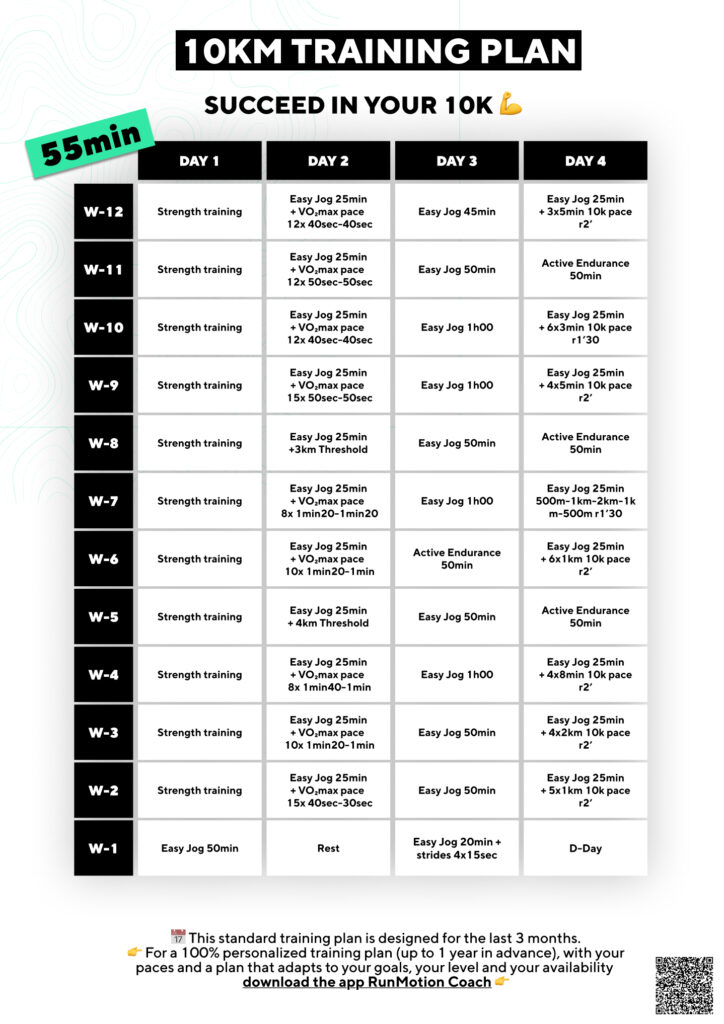
Here’s an excerpt from your 12-week 55-minute 10K training plan (available below):
| DAY 1 | DAY 2 | DAY 3 | DAY 4 | |
| Week 1 | Strength training | easy run 25 min + vVO2max 12×40/40 sec | easy run 45 min | easy run 25 min + 3×5 min at 10K pace (2 min rest) |
| Week 7 | Strength training | easy run 25 min + vVO2max 10×1 min 20 / 1 min | Steady run 50 min | easy run 25 min + 6×1 km at 10K pace (2 min rest) |
| Week 10 | Strength training | easy run 25 min + vVO2max 10×1 min 20 / 1 min | easy run 50 min | easy run 25 min + 4×2 km at 10K pace (2 min rest) |
How should you pace yourself on race day?
A successful 10K is just as much about pacing as it is about training. At the start, the atmosphere and adrenaline often make runners go out too fast. But the few seconds you “win” early can easily turn into minutes lost in the final kilometers.
Try to settle into your target pace from the first kilometers without getting dragged along by other runners. If you hit the 5K mark in about 27:30, you’re right on schedule.
From kilometer 7 or 8, if you’re feeling good, you can start to gradually press the pace and finish strong.
Why recovery matters
Many runners underestimate how important recovery is for real progress.
Your body adapts when it recovers after training. Getting enough sleep, eating well, and respecting rest days help you absorb the work you’ve done.
Good recovery also lowers injury risk and helps you stay motivated long term. Often, it’s better to skip a session when fatigue is high than to stack workouts and end up injured.
Strength training: a smart add-on
Even with a 55-minute goal, strength training can make a real difference. A few simple exercises done once or twice per week help strengthen the muscles used in running, improve posture, and reduce muscular imbalances.
Core work, squats, and lunges are excellent choices to complement your 10K preparation.
Train for your 10K with RunMotion Coach
Everyone has a different starting point and different constraints. A standard plan can be a solid framework, but it can’t account for everything that makes you, you: schedule, athletic background, personal life, and more.
With RunMotion Coach, you get a training plan that adapts to you. Your sessions evolve as you improve, so you arrive ready on race day. With training tailored to your level and a smart pacing strategy, breaking 55 minutes in the 10K is a very realistic goal.
Download the RunMotion Coach app to get your personalized 10K training plan.
FAQ: 55-minute 10K training plan
What pace should you target to run a 55-minute 10K?
A 55-minute goal equals an average pace of 5:30 per kilometer. This speed is achievable for many regular runners after a few months of structured training. Endurance work and consistent weekly training are the foundation for reaching this target.
What 5K time suggests this goal is realistic?
If you can run a 5K in roughly 26 to 27 minutes, you usually have the potential to aim for 55 minutes over 10K. It’s only a guideline and it also depends on the endurance you build in training. A well-designed plan often turns that potential into race-day performance.
How can you improve your endurance to break 55 minutes?
Endurance is built mainly through low-intensity running, especially easy runs. These sessions gradually increase your ability to sustain effort without excessive fatigue. Consistency is still the most important factor for lasting progress.
Do you need to do intervals?
Intervals aren’t mandatory, but they’re a great addition to a 10K training plan. They improve speed, running form, and cardiovascular capacity. Combined with endurance training, they usually lead to faster progress.
How many weeks do you need to prepare for a 10K?
An 8 to 12-week training block is usually enough to move toward this goal. The ideal duration depends on your starting level and running experience. The more gradual the progression, the more sustainable the results.