Have you been running for a while and want to train for a marathon? You are in the right place. Discover a training plan to run your marathon in 3:30!
Contents
Requirements for Running a 3:30 Marathon
Running a 3:30 marathon is an ambitious goal that requires a few key foundations. Following a training plan alone is not enough. You also need a solid fitness base, running experience and a sufficient vVO2max level.
Basic Fitness
To run a marathon in 3:30, you need to be able to run continuously for at least 90 minutes without difficulty or pain. This means having good endurance, or the ability to sustain a moderate effort over a long period.
Easy-run fitness is built through long runs at an intensity between 65% and 75% of your maximum heart rate, or HRmax. HRmax can be estimated by subtracting your age from 220. For example, for a 40-year-old runner, HRmax is 180 beats per minute, or bpm, so the easy-run range is between 117 and 135 bpm.
Calculate your vVO2max, your endurance and estimate your next marathon finish time with our calculator.
Running Experience
To target a 3:30 marathon, you also need some running experience, especially over shorter distances. It is recommended that you have completed at least two or three half marathons, so you are familiar with pacing, nutrition, hydration and recovery.
A half marathon time of 1:40 or faster is also recommended. This equates to 12.7 km/h, or 4:43 min/km. It shows that you have the speed required to hold 12 km/h, or 5:00 min/km, over the marathon distance.
It is important to know that running a maximum of three marathons per year is recommended to prevent injuries, allow for optimal recovery and maintain a high level of performance.
Nutrition and Hydration for a 3:30 Marathon
Nutrition and hydration are key factors in marathon success. They affect your energy, recovery and performance.
Here are a few guidelines to follow:
- Gradually increase your carbohydrate intake during the three weeks before the marathon to top up your glycogen stores. Aim for around 7 to 10 g of carbohydrates per kg of body weight per day, choosing low- to moderate-glycemic-index sources such as pasta, rice, potatoes, fruit and bread.
- Hydrate regularly throughout the day by drinking water, tea, herbal tea, fruit juice or sports drinks. Avoid alcohol, coffee and soda, which have a diuretic and dehydrating effect.
- The day before the marathon, eat a carbohydrate-rich meal that is not too large or too high in fat to avoid digestive issues. For example, you could have pasta with tomato sauce, chicken, a green salad, yogurt and fruit purée. Drink plenty of water, but not so much that you dilute your electrolytes.
- On marathon morning, have a light, easy-to-digest breakfast around three hours before the start. For example, you could eat toast with honey, a banana, orange juice and coffee. Drink a little water, but not too much so you do not need to stop for the bathroom during the race.
- During the marathon, drink regularly at aid stations, around 150 to 200 ml every 5 km, to replace fluid losses. Alternate between water and sports drinks, which provide carbohydrates and electrolytes. Also take gels, such as Maurten gels, or energy bars, aiming for around 30 to 60 g of carbohydrates per hour to maintain blood sugar levels and delay fatigue.
If you want to go further and build your race strategy, we have developed a tool that lets you create a personalized race plan, including split times, paces, nutrition and hydration management. Everything you need to manage your race on the big day.
👉 Head to Race StrategyRace Strategy.
8-Week and 12-Week Marathon Training Plans
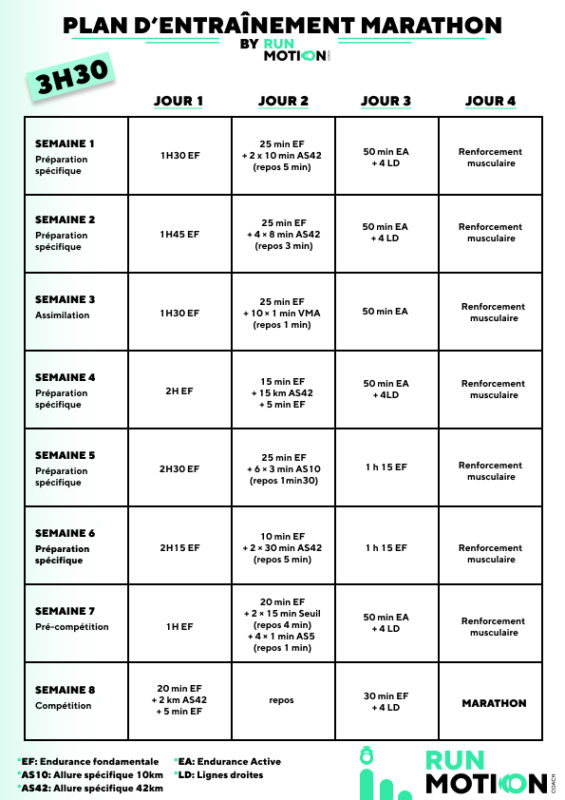
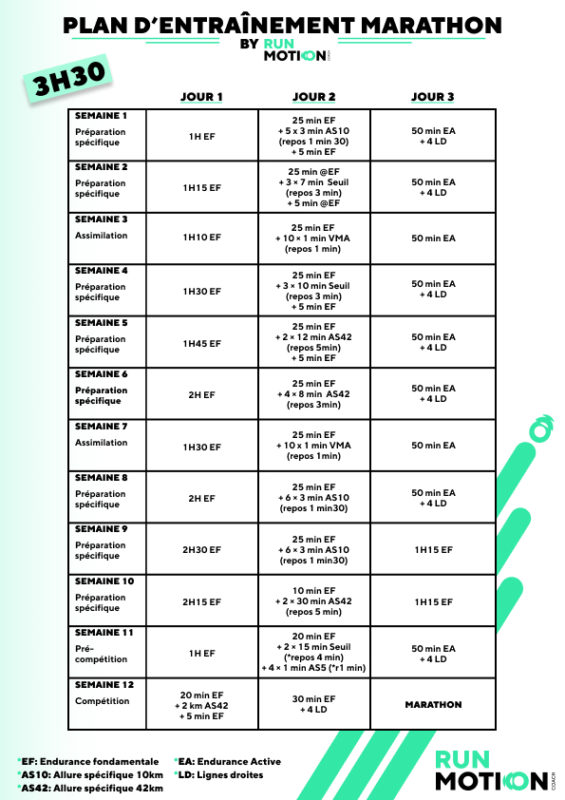
If you meet the requirements for a 3:30 marathon and are motivated to reach your goals, it is time to discover an example training plan. We offer a four-workout-per-week program over eight weeks and a three-workout-per-week program over 12 weeks.
These plans include vVO2max workouts, easy runs and long runs.
Here is an extract from your 12-week 3:30 marathon training plan, shown below:
| DAY 1 | DAY 2 | DAY 3 | |
| Week 1 Specific preparation | 1 hour easy run | 25 min easy run + 5 x 3 min at 10K pace (90 sec recovery) + 5 min easy run | 50 min steady endurance + 4 strides |
| Week 7 Adaptation | 1 hour 30 min easy run | 25 min easy run + 10 x 1 min at vVO2max (1 min recovery) + 5 min easy run | 50 min steady endurance |
| Week 10 Specific preparation | 2 hours 15 min easy run | 10 min easy run + 2 x 30 min at marathon pace (5 min recovery) | 1 hour 15 min easy run |
3:30 Marathon Training Plan: 8 Weeks, 4 Workouts
3:30 Marathon Training Plan: 12 Weeks, 3 Workouts
Your 3:30 Marathon Training Plan With the RunMotion Coach App
Training for a 3:30 marathon is a demanding challenge that requires patience and determination.
Rather than following a fixed PDF marathon training plan, we recommend using the RunMotion app instead. It gives you a personalized marathon training plan based on your availability and current fitness level. Benefit from expert advice and discover dedicated modules, including strength training, for a complete marathon preparation !
We wish you a great 3:30 marathon training block and hope to see you again soon for training for a 3:15 marathon 😉
You may also be interested in these articles:
- Marathon 4h30: Achieve Your Goals4:30 Marathon: Achieve Your Goals
- Run Your Marathon in 4h15: Our Best TipsRun Your Marathon in 4:15: Our Best Tips
- 4-Hour Marathon Training
- 3:45 Marathon Goal: Our Advice
- Sub-3-Hour Marathon Training
FAQ: 3:30 Marathon Training Plan
What marathon pace do I need to finish in 3:30?
A 3:30 marathon requires an average pace of around 4:58 per kilometer. This pace demands strong endurance and consistent, specific training.
What half marathon time supports this goal?
Runners capable of completing a half marathon between 1:35 and 1:40 generally have a level that is compatible with a 3:30 marathon goal.
What vVO2max do I need to run a 3:30 marathon?
Although vVO2max is not the only performance indicator, a vVO2max of around 16 to 17 km/h is often seen in runners targeting a 3:30 marathon.
How should I pace my effort to avoid slowing down after 30 km?
Consistent pacing, smart hydration and appropriate fueling are the keys to limiting late-race fatigue and maintaining a steady rhythm all the way to the finish. Find more information in this dedicated article.
How many kilometers per week are needed?
Most runners training for a 3:30 marathon cover between 50 and 70 kilometers per week, spread across several complementary workouts.