In triathlon, we talk nonstop about swim, bike, and run training, but we too often forget a discipline in its own right, the transition. A lot of athletes, even experienced triathletes, lose several precious minutes every season because their transitions are poorly prepared, messy, or simply never practiced. Yet a well-executed transition does not require extra watts or an exceptional vVO2max, it requires method, anticipation, and a bit of practice.
In this article, we will look at how the two triathlon transitions work, T1 (swim to bike) and T2 (bike to run), which mistakes the fastest triathletes avoid, and how to adjust your preparation based on your level.
Contents
Why triathlon transitions deserve as much attention as the three disciplines
In a triathlon, the clock never stops. From the moment you get out of the water to the finish line, every second spent looking for your helmet, untangling your laces, or figuring out where your bike is in transition counts exactly the same as a second gained by pushing harder on the pedals.
Beyond pure time loss, a chaotic transition also has a physiological and mental cost. Rushing, panicking because you cannot find your gear, or realizing you forgot to rotate your race belt before the run creates a stress spike that disrupts breathing and clear thinking for the next few minutes. On the other hand, a smooth, automatic transition lets you restart with a controlled heart rate and a clear mind, and that can genuinely change how the rest of your race unfolds.
T1 setup: from swimming to cycling
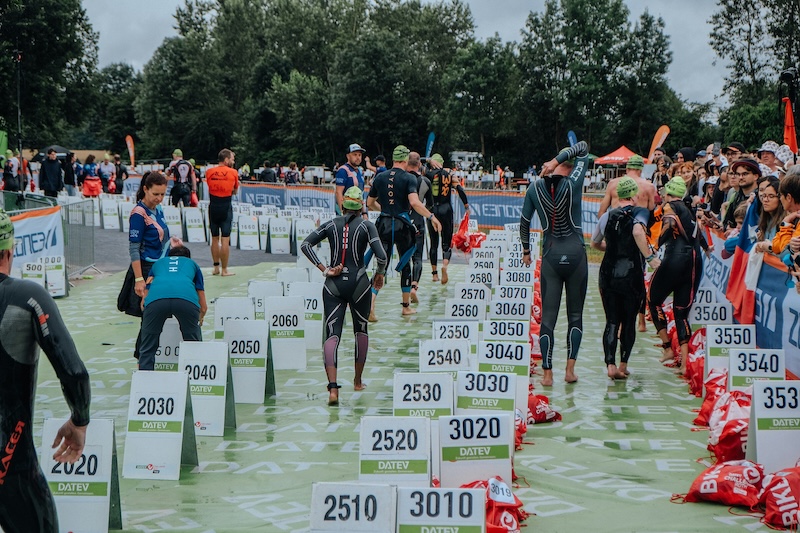
Getting out of the water is often the most unsettling moment of the race for less experienced triathletes. After several minutes, or even dozens of minutes, in a horizontal position, standing up and running to transition frequently causes dizziness and heavy legs as blood flow suddenly redistributes. Your first reflex should be to slightly ease into your stride as you exit the water rather than sprint right away, just long enough for your circulation to stabilize.
Next comes removing the wetsuit, often underestimated in training even though it can make up a big chunk of transition time for beginners. The most effective approach is to unzip in the water or right as you get out, then peel the top down to your waist while running toward transition. Once you arrive, sit down or step on the suit to free each leg with a sharp pull rather than endlessly yanking at wet neoprene, which naturally sticks to your skin. Practicing this move dry at home makes a real difference on race day, many first-time triathletes discover in competition just how hard it is to remove a wet wetsuit.
Once you are in transition, the sequence needs to follow a logical order and always be the same, so your body can do it on autopilot without thinking:
- quickly wipe your feet with a small towel to avoid sand or gravel sticking to your shoes,
- put your helmet on before touching your bike (this is mandatory at almost every race),
- add sunglasses if needed,
- then unrack your bike.
More advanced triathletes use rubber bands or leave shoes already clipped into the pedals to save a few more seconds, but this technique requires real practice beforehand and is not recommended until you can execute it perfectly while stationary.
Managing T2: from cycling to running
The second triathlon transition brings a different challenge, running right after cycling, sometimes after several hours in the saddle. Your muscles, heavily loaded on the bike, must quickly switch to a different running pattern. That is exactly why bike-to-run combo sessions, also called brick workouts, are a key part of specific triathlon training, they teach your body to handle that unusual sensation of “dead legs” and help you find an efficient stride faster.
Practically speaking, as you approach the transition area, it is recommended to start getting your feet out of your cycling shoes a few meters before the dismount line if you have mastered the skill, or simply dismount calmly if you have not, safety always comes before speed at this point in the race. Once at your rack, your helmet comes off last, after you have racked your bike, again because most events enforce strict helmet rules. Running shoes, ideally set up with elastic laces or a quick-lace system, can save meaningful time compared with traditional lacing, especially late in the race when fine motor skills fade with fatigue.
The first minutes of the run after the bike often feel uncomfortable, with heavy legs or a choppy stride. That is normal and temporary, it is better to accept a slightly slower pace for the first 500 to 1000 meters rather than forcing the speed immediately, which only leads to early, unnecessary lactate buildup on the run.
Set up your transition area: the foundation of a great transition
Beyond technique, gear organization is often what makes the difference between a smooth transition and a stressful one. The simplest rule is to lay out your equipment in the exact order you will use it, left to right or top to bottom depending on the space: towel on the ground, helmet and glasses placed on the handlebars or next to them, cycling shoes already clipped into the pedals if you have mastered the method, then a bit further your running shoes, cap, and race bib already prepared on a race belt.
It is also essential to physically locate where your bike is before the start, memorizing fixed landmarks like a pole, a banner, or your rack number. Searching for your bike among hundreds of others under stress is one of the most common causes of lost time, even for experienced triathletes. Many clubs and coaches recommend doing this walk-through the day before the race, with a clear head, rather than on race morning in a rush.
The most common mistakes in triathlon transitions
Some mistakes show up again and again, no matter your level. Forgetting to rotate your race belt before heading out on the run, leaving without your sunglasses when the sun is blazing, or skipping anti-blister prep like lube or talc in your shoes for long-distance triathlon are details that seem minor in training but can ruin an entire race. Another classic mistake is trying brand-new gear, such as new shoes or a new lacing system, on race day instead of in training, transition is never the place to discover your equipment.
How to practice transitions based on your level
For a beginner triathlete, the main goal is not speed but reliability, the priority is to forget nothing and not panic. Doing dry runs at home, repeating the full sequence several times with your own gear, turns an unfamiliar checklist into a reassuring automatic routine. Walking instead of running in transition during your first races is not a problem at this stage, the priority is to execute each step safely.
For an intermediate triathlete who already has the basics, training can focus on cutting time at each step: time your transitions in practice, simplify your setup to reduce the number of actions, and include regular brick workouts to teach your body to run efficiently right after the bike.
For an advanced or performance-focused triathlete, the biggest gains are in the details: flying mounts, leaving shoes clipped into the pedals, skipping socks combined with Vaseline or talc to prevent chafing, and precise, minimalist gear layout. These techniques require repeated, specific practice, because a mistake in a race often costs more time than it is supposed to save.
Triathlon transitions are not just logistics between disciplines, they are part of performance, and they can be trained like any other part of your preparation. By practicing transitions regularly, organizing your setup methodically on race day, and matching your ambitions to your current level, you can save valuable time without burning a single extra calorie. To go further with specific triathlon prep, it can help to combine this work with brick workouts and dedicated training to run faster off the bike.