Triathlon, a unique and thrilling blend of swimming, cycling, and running, stands out as a complete and demanding endurance sport. Linking three disciplines that are both exciting and tough, it calls for consistent, structured preparation. Discover what makes this fast-growing sport so fascinating, and why it keeps attracting more and more athletes worldwide.
Contents
The History of Triathlon
The story of triathlon begins in the 1970s, and its origins are often linked to San Diego, California. The first known triathlon took place on September 25, 1974, organized by Jack Johnstone and Don Shanahan, members of the San Diego Track Club.
This pioneering event grew out of a challenge between athletes from different sports, putting their abilities in swimming, cycling, and running to the test. The concept quickly took off, pushing triathlon toward broader recognition at both national and international levels.
The first official triathlon, known as the Mission Bay Triathlon, was held in 1975 in San Diego and attracted a small but enthusiastic group of participants.
However, the real boom came in 1978 with the creation of the Ironman Triathlon in Hawaii. Ironman, now one of the most iconic events in triathlon, was designed by John Collins and his wife Judy as the ultimate endurance challenge: a 3.8 km swim, a 180 km bike leg, and a 42.2 km run. That is quite a day out.
The Different Triathlon Distances
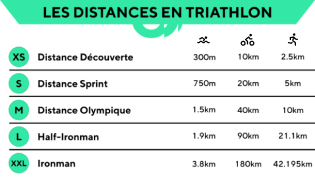
Here are the different triathlon distances, from XS formats to XXL formats.
Swimming in Triathlon
Swimming is the first discipline in triathlon. The swim distance depends on the race format. At the Olympic Games, it is the M distance: you have to swim 1500 meters. That is almost the equivalent of four laps around an athletics track.
Swimming can feel intimidating for runners moving into triathlon. It is important to work on your swim training so you do not lose too much time when exiting the water. For others, the swim is the perfect opportunity to start fast and earn a strong position for the rest of the race.
Cycling in Triathlon
Cycling is the second discipline in triathlon. At the Olympic Games, you ride 40 km, a challenge that demands both endurance and smart race strategy. This leg is crucial because it shapes the rest of your day. Some athletes need to push to move up the field, but not so hard that they burn their matches too early.
Having a properly fitted bike and an efficient riding position is essential so you do not waste energy. It is also at this point, whatever the triathlon distance, that you should start fueling.
Running in Triathlon
Running is the final triathlon discipline, where everything gets decided. At the Olympic Games, the run is 10 kilometers, a real test of endurance and grit after the swim and the bike.
Triathletes must adapt quickly from the cycling position to running. Running form, pacing, and running economy are key to top performance. That is why run training is a cornerstone of triathlon performance and endurance training.
How to Train for Triathlon
To train for triathlon, you need consistency and a structured triathlon training plan. That means combining all three sports and building your fitness across swimming, cycling, and running.
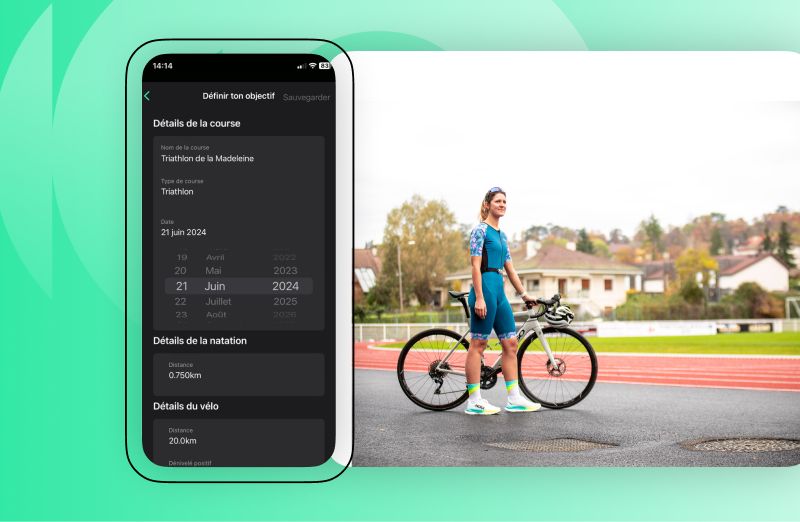
And that is perfect, because at RunMotion Coach we just launched a brand-new module that helps you prepare for triathlon goals with a 100% personalized plan. To download our app and try the triathlon module, go here 😉
We coach triathletes and runners of all levels who want to make the most of their time. These triathlon programs let you choose how many weekly sessions you can do in running (up to 7, since it is usually the easiest to fit in), swimming (up to 2), cycling (up to 2), and strength and conditioning (up to 2), so your training stays complete and fits your schedule.