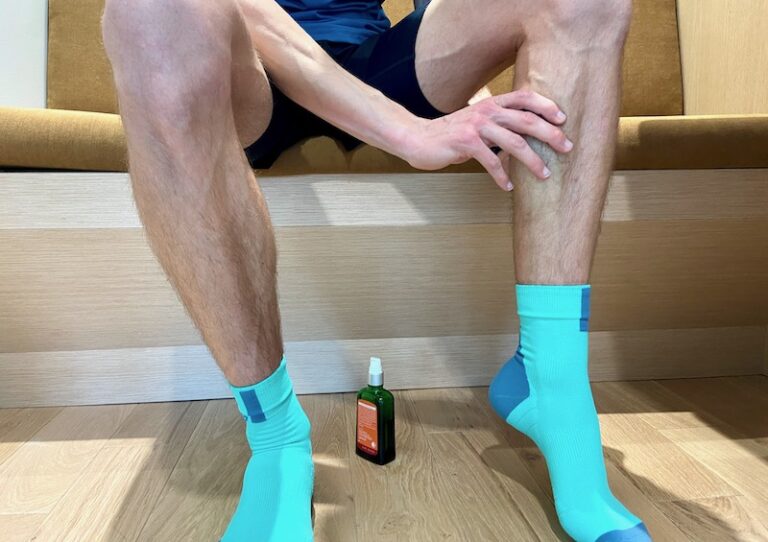
JOLT compression boots promise lighter legs after your sessions. We used them after our running workouts to see what they really bring. Here’s our review, what the science says and how to use them well.
The short answer
- Compression boots inflate and deflate air chambers around your legs, from foot to thigh, to stimulate circulation.
- Studies mainly show an effect on how sore and tired you feel right after use. A performance benefit hasn’t been shown.
- A 20 to 30 minute session after a hard workout or a long run is the most common protocol.
- With JOLT Boots, our legs felt lighter the next day, but the soreness didn’t disappear. They’re a bonus, not a substitute for sleep, nutrition and gradual training.
Contents
What are compression boots?
How pneumatic compression works
Pressotherapy applies pressure to your legs with inflatable cushions. Each boot has several air chambers that inflate one after another, from the foot up to the top of the thigh, then release. This wave-like massage aims to support venous and lymphatic return.
Scientists call it intermittent pneumatic compression (IPC). That’s the term you’ll find in research papers.
From the physio’s office to your living room
For a long time, pressotherapy was only available from physiotherapists and specialist clinics. Recovery boots are now compact enough to use at home after training, which is why they’ve become popular with runners and trail runners.
Do compression boots actually work?
Yes for how recovered you feel, much less clearly for performance. That’s what the available research shows.
A 2024 meta-analysis pooled 17 randomised trials on leg pneumatic compression after exercise (Maia et al., 2024). It found a small effect on perceived soreness, right after the session and four days later. Effects on muscle function, performance and blood markers (CK, lactate) were small or inconclusive.
A trial of 72 Western States finishers (161 km) points the same way (Hoffman et al., 2016). Twenty minutes of compression reduced perceived muscle fatigue right afterwards, compared with simply resting. But there was no difference in pain or in a 400 m running test in the following days.
The takeaway: compression boots feel good and can help you feel fresher. They don’t magically speed up muscle repair.
Our JOLT Boots test
What’s in the pack
For this test, JOLT sent us the full Boots 1.2 pack: two boots, the control unit and a storage bag. Each boot has 6 air chambers, with air flow advertised at 360° around the leg. Pressure goes up to 260 mmHg and the built-in battery lasts 2 to 4 hours depending on the mode, so you can use them unplugged.
JOLT also offers Pants that go up to the glutes, and a Cryo Presso accessory that combines cold and compression. You’ll find the full range on the JOLT website.

Setup and settings
Setup is simple: put on the boots, plug them into the control unit and pick your setting. The instructions are clear and the bag keeps every part in its place. The remote adjusts pressure, speed and rest time between cycles, in sequential mode (chambers inflate one after another) or continuous mode.
Pressure is the trickiest setting. Everyone has their preference: start moderate and build up gradually. It should feel pleasant, never painful. Sit in a semi-reclined position, as the manufacturer recommends.
How our legs felt after training
Romain, co-founder of RunMotion Coach, tested the boots for the team after his sessions. Even after big workouts at his marathon pace (3′35″/km), his legs feel light again the next day and he handles the following sessions more easily. Some soreness remains after the hardest sessions: the boots don’t work miracles.
One trap to avoid: feeling fresher doesn’t mean your muscles and tendons have finished recovering. Don’t use the boots as an excuse to suddenly increase your training volume, it’s the best way to get injured. Gradual progression and easy runs remain the foundation.
Pros and cons
Pros
- A clear feeling of lighter legs after a hard workout or a long run.
- Quick to get started, simple settings.
- Built-in battery: use them on the sofa or when travelling, without plugging in.
Cons
- A significant budget for a recovery tool.
- A benefit that’s mostly felt, with little evidence on performance.
- You need to stay still for 20 to 30 minutes each session.
How to use compression boots after a run
When should you use them?
The most useful time is in the hours after a demanding session (intervals, long run, race) or in the evening, when you’re relaxing. After an easy run, the benefit is more limited. Save them for the sessions that really leave your legs heavy.
How long and at what pressure?
Studies most often use 20 to 30 minute sessions, around 80 mmHg (Maia et al., 2024). No optimal protocol has been established yet. Start low, then increase if it stays comfortable. There’s no need to use the device’s maximum pressure.

What the boots don’t replace
The basics of recovery are still sleep, nutrition, hydration and well-dosed training. We cover them in our article on how to recover from training. Boots come on top, just like compression socks or self-massage.
How to choose compression boots
If you’re comparing models, look at these criteria:
| Criterion | Why it matters | JOLT Boots 1.2 |
|---|---|---|
| Number of air chambers | More chambers = more gradual compression | 6 per boot |
| Maximum pressure and settings | Adjust the pressure to how it feels | Up to 260 mmHg, adjustable pressure, speed and rest |
| Compression modes | Adapt the massage to your needs | Sequential and continuous |
| Battery life | Use the boots anywhere, cordless | 2 to 4 h depending on the mode |
| Area covered | Legs only or up to the glutes | Legs (Pants model for the glutes) |
Our verdict on JOLT compression boots
JOLT compression boots deliver on comfort: lighter legs and a more pleasant recovery after big sessions. They’re mostly worth it for runners who train often, are preparing a marathon or a trail race, or stack demanding sessions. If you run twice a week at an easy pace, your budget is better spent elsewhere.
To go further, read our tips on how to recover after a race.
JOLT discount code: RunMotion private club members get an extra 5% off on the JOLT website, even during sales. The discount is applied automatically in your cart with this RUNMOTION link.
FAQ: compression boots
Do compression boots really work?
They mainly reduce how tired and sore you feel right after using them. Studies don’t show a clear effect on performance or on markers of muscle damage. They’re a useful comfort tool, not a shortcut to progress.
How long should you use compression boots?
Most studies use 20 to 30 minute sessions. That’s also what we recommend after a hard workout or a long run. There’s no need to go much longer.
Can you use compression boots every day?
Nothing requires daily use. Save them for days when your legs feel really heavy: after intervals, a long run or a race. And if pain persists, the boots won’t fix it: see a health professional.
What pressure should you use on compression boots?
Start with a moderate pressure and increase gradually. Study protocols are often around 80 mmHg. The compression should stay comfortable, never painful: there’s no need to use the device’s maximum.
Are there contraindications to pressotherapy?
Yes. Ask your doctor before using compression boots if you have vein problems (phlebitis, blood clots), heart or vascular disease, if you’re pregnant or have a wound on your legs. Read the manufacturer’s instructions too.
Sources
- Maia F, Nakamura FY, Sarmento H, Marcelino R, Ribeiro J. Effects of lower-limb intermittent pneumatic compression on sports recovery: a systematic review and meta-analysis. Biology of Sport, 2024;41(4):263-275. DOI: 10.5114/biolsport.2024.133665
- Hoffman MD, Badowski N, Chin J, Stuempfle KJ. A randomized controlled trial of massage and pneumatic compression for ultramarathon recovery. J Orthop Sports Phys Ther, 2016;46(5):320-326. DOI: 10.2519/jospt.2016.6455
Updated on 24 October 2026.