A marathon is an adventure, a journey of self-discovery. The idea of running one had been on my mind since I cheered on runners at the Boston and New York marathons in 2017 and shared a few long runs with marathoner friends. Like a travel diary, here are my impressions of this very special week and of the Lausanne Marathon (2:28), where I went through everything.
Contents
Monday 22 October
It’s the last week before the marathon. I’m not at my best: I’ve been dragging a nasty cold since the middle of last week, and the training weekend was chaotic. All the kilometres piled up during the marathon build-up, plus the final tweaks before the launch of the RunMotion Coach app, have left me tired.
I take these signals seriously and rest. It’s as if my body were telling me to ease off this week so I arrive on Sunday completely fresh. On Sunday, a relaxation session at the thermal baths in Aix-les-Bains did me a world of good. Rest today and tomorrow.
Tuesday 23 October
I read the athle.ch article previewing the Lausanne Marathon. I’m presented as one of the favourites, despite this being my debut over the distance. It makes me smile to be billed as a favourite against a runner who has won more than five marathons this year.
I chose Lausanne because the city inspires me. It’s the Olympic Capital, the city where I watched the champions at the Athletissima Diamond League meeting and met David Rudisha, Olympic 800 m champion. It’s also on this course that I set my 10K personal best in 2014 (29:31), winning the race to everyone’s surprise, including mine! This time there are “only” 32 more kilometres to discover.
Everyone tells me the course isn’t fast, as if trying to persuade me to pick a pancake-flat course for this first attempt. Frankfurt, the same weekend, could have been the ideal course, but I’ll go for ultra-fast marathons once I can complete a more thorough marathon build-up.
Wednesday 24 October
I start reading a book of quotes from around fifteen marathoners, famous and anonymous, and soak up this unique atmosphere. Emil Zátopek said: “If you want to run, run a mile. If you want to experience a different life, run a marathon.” How could a marathon be harder than an 800 m or a 1500 m, where, flooded with lactate, it’s not unusual to throw up once you cross the finish line?
The one-hour race-pace reminder session, with 3 km at 3:25/km, my planned pace for Sunday, reassures me. The legs are back, and so is the relaxation in my shoulders.
Thursday 25 October
The excitement is building. I love feeling the buzz I used to get before big events, like the French Championships or my first races in the national team vest. Over the past few months I’ve turned up to most races without that excitement, and I’ve missed it. The marathon adventure is above all a race against yourself. A thrilling challenge.
Easy 50-minute jog with Romain.
Friday 26 October
I prepare mentally with a sophrology session to get ready for battle, all the more so since rain, wind and cold are forecast for Sunday. All the better: if you’re going to run a marathon, it might as well be truly epic…
Rest day today, as I’ve done two days before a race for many years. Never change a winning formula.
Saturday 27 October
The day before the race: about twenty minutes of jogging and four 15-second strides. I feel excellent.
Over the last four weeks I’ve run between 50 and 70 kilometres a week, well below my September average of 105 kilometres. My body slowed me down, but I’m arriving fresh. I know I’ll be better prepared for my next marathons. Still, the 31 km long run with 27 km at 3:27/km at the end of September reassures me, and I’ll set off on 2:25 pace (3:26/km).
This first marathon will be a discovery. I’ve only managed five weeks of solid training, so I want to enjoy this new adventure.

Sunday 28 October: first marathon, race day!
Snow has fallen on the Alps and it’s freezing outside! Conditions will be the same for everyone, so I might as well see them as an ally. The rain kindly stops just as we head out to warm up: ten minutes or so and a few strides to get dialled in.
And we’re off! As always, one runner sprints away to get in the race photos, and we let him go. I run side by side with Romain for the first few hundred metres. Everyone is watching each other, I check my watch: a very relaxed start at 3:40/km. We catch the early leader on the downhill in the second kilometre, and I use it to speed up slightly and settle into race pace. I’m alone at the front with Ethiopian Masha Feleke until km 5, where Moroccan Alaa Hrioued, Ethiopian Tura Kumbi and Kenyan Schumbi join us.
I try to avoid the puddles, but I can already feel my socks are wet. They’ll give me two big blisters later on. We get hit by some strong gusts, and everyone tries to shelter as best they can. I feel good, so I set much of the pace. That lets me open up my stride, and at these speeds you don’t waste energy leading.
We go through 10 km in a high 34 minutes, and the serious business is about to start. In places the view over the lake is stunning. The snow-capped mountains in the distance are breathtaking. The autumn colours on the Lavaux vineyards, terraces listed as a UNESCO World Heritage Site, are soothing.
On one of the climbs, Feleke, in a yellow vest that blends perfectly with the autumn colours, launches a fierce attack. Kumbi tries to bridge shortly after, and the experienced Hrioued, winner of more than five marathons this year, gradually brings Schumbi and me back to Feleke, who had built up a gap of up to twenty seconds.
I realise that, just like on a Tour de France stage, we’re a five-man breakaway, each sizing up the others and playing mind games. All that’s missing is a motorbike announcing the time gaps to feel like a real bike race! I find it absolutely incredible: in running, only the marathon or trail can offer that.
The kilometres fly by, and I spot the first marker: km 17. I don’t think there were any before that one. Truth is, I didn’t notice. I’m starting to feel hot and hand my gloves and headband to a motorbike commentator. Then I fuel with an energy purée I carried with me, taking a few sips regularly until km 30.
Leading the Lausanne Marathon
I feel good, and on a slight downhill drag I gradually pick up the pace as we approach Vevey. Feleke follows: him at 1.65 m with a quick stride, me at 1.88 m with long strides, two opposite body types that are just as efficient. We have a 20-second lead at halfway, going through in 1:11:58. I feel good even though I know I’ve upped the pace. We turn around to start the way back. I’m happy to see Romain, and we wave to each other.
The runners we pass on the way back cheer us on. I’d love to cheer them in return, but we stay focused on our race. I see crowds of runners around the pacers, the runners setting the rhythm for 3:00, 3:30 or 4:00 finishes.
Around the 25th kilometre, Hrioued, Kumbi and Schumbi catch us, and my legs start to feel the ups and downs. I still lead the pace: the kilometres seem to pass faster that way. We reach 30 km and I still feel great! I try to stay as relaxed as possible, especially in the shoulders. I take a gel at km 32, as planned in my fuelling strategy.
At km 34, Hrioued attacks and Kumbi follows. Feleke tries to hang on and I try to do the same. My legs aren’t responding as well, and my hamstrings tighten a little more with every stride. I try twice to grab a cup at the aid station, but I’m not lucid enough to catch it. That attack hurts me badly.
Hitting the marathon wall
At km 35, the pace suddenly drops: I hit the marathon wall head-on! My muscles need energy, but my body can no longer supply it. I feel my hamstrings ready to cramp at any moment. I take no risks and try to finish as best I can, because I want to reach the line without having to walk because of cramp. It reminds me of the Ancilevienne, a 46 km run & bike race where cramps floored me in the last 5 kilometres. I try to stay as relaxed as possible and keep my stride as light as I can.
The kilometres seem endless! I wait for every sign so impatiently. Only the finish line can free me from this ordeal. I reach km 39, and even though the hardest part is done (what’s 3 kilometres?), I feel my hamstrings could give way at any moment. On the track it’s sometimes tough and you hang on as best you can, but I had never experienced moments like these while running. This is what I came for.
I start wondering whether I’ll get under 2:30, the minimum goal I’d set myself. I grimace, I grit my teeth, I must be a horrible sight. Kilometre 40: please let it end. Emotion rises after these hard moments: I know I’m reaching the end of the marathon adventure and that I’ll be a marathoner in 2 kilometres.
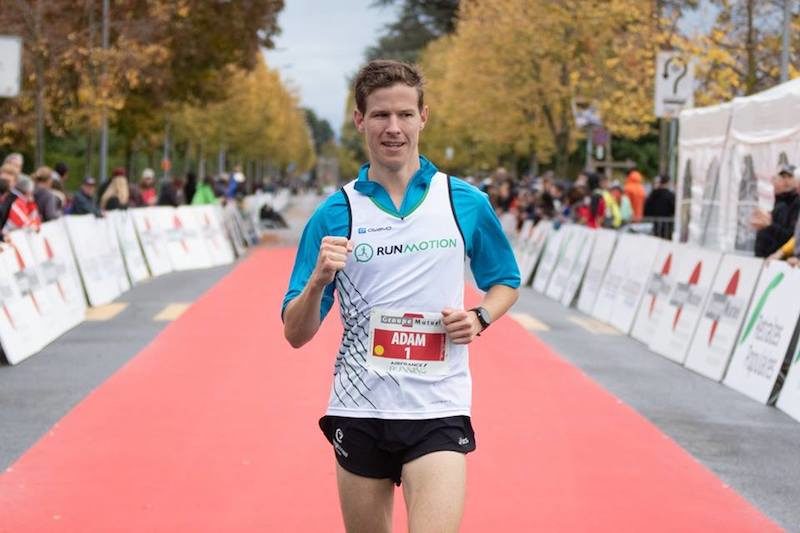
The last 2 kilometres are mostly downhill: what a relief! I try to spare my hamstrings as much as possible, which gives me a rather odd gait. The final straight, half a kilometre long, goes by quickly, and I see the red carpet in the distance. I look back and see that I’ll hold on to fourth place. I pump my fist as I cross the line: I’ve lived an extraordinary adventure, a thousand times more than I could have imagined! I’m almost surprised to cross the line in 2:28, given how little I was moving in the final kilometres.
I hug Romain when he arrives a little under 10 minutes later, delighted with his own marathon adventure too. Maybe by racing differently I could have made the podium, but that’s not what I came for. I came for an incredible adventure and to learn more about myself. I got plenty of both.
I raced boldly, and there will be other marathons to bring the time down. I already have only one thing on my mind: “What will my next marathon be?”


Photo credits: 1st: Athle.ch | 2nd and 3rd: Michel Adam