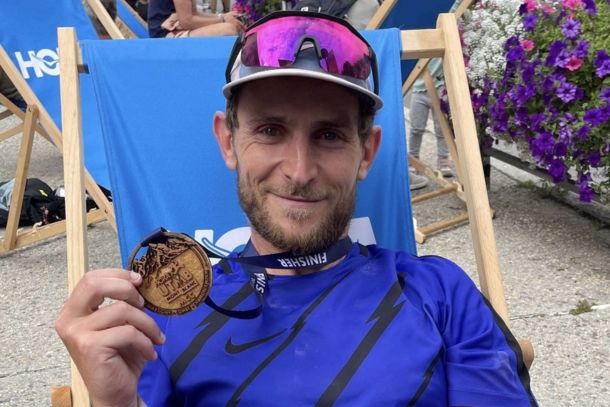

When Xuane Nguyen steps onto the start line of the Backyard Ultra des Barjots, he knows he is about to dive into something extraordinary.
What he does not know yet is that he will spend nearly three days running almost non-stop, that he will string together 66 loops of 6.706 km and cover 443 kilometres in total before finally stopping.
It is a jaw-dropping endurance performance, and it captures exactly what makes the Backyard Ultra so unique. There is no set distance. No finish line to chase. Just one question: How many times will you be able to go back out?
Contents
- The Backyard Ultra, where the last runner standing wins
- “At first, it feels like it is easy”
- Running 443 kilometres, above all, a lesson in pacing and management
- Sleep, the invisible opponent
- As much a mental adventure as a physical one
- A unique atmosphere in the trail running world
- What Xuane’s experience teaches us
- Why are Backyard Ultras attracting more and more trail runners?
The Backyard Ultra, where the last runner standing wins
Created by Lazarus Lake, also the mastermind behind the legendary Barkley, the Backyard Ultra is built on a simple rule: every hour on the hour, runners start a 6.706-kilometre loop. To stay in the game, you must finish the loop before the hour is up. Back at base camp, whatever time is left can be used to eat, hydrate, change clothes, or try to recover.
Then a new hour starts.
And a new loop.
Until only one runner is still able to head back out.
This format completely reshapes your approach to running: speed becomes secondary. What matters is your ability to endure, manage fatigue, and keep showing up.
“At first, it feels like it is easy”
That is one of the classic traps of the Backyard Ultra.
The early loops can feel almost harmless for a trail runner used to long distances. The pace is controlled, the aid is close, the body feels fresh.
But as Xuane explains, the real difficulty is not in the first hours. It builds gradually, often when runners start stacking fatigue, sleep deprivation, and muscle soreness.
The Backyard Ultra is the kind of endurance event where every small mistake eventually comes back to cost you, sometimes dozens of hours later.
Running 443 kilometres, above all, a lesson in pacing and management
When you hear 443 kilometres, your mind immediately goes to exceptional physical capacity.
Of course, endurance fitness matters. But Xuane’s result is driven mainly by his ability to manage effort. In a Backyard Ultra, going out too fast gives you no advantage. If anything, it is a mistake. The best runners constantly try to save energy by holding a comfortable pace, cutting out wasted effort, optimising every stop at base camp, and planning ahead for the hours to come.
Loop after loop, the race becomes a continuous exercise in self-control and smart ultra running strategy.
Sleep, the invisible opponent
After a typical sleepless night, most of us already struggle to stay focused. Now imagine running through two nights in a row…
One of the most fascinating parts of Xuane’s story is precisely his sleep management. In a Backyard Ultra, every minute is valuable. Do you grab a few minutes of sleep? Is it better to stay awake? How do you recover enough before the next start?
Little by little, these questions become more important than running pace itself. The difference is often made by who can keep moving despite the sleep deprivation.
As much a mental adventure as a physical one
As the hours pass, the Backyard Ultra reveals another truth: your legs are not always the limiting factor.
Xuane describes how the goal shifts over time. At first, you might think about a distance, then about the next night. After that, it becomes simply the next loop, then just making it to the next start. The race breaks down into smaller and smaller targets.
This ability to stay locked into the present moment is often what keeps you going when the body starts sending loud signals of fatigue.
A unique atmosphere in the trail running world
Paradoxically, the Backyard Ultra is one of the most competitive and most friendly races out there. Rivals share the same base camp, cross paths every hour, and live through the same challenges.
And the deeper the race goes, the more the remaining runners develop genuine mutual respect, because everyone knows that the other person’s performance also fuels their own adventure. To chase records or reach extraordinary distances, you need others to keep heading back out too.
That dynamic creates a one-of-a-kind atmosphere many participants describe as addictive.
What Xuane’s experience teaches us
Beyond the 443 kilometres, Xuane’s story highlights a few universal lessons for endurance athletes. The first is that big performances are rarely built on constant heroics. They usually come from an accumulation of simple good decisions:
- start conservatively;
- fuel regularly;
- accept slowing down;
- stay focused on the next step.
The second lesson is about the mental game. A Backyard Ultra does not require you to believe it will be easy. It requires you to accept that tough moments will come, and to keep going anyway.
Finally, it reminds us that endurance is often less about speed and more about patience, pacing, and resilience.
Why are Backyard Ultras attracting more and more trail runners?
The growing popularity of Backyard Ultras is probably no accident. In a world obsessed with split times and rankings, this format offers a different view of performance. It is not only about running fast, it is about managing energy, sleep, emotions, and motivation, sometimes over several days.
A Backyard Ultra is not just a race, it is an exploration of your own limits. And sometimes, as Xuane proved with his breakthrough ultra endurance feat, those limits are much farther away than you think.
This article is an excerpt from the episode “Backyard Ultra: the format that pushes runners to their limits, with Xuâne Nguyen” from the podcast BPM by RunMotion Coach.