 Choosing the right pair of running shoes for a race feels essential. Almost unavoidable, you could say. Could you imagine lining up for a road race barefoot? Now imagine doing that for a marathon…
And yet, just over 50 years ago, one athlete took off barefoot for 42.195 km, and not at some small-town fun run, no. At the Olympic Games. Rome, 1960.
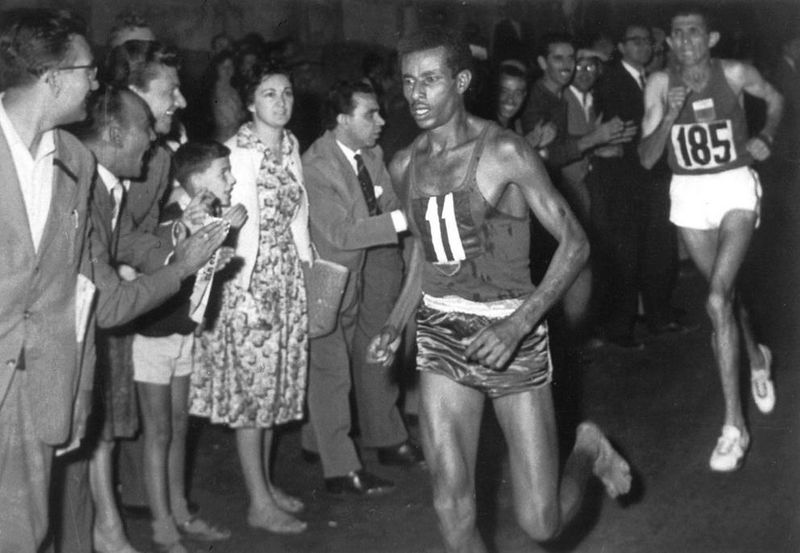
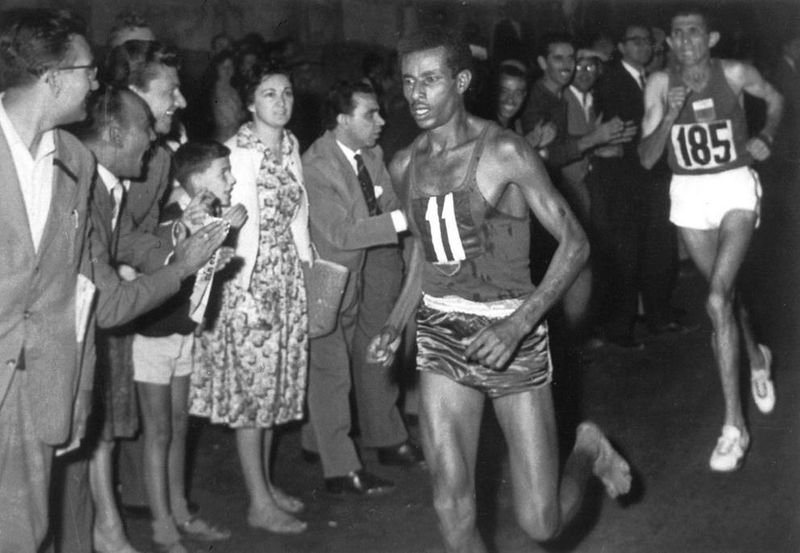
His name? Abebe Bikila. The Ethiopian runner started the Olympic marathon barefoot, under awkward stares and smug smiles from the crowd, the experts, and sometimes even other runners.
Contents
Abebe Bikila, the surprise of the Rome Olympics
Legend has it that on site, Bikila tried several pairs of shoes, but none felt right, and some even gave him blisters.
Before the gun, Abebe Bikila was not on anyone’s list of favorites. His best time of 2:21 at altitude was dismissed by specialists as unrealistic, it sounded downright insane.
The race starts, and within the first kilometers a lead pack breaks away, including the Ethiopian and the pre-race favorite, Morocco’s Rhadi Ben Abdesselam. The two men stay locked together until the 41st kilometer, the moment Abebe Bikila chose to launch his attack.
The finish in Rome, a powerful symbol
A hugely symbolic place, because this is where the Obelisk of Axum stood, brought back from Ethiopia by Italian troops after Mussolini’s invasion a quarter of a century earlier.
Bikila crossed the finish line as the winner, barefoot, with a world record by a single second, 2:15:16. He made history as the first East African to win an Olympic medal.
After the race, he said with great modesty: “In the Imperial Guard, there are many other runners who could have won in my place.” Then he added, “I wanted to show the world that my country, Ethiopia, has always won with determination and heroism!”
Another Olympic masterpiece for Abebe Bikila in Tokyo 1964
Abebe Bikila still trained barefoot, and over time a thick, tough callus formed under his arch. For him, barefoot running was no more painful than running in shoes.
Four years later, the legend continued. He underwent surgery for acute appendicitis just 35 days before winning the Tokyo Olympic marathon (2:12:11, another world record). This time, with a pair of running shoes on his feet…
He passed away on October 25, 1973 in Addis Ababa, leaving a massive mark on Olympic history and in Ethiopia.
A story that puts a spring in your step! 😉
His Olympic performances on video: