 The word “mile” comes from the Latin “mille”, tied to the distance Roman soldiers covered in 2,000 steps. The mile is used as a unit of measurement in the United Kingdom and the United States, and by the international agreement of July 1, 1959, it measures exactly 1,609.344 meters.
The mile earned its place in sporting royalty at the end of the 19th century, when pedestrian races became one of England’s most popular sports, led by Walter George, the first true star miler. Since then, legends like Finland’s Paavo Nurmi, Australia’s Herb Elliott, Britain’s Sebastian Coe, and Morocco’s Hicham El Guerrouj have helped turn this distance into a symbol of speed, grit, and endurance performance. Still, the man who permanently stamped his name on mile history is the Briton Roger Bannister.
From 1942 to 1945, Sweden’s Gunder Hägg and Arne Andersson took turns lowering the mile world record from 4:06.6 to 4:01.4. In the early 1950s, elite milers kept hitting a wall at that mark. Observers even began to believe the human body had reached its physiological limit, and that we would never see a runner break the 4-minute mile.
Contents
Roger Bannister’s legendary feat
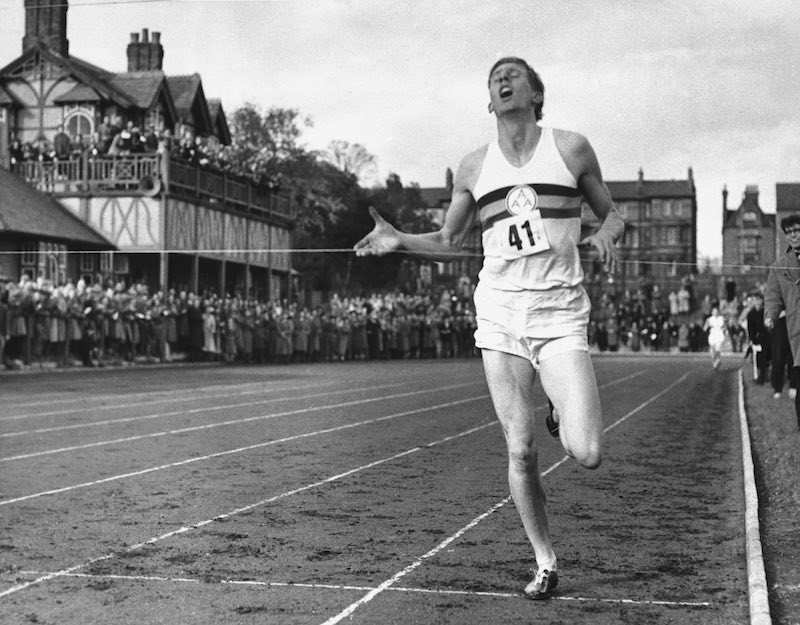
May 6, 1954 shattered those “certainties.” A young medical student, Roger Bannister, committed himself to that seemingly impossible mission. Nearly 3,000 spectators packed the Oxford track to support the British runner. Bannister hesitated, the strong wind could ruin everything. Then the weather improved, confirmed by the flag flying atop Oxford’s tower, and the attempt was on. Perfectly paced by his two pacers, Chris Chataway and Chris Brasher, in 1:58 at the half-mile and 3:01 with one lap to go, Bannister unleashed a surge on the final lap.
To keep the suspense alive, announcer Norris McWhirter began the time announcement: “Ladies and gentlemen, here is the result of event 9, the mile: first, number 41, R. G. Bannister, Amateur Athletic Association and formerly of Exeter and Merton Colleges, Oxford, with a time which is a new meeting and track record and which, subject to ratification, will be a new English, UK, European, British Empire, and world record. The time was three…”
Before he could finish, the crowd erupted. The achievement was so huge it reportedly even interrupted proceedings in the House of Commons, the British Parliament. With 3:59.6, the British Empire had a new hero, less than a year after Edmund Hillary and Tenzing Norgay’s first ascent of Mount Everest. A month and a half later, Australian John Landy joined Roger Bannister as the next man to break the 4-minute barrier.
The mile’s rebirth
In 2018, just under 1,500 milers in history had run under 4 minutes. That’s what led Roger Bannister to say: “It’s amazing to think there are more people who have climbed Everest than have run the mile in under four minutes.”
Even if the mile can’t compete with the 1500 meters, the Olympic track event, it has seen a real resurgence in recent years across countries shaped by the British Empire. As of April 20, 2017, out of 1,440 milers who had gone sub-4, 492 were American, 201 were British, and 143 were Kenyan. The first non-English-speaking nation ranked 9th, Germany with 35 milers, and France was 11th with 29.
In the United States, the mile often replaces the 1500m during the indoor season. That’s why so many Americans, most of them college athletes, break the famous, mythical 4-minute barrier. The mile is unquestionably the most watched race at indoor collegiate meets, and it’s easy to understand why, it’s pure high-speed endurance, tactics, and pacing all in four intense minutes.
Guillaume Adam, the 29th French sub-4 miler
Guillaume Adam, the 29th French runner to go sub-4 (3:58.38), experienced the mile’s unique atmosphere at indoor collegiate meets in Boston: “I got the chance to watch a few mile races and run them in Boston, and every time athletes are on pace for under 4 minutes, the crowd goes crazy. It’s a race that’s easy to follow, 4 minutes for the mile equals 30 seconds per lap indoors. If runners hit 3:00 at 1209m, the crowd knows the 4 minutes are close and gives you all their energy to get you there. In the end it adds another layer of suspense, beyond who’s going to win, who’s going to dip under that mythical 4-minute barrier?”
According to observers, 4:00 for the mile roughly corresponds to 3:42.2 for 1500 meters. That level demands a serious training investment and represents a milestone for thousands of runners chasing performance breakthroughs. For European athletes, the challenge is simply the lack of chances to race an actual mile, usually once or twice at most during the outdoor season.
What if the mile’s future is in road running?
The mile is stepping outside the stadium. More and more road mile races are being organized. Like the City Games in the UK, where Usain Bolt once raced a straight 150m through the streets of Manchester, street events are made for spectacle. Fans are close to the athletes, and the show is free, just like lining the roads at the Tour de France. A US mile circuit has also emerged, Bring Back the Mile, currently with 8 races on the schedule. Rome has joined in too, Florian Carvalho notably won the race in 2016.
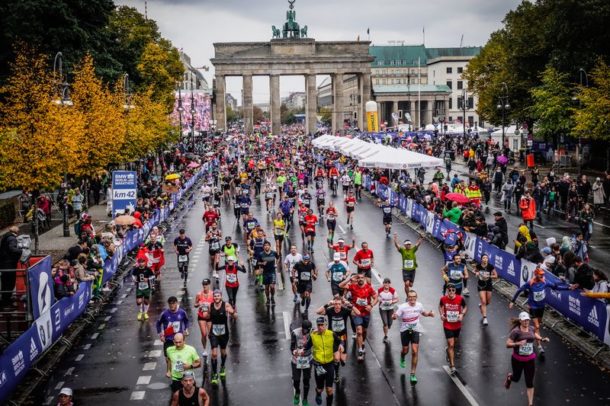
The road mile is also a popular success in England, with more than 5,000 runners at the Westminster Mile in London in May 2016. The mile is a distance within reach for everyone, regular runners and occasional runners alike. What if the road mile became as popular as the marathon, a gateway race where speed training, pacing, and endurance meet?
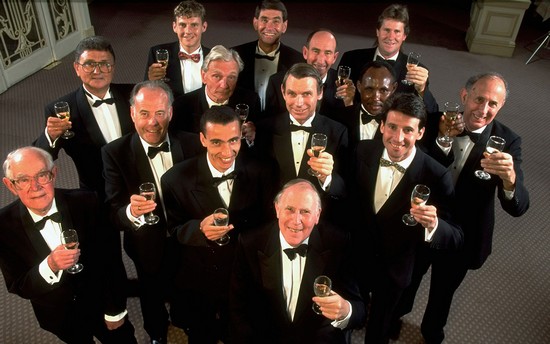
The very exclusive club of mile world record holders, including Michel Jazy (3:53.6, 1965), the only Frenchman, along with Jules Ladoumègue (4:09.2, 1931), to have held this prestigious record.
NB: Contrary to a common belief, once Bannister succeeded, there was not a sudden flood of dozens or hundreds of sub-4 milers. In fact, the number of first-time sub-4 performances was 2 in 1954, 3 in 1955, 5 in 1956, 7 in 1957, 4 in 1958, 1 in 1959, 4 in 1960, and 0 in 1961. Michel Jazy became the first Frenchman in 1962 with 3:59.8.
The list of all runners under 4 minutes can be found here.
The list of all sub-4 performances can be found here.
Convert a distance in miles or kilometers
Want to convert a distance in miles or kilometers? The math is simple:
Kilometers × 0.621371 = Miles
Miles × 1.60934 = Kilometers
To convert kilometers to miles, multiply the number of kilometers by 0.621371. To go from miles to kilometers, multiply the number of miles by 1.60934.
The list of the 29 French sub-4 milers, with the year of their first sub-4
| Michel Jazy | 1962 |
| Michel Bernard | 1963 |
| Jean Wadoux | 1965 |
| Gérard Vervoot | 1965 |
| Christian Nicolau | 1965 |
| Jacky Boxberger | 1971 |
| José Marajo | 1978 |
| Francis Gonzalez | 1978 |
| Alexandre Gonzalez | 1981 |
| Pascal Thiébaut | 1984 |
| Cyrille Laventure | 1985 |
| Dominique Bouchard | 1987 |
| Bruno Levant | 1987 |
| Rémy Geoffroy | 1987 |
| Philippe Collard | 1987 |
| Hervé Phélippeau | 1989 |
| Eric Dubus | 1990 |
| Mickaël Damian | 1994 |
| Ismaïl Sghyr | 1995 |
| Samir Benfarès | 1995 |
| Nadir Bosch | 1997 |
| Saïd Chébili | 1997 |
| Brahim Lahlafi | 2000 |
| Driss Maazouzi | 2000 |
| Bouabdellah Tahri | 2002 |
| Mehdi Baala | 2009 |
| Jamale Aarrass | 2012 |
| Anass Zouhry | 2016 |
| Guillaume Adam | 2017 |