Looking for a 2:30 half marathon training plan to get ready for your first half marathon? This goal is ideal if you’re new to running or simply want to finish the 21.1 km feeling good, without chasing performance at all costs.
With an average pace of 7:07 per kilometer, running a half marathon in 2:30 is within reach for many runners thanks to progressive training tailored to their level.
In this article, you’ll discover what level you need to aim for a 2:30 half marathon, which training paces to use, the most important workouts, and our 12-week 2:30 half marathon training plan.
Contents
What level do you need to run a 2:30 half marathon?
This 2:30 half marathon training plan is designed first and foremost for beginner runners. It’s a great fit if you’re preparing for your first half marathon or if you’ve only been running for a few months.
You don’t need to be fast. What matters most is running consistently and being able to run for an hour at a comfortable pace.
If you’ve already raced a 10K, finishing somewhere between 1:05 and 1:15 is usually a solid starting point for targeting a 2:30 half marathon. But it’s only a guideline.
What will really make the difference is how consistent you are with your training.
Today, the average half marathon finishing time worldwide is around 2:15. So aiming for 2:30 is still an excellent goal when you’re starting out, and it lets you fully enjoy the half marathon experience.
What pace do you need to hold for a 2:30 half marathon?
To finish your half marathon in 2:30, you’ll need to maintain an average pace of 7:07 per kilometer. You can also aim for 6:50 to 7:00/km to give yourself a bit of margin and keep the option to walk for 30 seconds to 1 minute during a few tougher moments.
This pace feels comfortable for many runners at the start of the race, but running for more than two hours still requires solid endurance.
That’s why this training plan focuses above all on easy aerobic running.
These sessions help you progressively build your cardiovascular fitness, strengthen your muscles, and improve your ability to run longer without fading.
A few workouts at half marathon pace round out the program so you can gradually get used to the rhythm you’ll need to hold on race day.
How many weeks do you need to prepare for a 2:30 half marathon?
A 12-week training block is ideal for this goal.
It gives you enough time to build your endurance progressively without suddenly increasing your training volume.
If you’re a complete beginner, you can even add a few extra weeks to get used to running regularly before starting this plan.
The goal is to arrive at the start line feeling confident, fresh, and with minimal injury risk.
The most important workouts in a 2:30 half marathon training plan
This 2:30 half marathon training plan was created for runners who want to prepare for their half marathon with a reasonable training load.
It includes two running sessions per week, plus one strength training session.
The first run is usually focused on building endurance. Some weeks also include short faster segments to gradually improve your stride and running efficiency.
The second session alternates between longer runs, steady endurance, and work at half marathon pace. These workouts will gradually teach your body to run for more than two hours.
Strength training, included every week, is an effective complement to your preparation. It helps improve your posture, running economy, and reduce injury risk.
For a 2:30 goal, the clear priority is building solid endurance before trying to run faster.
12-week 2:30 half marathon training plan
This 2:30 half marathon training plan is designed for runners with limited time who can commit to two runs per week, plus one strength training session.
This setup helps you progress with confidence while leaving enough recovery time between workouts.
The program gradually alternates easy runs, steady endurance, a few sessions with short accelerations, and segments at half marathon pace so you arrive ready on race day.
If you’d like to add a third run, make it a very easy 30 to 45 minute run in easy aerobic endurance. It should never create significant fatigue.
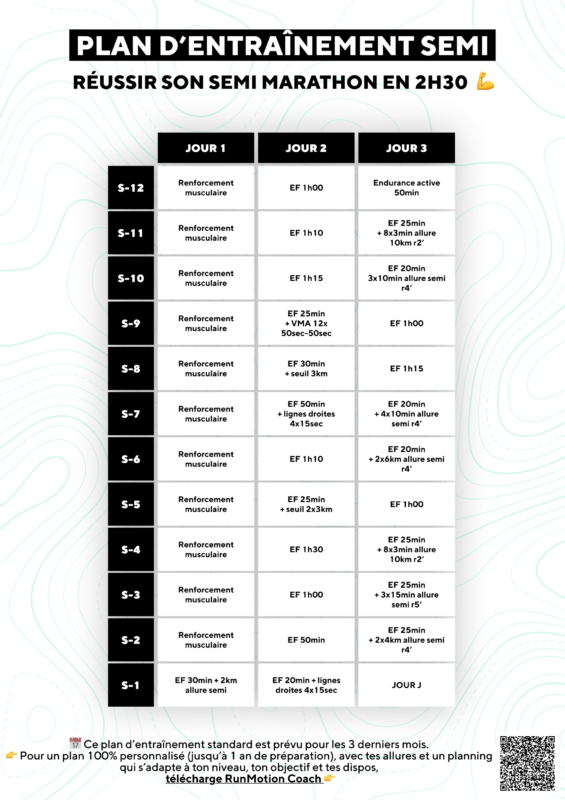
Before you start, it can be helpful to do a vVO2max test to better fine-tune certain workouts. But if you’re a beginner, your perceived effort is still the best guide, it’s better to run a little too easy than too fast every time.
How should you manage your half marathon on race day?
The best advice is to start conservatively.
The first few kilometers often feel very easy thanks to the race atmosphere. Still, starting too fast is the most common mistake among beginners.
Try to stay close to your target pace of 7:07/km right from the start.
Don’t worry if some runners pass you in the early kilometers.
If you’ve managed your effort well, you’ll still feel relatively comfortable after the 15 km mark, and you may even be able to speed up slightly toward the finish.
In a half marathon, consistency is often the best strategy.
Nutrition and hydration, plan your race fueling too
Even if your main goal is simply to finish your half marathon, don’t overlook nutrition.
In the weeks leading up to the race, prioritize a balanced diet and make sure you’re recovering well between sessions.
On race day, eat a breakfast you’ve already tested before a workout.
During the race, remember to drink regularly at the aid stations.
If you want to use an energy gel, test it first on a long run to make sure you tolerate it well.
Mistakes to avoid during your training
The first mistake is running every session too fast.
To improve, most of your runs should be done at a comfortable pace where you can easily hold a conversation.
Another common mistake is trying to add too many workouts to the program.
With this plan, two well-executed runs are already enough to prepare for your first half marathon. It’s better to be consistent than to stack extra sessions and risk getting too tired or injured.
Finally, avoid sharply increasing your mileage in the final weeks. Progress is built gradually throughout the entire training block.
Why choose a personalized training plan?
Every runner has a different level, background, and schedule.
A personalized half marathon training plan lets you adapt your workouts to your profile and your availability.
If you’re a beginner or you can’t always follow a schedule perfectly, an adaptive plan will be far more effective than a standard program.
With RunMotion Coach, your plan automatically adjusts to the training you’ve completed, your progress, and your constraints, so it can guide you all the way to race day.
Download the RunMotion Coach app and prepare for your next half marathon with a personalized training plan.
FAQ, 2:30 half marathon training plan
What 10K time do you need to run a 2:30 half marathon?
Most runners aiming for a 2:30 half marathon run 10K in between 1:05 and 1:15. This is simply a guideline, some runners with stronger endurance can hit this goal with a different time.
Can you prepare for a 2:30 half marathon with only two runs per week?
Yes. This plan was specifically designed for runners with limited time. Two runs per week, combined with one strength training session, are enough to prepare confidently for a first half marathon.
What vVO2max do you need to run a 2:30 half marathon?
A vVO2max of around 11 to 12 km/h is generally a solid baseline for targeting a 2:30 half marathon.
How many kilometers should you run each week?
Most runners cover between 15 and 25 kilometers per week during this preparation, depending on their level and pace.
What pace do you need to hold to run a 2:30 half marathon?
To run a half marathon in 2:30, you need to maintain an average pace of 7:07 per kilometer for the full 21.1 kilometers.
Download the RunMotion Coach app to get your personalized half marathon training plan.