
Running a 10K in 1:05 is a perfect goal when you are getting started with running. Whether you are training for your first race bib or you simply want to run more consistently, this target helps you improve without putting too much pressure on the clock.
At this pace, the main challenge is not pure speed, it is your ability to hold a steady effort for more than an hour. The right training approach will help you build endurance step by step, gain confidence, and line up for your 10K feeling calm and ready.
This goal is achievable for the vast majority of runners with a few weeks of consistent training.
Contents
- Running a 10K in 1:05, what pace do you need?
- Is this goal right for you?
- Why endurance should be your top priority
- How long do you need to train for a 10K in 1:05?
- How many sessions should you do each week?
- Do you need interval training?
- How should you manage your pace on race day?
- Is strength training useful?
- Do not forget recovery
- Train for your 10K with RunMotion Coach
- FAQ: 10K 1:05 training plan
Running a 10K in 1:05, what pace do you need?
To finish a 10K in 1:05, you need to average 6:30 min/km. That equals an average speed of about 9.2 km/h (around 5.7 mph).
For a beginner runner, it can feel comfortable over the first few kilometers, but it still requires enough endurance to hold it all the way to the finish. The good news is that endurance improves quickly with progressive training.
So the main focus of your build-up will be learning to run longer without excessive fatigue.
Is this goal right for you?
A 1:05 finish time is often one of the first goals new runners set. If you can already run 30 to 40 minutes without stopping, or if you still sometimes alternate walking and running, this target can be a great fit.
It also works well if you are returning to exercise after a few years off and want to rebuild fitness gradually.
The most important thing is to start from where you are now and create a realistic progression.
Why endurance should be your top priority
When you are new to running, it is tempting to try to run faster and faster to improve quickly. In reality, your first big gains mostly come from building endurance. The more your body learns to use oxygen efficiently, the longer you can sustain an effort while still feeling in control.
That is why a large part of your training should be done at an easy pace.
These runs can feel almost too simple, but they are the foundation for everything that comes next in your running performance. They also help your body adapt to impact, while strengthening muscles, tendons, and joints. Even experienced runners spend a big chunk of their week at this “easy” effort level (their pace is just different).
How long do you need to train for a 10K in 1:05?
A 8 to 12 week training block is usually enough.
If you are already active, 8 weeks is often sufficient to hit the goal. If you are starting from scratch or coming back after a long break, adding a few more weeks will help you progress without rushing.
The key is to increase gradually so your body has time to adapt. Consistency matters more than intensity.
How many sessions should you do each week?
Two to three weekly sessions are already enough to prepare effectively for a 10K in 1:05.
Your first run can be an easy run of around 40 minutes.
Your second session can include a few short pick-ups to gradually improve your stride, coordination, and running economy.
Finally, a third longer run will build general endurance and your ability to run for more than an hour.
Do you need interval training?
Yes, but in small doses.
The goal is not to crush yourself with brutal workouts. A few 20 to 30 second accelerations or short repeats are enough to develop speed and leg turnover without creating too much fatigue.
At this stage, the biggest improvements often come from regular easy runs and gradually increasing your total time on your feet. So there is no need to chase complicated sessions.
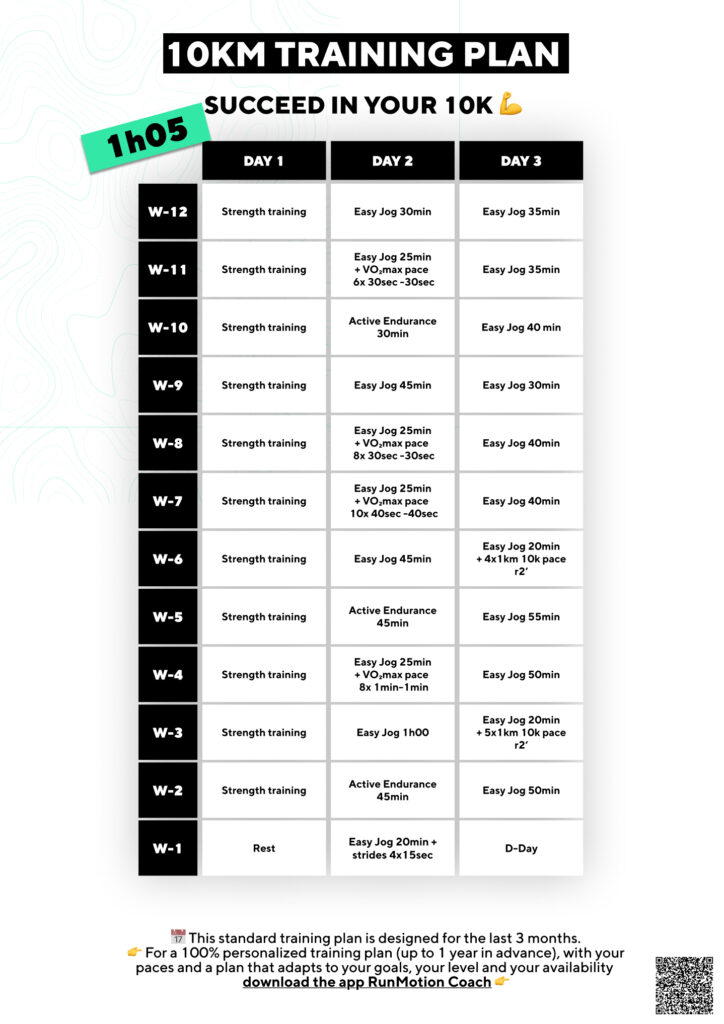
Here is an excerpt from your 12-week 10K 1:05 training plan (full plan below):
Week 1
Session 1: Strength training
Session 2: Easy aerobic run 30 min
Session 3: Easy aerobic run 35 min
Week 7
Session 1: Strength training
Session 2: Easy aerobic run 45 min
Session 3: Steady endurance 20 min + 4×1 km at 10K race pace (2 min recovery)
Week 10
Session 1: Strength training
Session 2: Easy aerobic run 1h
Session 3: Steady endurance 20 min + 5×1 km at 10K race pace (2 min recovery)
How should you manage your pace on race day?
The biggest trap in your first 10K is starting too fast.
The start-line buzz, other runners around you, and race-day adrenaline can make you speed up without realizing it, but it is not the best strategy. Try to lock into your natural rhythm early. Over the first few kilometers, you should feel like you can speak in short sentences.
If you still feel good after kilometer seven, you can gradually pick up the pace to the finish.
A well-paced race is often more enjoyable and faster than one that starts too hard. If you need to walk for a few meters, it is not a big deal, it can help you reset and get going again feeling stronger.
Is strength training useful?
Even for a first goal, strength training has plenty of benefits. A few simple at-home exercises can help you strengthen your legs, core, and posture.
This improves running comfort and reduces injury risk. Just a few minutes of core work or a few sets of squats each week can already deliver real gains.
Do not forget recovery
Rest days are part of training. Your body improves when it recovers from the work you have done. Quality sleep, a balanced diet, and good hydration directly support your progress and performance.
Do not hesitate to cut back for a week if fatigue builds up. The goal is to arrive on the start line feeling strong, not drained by training.
Train for your 10K with RunMotion Coach
Every runner starts at a different level, with different constraints and goals. A standard plan is a solid base, but it cannot cover all individual needs.
With RunMotion Coach, you get a personalized training plan that adapts to your schedule, your level, and your progress. The app guides you step by step so you can reach your goal in the best possible conditions.
Whether you are training for your very first 10K or you simply want to finish the distance feeling good, the right preparation will help you toe the line with confidence.
So, are you ready to take on the 10K in 1:05 challenge?
FAQ: 10K 1:05 training plan
What pace do you need to run a 10K in 1:05?
To finish a 10K in 1:05, you need to run at an average pace of about 6:30 per kilometer. This speed is realistic for many beginner runners with consistent training.
Can you train for a 10K in 1:05 by running only twice a week?
Yes, two weekly sessions can be enough to reach this goal, as long as you stay consistent and gradually increase your training load.
How do you improve when you are new to running?
Progress comes down to consistency above all. Mixing easy aerobic running, recovery, and a gradual increase in weekly volume is the best way to build lasting endurance and fitness.
How long should your long run be for this goal?
A long run between 1:00 and 1:15 is usually enough to develop the endurance you need to successfully run a 10K in 1:05.
How do you avoid going out too fast?
It is recommended to stick to your target pace from the first kilometers. Starting too fast often leads to a major slowdown in the second half of the race.